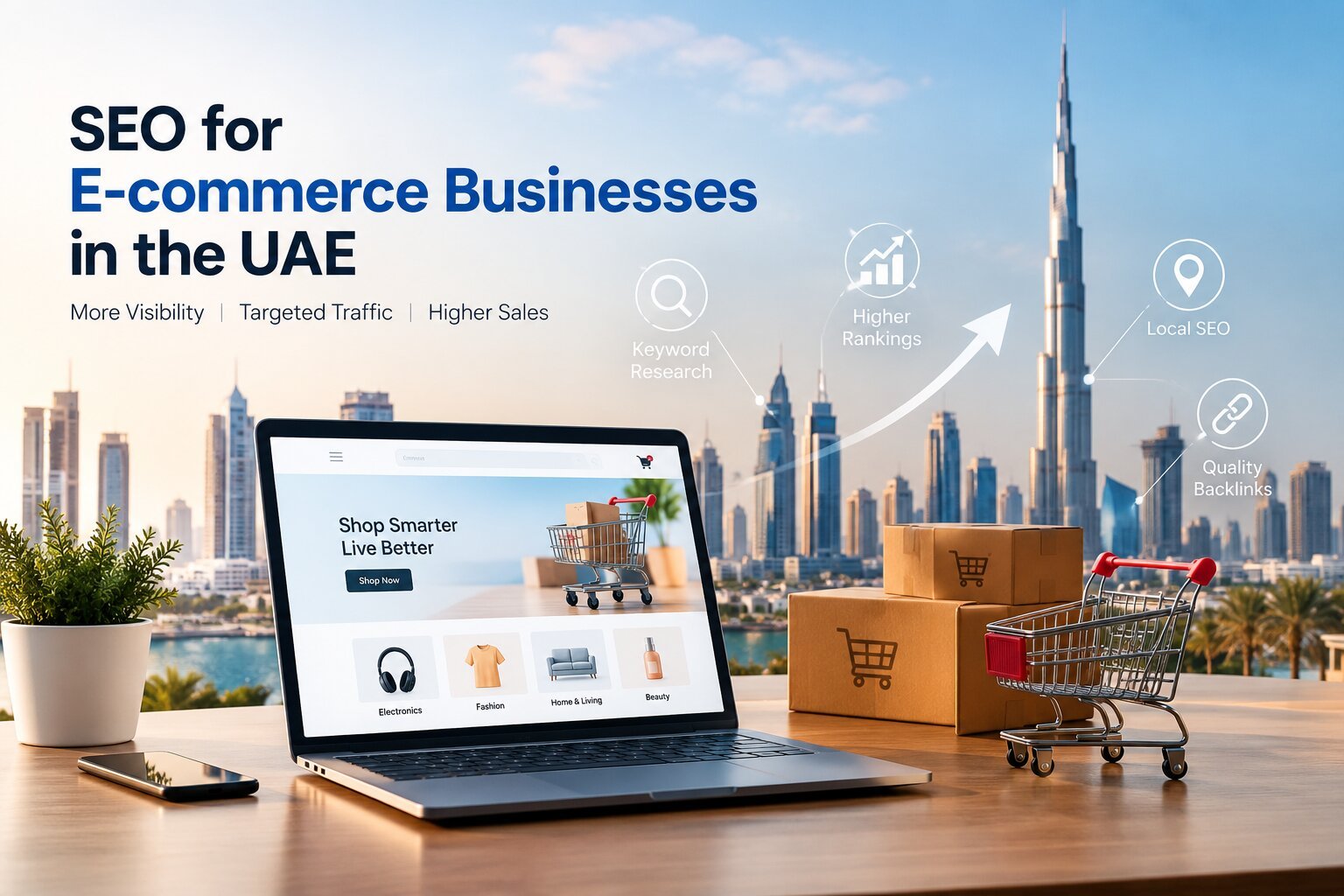
UAE e-commerce has grown fast. New stores launch every month across Dubai, Abu Dhabi, Sharjah, and beyond, all chasing the same pool of online shoppers. Most of them focus entirely on one metric: traffic. Rankings go up, visitors arrive, and yet revenue stays flat. That gap is the most common failure mode in e-commerce SEO — treating visibility as the finish line instead of the starting point.
Traffic without conversion is just a vanity number. This guide covers how to build SEO and conversion rate optimization together, so the visitors you earn actually become paying customers, not just page-view statistics.
Table of Contents
ToggleWhy SEO Matters for UAE E-commerce Businesses
Rising paid advertising costs. Google and social ad costs have climbed steadily across the UAE’s competitive e-commerce space, making paid traffic an increasingly expensive customer acquisition channel on its own.
Sustainable customer acquisition. Unlike paid ads, organic visibility doesn’t disappear the moment you pause spending. It builds a durable asset that keeps working.
Long-term ROI. SEO’s cost-per-acquisition typically decreases over time as rankings stabilize, while paid channels tend to hold steady or increase.
Building brand authority. Consistent organic visibility across product, category, and content pages builds recognition that paid ads alone rarely achieve.
Reducing marketplace dependency. Stores relying heavily on Amazon.ae or Noon compete directly against other sellers on the same platform, often on price alone. A strong owned website reduces that dependency and builds direct customer relationships.
| Factor | SEO | Google Ads | Marketplaces |
|---|---|---|---|
| Cost over time | Decreases as authority builds | Stays consistent or rises | Ongoing commission/fees |
| Traffic stops when spend stops | No | Yes | Somewhat — depends on platform ranking |
| Customer data ownership | Full | Full | Limited or none |
| Brand building | Strong | Moderate | Minimal — platform brand dominates |
| Competitive exposure | Your site only | Your site only | Directly next to competitors |
| Time to results | Slower | Immediate | Immediate, platform-dependent |
Understanding the UAE E-commerce Customer Journey
Shoppers move through distinct stages before buying, and each stage needs different content.
Awareness stage — broad, exploratory searches like “best running shoes UAE” or “best skincare products Dubai.” Shoppers here are researching, not ready to buy yet.
Consideration stage — comparison-focused searches like “Nike vs Adidas running shoes” or “best wireless headphones UAE.” Shoppers are narrowing options.
Purchase stage — direct, high-intent searches like “buy iPhone 16 UAE” or “order protein powder Dubai.” Shoppers are ready to transact immediately.
| Funnel Stage | Shopper Mindset | Content That Wins |
|---|---|---|
| Awareness | Exploring options, not ready to buy | Buying guides, “best of” content |
| Consideration | Comparing specific products or brands | Comparison articles, detailed reviews |
| Purchase | Ready to buy now | Optimized product pages, clear CTAs |
Most stores over-invest in purchase-stage content (product pages) and under-invest in the awareness and consideration content that actually brings new shoppers into the funnel in the first place.
Keyword Research for E-commerce SEO
A complete keyword strategy spans five categories:
Informational keywords — “how to choose running shoes,” “skincare routine for humid climate.” Build trust and topical authority.
Commercial investigation keywords — “best budget laptops UAE,” “Nike vs Adidas comparison.” Capture shoppers actively comparing.
Transactional keywords — “buy running shoes online UAE,” “order skincare products Dubai.” Directly drive sales.
Long-tail keywords — “best waterproof running shoes for Dubai summer.” Lower volume individually, but collectively significant and often easier to rank for.
Location-based keywords — “buy electronics Abu Dhabi,” “skincare delivery Sharjah.” Capture geographically specific intent.
| Keyword | Search Intent | Funnel Stage | Conversion Potential |
|---|---|---|---|
| “best running shoes UAE” | Informational | Awareness | Low-medium |
| “Nike vs Adidas running shoes” | Commercial | Consideration | Medium |
| “buy Nike Air Zoom UAE” | Transactional | Purchase | High |
| “running shoes for humid climate Dubai” | Long-tail/Informational | Awareness | Medium |
| “order running shoes Abu Dhabi” | Location + Transactional | Purchase | High |
Building an SEO-Friendly E-commerce Website
Site architecture should follow a clear, shallow hierarchy — homepage to category to subcategory to product, ideally within three clicks of any page.
Category structure should reflect how customers actually think about products, not just internal inventory logic. “Men’s Running Shoes” is more useful than “Footwear > Athletic > Category 4.”
Product page optimization covers everything from titles to schema, detailed further below.
Internal linking should connect related products, categories, and relevant guide content, helping both users and search engines navigate logically.
Navigation design needs to work cleanly on both desktop and mobile, since a confusing menu structure loses shoppers before they even reach a product.
Faceted navigation (filters by size, color, price) needs careful technical handling — unmanaged filter combinations can generate thousands of near-duplicate URLs that dilute SEO value if left unchecked.
Example ideal structure: Homepage → Men’s Shoes (category) → Running Shoes (subcategory) → Specific Product Page
Each level should have genuinely useful content, not just a product grid — a short category description, relevant internal links, and clear navigation cues.
Product Page SEO That Drives Sales
Product titles should include the brand, model, and key distinguishing feature, matching how customers actually search.
Product descriptions need to be unique per product, not copied from a manufacturer feed — duplicate descriptions across dozens of near-identical products actively hurt rankings.
Product images should be optimized for fast loading, with descriptive file names and alt text, and ideally multiple angles.
Product videos increase both engagement and time on page, both of which support conversion and, indirectly, ranking signals.
Product FAQs address common pre-purchase questions directly on the page, reducing friction and supporting FAQ schema opportunities.
Customer reviews build trust and generate fresh, unique content automatically over time.
Product schema helps search engines display rich snippets — price, availability, ratings — directly in search results, often improving click-through rate significantly.
Product Page Optimization Checklist
| Element | Optimized? |
|---|---|
| Unique, keyword-relevant product title | ☐ |
| Unique product description (not manufacturer copy) | ☐ |
| Multiple optimized images with alt text | ☐ |
| Product video where applicable | ☐ |
| FAQ section addressing common questions | ☐ |
| Visible customer reviews and ratings | ☐ |
| Product schema markup implemented | ☐ |
| Clear price, availability, and delivery info | ☐ |
Category Page SEO Strategies
Category pages are frequently neglected in favor of product-level optimization, despite often capturing higher-volume, earlier-stage searches.
Category content — a genuine, unique paragraph explaining the category, not just a product grid with no supporting text.
SEO-friendly URLs — clean, descriptive paths like /mens-running-shoes/ rather than parameter-heavy strings.
Filtering best practices — use canonical tags or noindex rules on filtered variations to prevent duplicate content issues while still allowing users to filter freely.
Internal linking — link relevant category pages to related buying guides and vice versa.
Buyer guides embedded or linked from category pages help capture awareness-stage traffic that a product grid alone can’t.
Example: A “Men’s Running Shoes” category page might include a short guide section — “How to Choose Running Shoes for Dubai’s Climate” — directly above the product grid, capturing both informational and transactional search intent on a single page.
Technical SEO for E-commerce Stores
E-commerce sites face technical challenges most other website types don’t — massive page counts, frequent inventory changes, and complex filtering systems.
| Technical Area | What to Check | Why It Matters |
|---|---|---|
| Crawl budget | Ensure search engines prioritize important pages | Prevents wasted crawling on low-value filtered URLs |
| Duplicate content | Audit for near-identical product/category variations | Prevents rankings from being split or diluted |
| Canonical tags | Correctly implemented across filtered and paginated pages | Consolidates ranking signals to the right URL |
| Pagination | Proper handling of multi-page category listings | Ensures all products remain discoverable |
| XML sitemaps | Updated automatically as inventory changes | Helps search engines discover new products quickly |
| Core Web Vitals | Loading speed, interactivity, visual stability | Directly affects rankings and conversion rate alike |
| Mobile optimization | Full functionality on mobile devices | Majority of UAE e-commerce traffic is mobile |
| Site speed | Fast loading despite high image volume | Slow sites lose both rankings and sales |
| Structured data | Product, review, and breadcrumb schema implemented | Improves rich snippet appearance and click-through rate |
Local SEO for UAE E-commerce Brands
Even primarily online-only stores benefit from local SEO signals, particularly if you offer local delivery, click-and-collect, or a physical showroom.
Google Business Profile should be claimed and optimized if you have any physical presence — a warehouse pickup point, a showroom, or a retail location.
Local landing pages for major emirates — Dubai, Abu Dhabi, Sharjah, Ajman — can capture location-specific searches like “buy electronics Abu Dhabi” or “skincare delivery Sharjah,” particularly useful if delivery times or availability vary by emirate.
Location-specific content addressing regional considerations (climate, delivery zones, local preferences) adds genuine value beyond generic product pages.
Local citations on UAE business directories support broader trust signals even for online-only operations.
Conversion Rate Optimization (CRO): Turning Traffic Into Sales
This is where most e-commerce SEO efforts fall short — driving traffic without addressing what actually turns a visitor into a buyer.
Product page UX should be clean, fast, and clearly guide the visitor toward “add to cart” without unnecessary friction.
Trust signals — secure checkout badges, clear business information, recognizable payment logos — reduce hesitation, especially for newer or less-established brands.
Reviews and ratings displayed prominently near the buy button significantly influence purchase decisions.
Checkout optimization means minimizing steps and required fields — every additional step increases cart abandonment risk.
Payment methods should include options UAE shoppers actually prefer, including cash on delivery where feasible, alongside cards and digital wallets.
Delivery information — clear, upfront shipping costs and timeframes — prevents last-minute cart abandonment at checkout.
Return policies should be clearly stated and easy to find, since return anxiety is a common purchase blocker, particularly for clothing and electronics.
WhatsApp integration is especially effective in the UAE, where many shoppers prefer messaging for pre-purchase questions over email or contact forms.
CRO Checklist
| Element | Implemented? |
|---|---|
| Clear, prominent trust signals on product pages | ☐ |
| Reviews and ratings visible near purchase button | ☐ |
| Simplified, low-friction checkout process | ☐ |
| Multiple relevant payment methods offered | ☐ |
| Upfront shipping costs and delivery timeframes | ☐ |
| Clear, accessible return policy | ☐ |
| WhatsApp or live chat support available | ☐ |
Content Marketing for E-commerce Growth
Buying guides capture awareness-stage traffic and build topical authority around your product categories.
Comparison articles address consideration-stage searches directly, positioning your products within a genuine, useful comparison.
Product reviews — either your own in-depth reviews or curated customer content — build trust and searchable long-form content.
Industry insights and trend content position your brand as a genuine authority, not just a storefront.
Seasonal campaigns — Ramadan, UAE National Day, Dubai Shopping Festival — align content with predictable, high-intent shopping periods.
UAE shopping trends content builds relevance and can earn backlinks from press covering regional retail trends.
Example Content Cluster: Running Shoes
- Pillar page: “Ultimate Guide to Running Shoes for Dubai’s Climate”
- Supporting page: “Best Running Shoes for Hot Weather UAE”
- Supporting page: “Nike vs Adidas Running Shoes: Which Is Better?”
- Supporting page: “How to Choose the Right Running Shoe Size”
- Category page: Men’s Running Shoes (linked throughout)
SEO for Shopify Stores in the UAE
Shopify powers a significant share of UAE DTC brands, and it comes with both advantages and specific considerations.
Shopify SEO best practices include using clean URL structures, avoiding excessive app bloat that slows the site, and properly configuring redirects when products or collections change.
Collection page optimization mirrors category page best practices — unique content, clean URLs, and proper internal linking.
Product schema on Shopify often requires a dedicated app or theme customization to implement fully and correctly.
Site speed improvements should focus on image optimization and limiting third-party app scripts, which are common speed bottlenecks on Shopify specifically.
Internal linking opportunities are often underused on Shopify themes by default — manually adding related product and content links improves both SEO and cross-sell potential.
GEO & AI Search Optimization
AI-powered tools — Google AI Overviews, ChatGPT, Gemini, Claude, Perplexity — increasingly generate direct product recommendations and comparisons, citing sources based on clarity, structured data, and demonstrated authority.
Entity optimization ensures your brand, product lines, and category expertise are clearly and consistently represented across your site and any third-party listings.
Structured answers — clear, direct responses to specific questions (“what’s the best running shoe for hot climates”) — are more likely to be extracted and cited by AI tools.
FAQ schema helps AI systems identify and reference direct question-and-answer content efficiently.
Product schema and review schema give AI tools structured, reliable data to draw from when generating product comparisons or recommendations.
Brand authority built through consistent, genuine content increases the likelihood of being cited as a trustworthy source for product recommendations.
Topical authority around your specific product categories strengthens your visibility across both traditional search and AI-generated results.
Ecommerce Link Building Strategies
| Link Opportunity | How to Pursue It | Value |
|---|---|---|
| Digital PR | Pitch unique data, trends, or newsworthy angles to journalists | High authority, strong relevance |
| Influencer collaborations | Partner with UAE-based influencers for genuine product coverage | Medium-high authority, strong audience relevance |
| Product reviews | Send products to relevant reviewers and bloggers | Medium authority, builds genuine third-party content |
| Affiliate partnerships | Build a structured affiliate program | Variable authority, ongoing referral value |
| Industry publications | Contribute expert commentary or data-driven articles | High authority and relevance |
| Local UAE directories | List on relevant UAE e-commerce and business directories | Lower authority, supports overall citation consistency |
Common Ecommerce SEO Mistakes
- Thin product descriptions — copied manufacturer text with no unique value. Fix: write unique, detailed descriptions for every product.
- Duplicate content — near-identical pages across filtered or similar products. Fix: implement canonical tags and consolidate near-duplicate listings.
- Slow mobile experience — heavy image loads and bloated apps slowing mobile speed. Fix: optimize images and audit third-party app scripts.
- Poor internal linking — isolated product pages with no connection to related content. Fix: build systematic internal linking between products, categories, and guides.
- Ignoring schema — missing product, review, and FAQ schema entirely. Fix: implement structured data across all key page types.
- Weak category pages — product grids with zero supporting content. Fix: add genuine, unique category descriptions and linked buying guides.
- Poor conversion tracking — no visibility into which pages and keywords actually drive sales. Fix: implement proper e-commerce analytics and conversion tracking.
- Neglecting out-of-stock pages — deleting or breaking URLs for out-of-stock products, losing accumulated SEO value. Fix: keep pages live with clear status and suggest alternatives.
- Ignoring page speed — accepting slow load times as a cost of high-quality images. Fix: compress images and implement lazy loading.
- No content beyond product pages — relying solely on transactional pages, missing awareness and consideration-stage traffic. Fix: build a genuine content strategy around buying guides and comparisons.
- Unoptimized faceted navigation — allowing filter combinations to generate thousands of crawlable duplicate URLs. Fix: implement proper canonical and indexing rules on filtered pages.
- Ignoring local SEO entirely — assuming it’s irrelevant for online-only stores. Fix: build emirate-specific content and claim any applicable local listings.
90-Day E-commerce SEO Action Plan
Month 1: Audit and Foundation
- Complete a full technical SEO audit, identifying crawl, indexing, and speed issues
- Finalize keyword research across informational, commercial, and transactional intent
- Fix critical technical issues (broken links, duplicate content, missing schema)
Month 2: Content and On-Page Optimization
- Rewrite thin or duplicate product descriptions, starting with top-selling products
- Optimize category pages with unique content and internal linking
- Implement product, review, and FAQ schema across key pages
Month 3: Authority Building and Conversion
- Launch initial digital PR and influencer outreach efforts
- Publish first content cluster around a priority product category
- Audit and improve checkout flow, trust signals, and CRO elements
- Set up comprehensive conversion tracking to measure what’s actually working
Ongoing (Month 4+)
- Maintain consistent content publishing across buying guides and comparisons
- Continue building backlinks and expanding content clusters
- Review analytics monthly, prioritizing pages and keywords with the strongest conversion potential
FAQ: E-commerce SEO in the UAE
How long does ecommerce SEO take? Most stores see initial movement within 3 to 6 months. Given competitive product categories, stronger, more stable results typically build over 6 to 12 months.
Is Shopify good for SEO? Yes, with proper configuration. Shopify offers a solid technical foundation, but success still depends on clean site structure, unique content, and managing app-related speed issues.
What are the best ecommerce SEO tools? Common tools include Google Search Console and Analytics for tracking, along with dedicated SEO platforms for keyword research and technical auditing — the right toolset depends on store size and budget.
How much does ecommerce SEO cost in the UAE? Ecommerce SEO in the UAE typically ranges from AED 5,000 to AED 25,000+ per month, depending on catalog size, competition, and content requirements.
How can I increase ecommerce sales organically? Combine SEO (to drive qualified traffic) with CRO (to convert that traffic) — ranking well without addressing trust signals, checkout friction, and page UX leaves significant revenue on the table.
What is the difference between SEO and CRO? SEO focuses on earning visibility and traffic through search engines. CRO focuses on converting the visitors you already have into paying customers. Both are necessary; neither alone is sufficient.
Do I need separate content for each emirate? It depends on your business — if delivery times, availability, or relevance genuinely differ by emirate, dedicated local pages can capture valuable location-specific search intent.
How important are product reviews for SEO? Very important. Reviews generate fresh, unique content automatically, support review schema for rich snippets, and directly influence purchase decisions.
Should I optimize for informational keywords if I only sell products? Yes. Informational and comparison content brings in earlier-stage shoppers who wouldn’t be reached through transactional keywords alone, and it builds the topical authority that helps product pages rank too.
What’s the biggest mistake ecommerce stores make with SEO? Focusing entirely on rankings and traffic while ignoring the conversion side — trust signals, checkout friction, and page experience — that determines whether that traffic actually generates revenue.
Does site speed really affect sales, not just rankings? Yes, significantly. Slow-loading pages increase abandonment directly, independent of any SEO or ranking impact.
How does AI search affect ecommerce visibility? AI tools increasingly generate direct product recommendations, citing sources based on structured data and demonstrated authority. Strong schema implementation and clear, authoritative content improve your chances of being cited.
Is WhatsApp integration really worth it for UAE stores? Yes. UAE shoppers frequently prefer WhatsApp for pre-purchase questions, and offering it can meaningfully reduce pre-purchase friction and cart abandonment.
Conclusion
Traffic is not the goal — revenue is. UAE e-commerce brands that treat SEO and conversion optimization as two halves of the same strategy consistently outperform those chasing rankings alone. Fix the technical foundation. Build genuine, unique content across the full buyer journey. Then make sure every visitor who arrives actually has a clear, trustworthy, frictionless path to becoming a customer.
Ranking is only step one. What happens after the click is what actually grows the business.