Bilibili has grown from a small anime fan site into one of China’s most influential entertainment platforms — and in August 2026, it took its biggest step yet toward becoming a global name. Whether you’re hearing about Bilibili for the first time or you’re a marketer trying to understand its business model, this guide covers everything: what it is, how it works, who uses it, how it makes money, and how it stacks up against YouTube.
Table of Contents
ToggleWhat Is Bilibili?
Bilibili (哔哩哔哩), often called “B站” (B-site), is a Chinese video-sharing and entertainment platform founded in Shanghai in 2009. It combines long-form videos, live streaming, and its signature scrolling “danmu” (bullet) comments with a strong focus on anime, gaming, and youth culture. It’s free to use, publicly traded on Nasdaq and the Hong Kong Stock Exchange, and as of mid-2026 reaches over 370 million monthly users.
Introduction
Bilibili started as a niche destination for anime and Hatsune Miku fans and evolved into a mainstream, publicly traded video community serving hundreds of millions of users. It’s best known for a distinctive real-time commenting system that floats across the screen, a deep catalog of anime and gaming content, and a creator culture that blends long-form video, live streaming, and community interaction in ways that don’t map neatly onto Western platforms.
International interest in Bilibili has grown sharply because of its recent push beyond China: a relaunched international app, an English-language site in development, and active recruitment of overseas creators. This guide explains what Bilibili is, how it works, what you can watch, how it compares to YouTube, whether it’s free, whether you can use it outside China, and how it makes money — with currently verified 2026 statistics throughout.
What Is Bilibili?
Bilibili is a Chinese video-sharing platform built around community, anime, comics, gaming (ACG) culture, and creator-driven content, later expanding into lifestyle, technology, education, and mainstream entertainment.
Bilibili was born from Chinese internet culture rather than being a copy of an existing Western product. It grew out of forums dedicated to Japanese anime and the virtual singer Hatsune Miku, and it still carries that DNA today: a passionate, opinionated fan community that treats video-watching as a shared, social activity rather than a passive one.
The platform’s defining feature is danmu (弹幕), or “bullet comments” — short viewer reactions that scroll across the video in real time, layered directly over the footage the whole audience is watching together. This turns even a solitary viewing session into something that feels communal, and it’s a major reason Bilibili’s culture feels distinct from YouTube’s comment-section model.
Over time, Bilibili expanded well beyond anime. It now hosts gaming content and esports, technology reviews, science and education, vlogs, music, comedy, and general entertainment, alongside a growing live-streaming business. Its creator ecosystem — millions of people uploading “professionally user-generated video” (PUGV) — is central to the platform’s identity and its advertising business.
What Does Bilibili Mean?
The name Bilibili has no literal translation; it’s an onomatopoeic, sound-based name drawn from Japanese anime culture. The platform was originally launched in June 2009 as Mikufans.cn, a fan community for the virtual singer Hatsune Miku. In January 2010 it was rebranded to “Bilibili,” a nickname associated with Mikoto Misaka, a character from the anime A Certain Scientific Railgun whose electrical powers are often rendered with a “bilibili” sound effect. The playful, fandom-rooted name reflects the site’s ACG (anime, comics, and games) origins, and Bilibili still marks Misaka’s birthday on its homepage each year as a nod to its roots. Users commonly refer to the platform as “B站” (B-site or “Station B”).
When Was Bilibili Founded?
Bilibili has an unusually well-documented history for a company its size, spanning founder-led beginnings, professional management, an IPO, and a Hong Kong secondary listing.
| Year | Milestone |
|---|---|
| 2009 | Xu Yi launches Mikufans.cn in Shanghai as a Hatsune Miku fan community |
| 2010 | Site rebranded to “Bilibili,” named after an anime character |
| 2011 | Chen Rui becomes an early angel investor in the company |
| 2014 | Chen Rui becomes President, later Chairman and CEO, professionalizing the business |
| 2018 | Bilibili IPOs on Nasdaq (ticker: BILI), raising roughly $483 million |
| 2020 | Sony Group invests approximately $400 million in Bilibili |
| 2021 | Secondary listing on the Hong Kong Stock Exchange (ticker: 9626) |
| 2025 | Bilibili posts a record quarterly net profit and record monthly paying users |
| 2026 | Bilibili relaunches its international app globally and begins active overseas expansion |
Who Owns Bilibili?
Bilibili Inc. is incorporated in the Cayman Islands and is publicly traded, listed simultaneously on Nasdaq (BILI) and the Hong Kong Stock Exchange (9626). It uses a dual-class share structure in which Class Y shares carry enhanced voting rights, which lets its founders and senior leadership retain significant control despite being a public company.
Founder Xu Yi (online alias “⑨bishi”) remains President and a director and continues to hold a meaningful ownership stake. Chen Rui, an early angel investor who became President in 2014, now serves as Chairman and CEO and is also a major shareholder. Tencent Holdings has historically been Bilibili’s largest institutional shareholder, and Sony Group Corporation holds a strategic minority stake following a 2020 investment. The remainder of the company is held by public shareholders and institutional investors through its Nasdaq and Hong Kong listings. Exact ownership percentages shift over time as shares are traded, so readers researching current stakes should consult Bilibili’s latest SEC or HKEX filings rather than treat any single percentage as fixed.
How Does Bilibili Work?
Bilibili works like a hybrid of YouTube, Twitch, and a fan forum — users browse a personalized homepage, discover videos through search, categories, and recommendations, follow creators, comment via danmu or traditional comments, and can pay for optional premium membership, virtual gifts, or in-platform purchases.
For a new user, the experience generally looks like this:
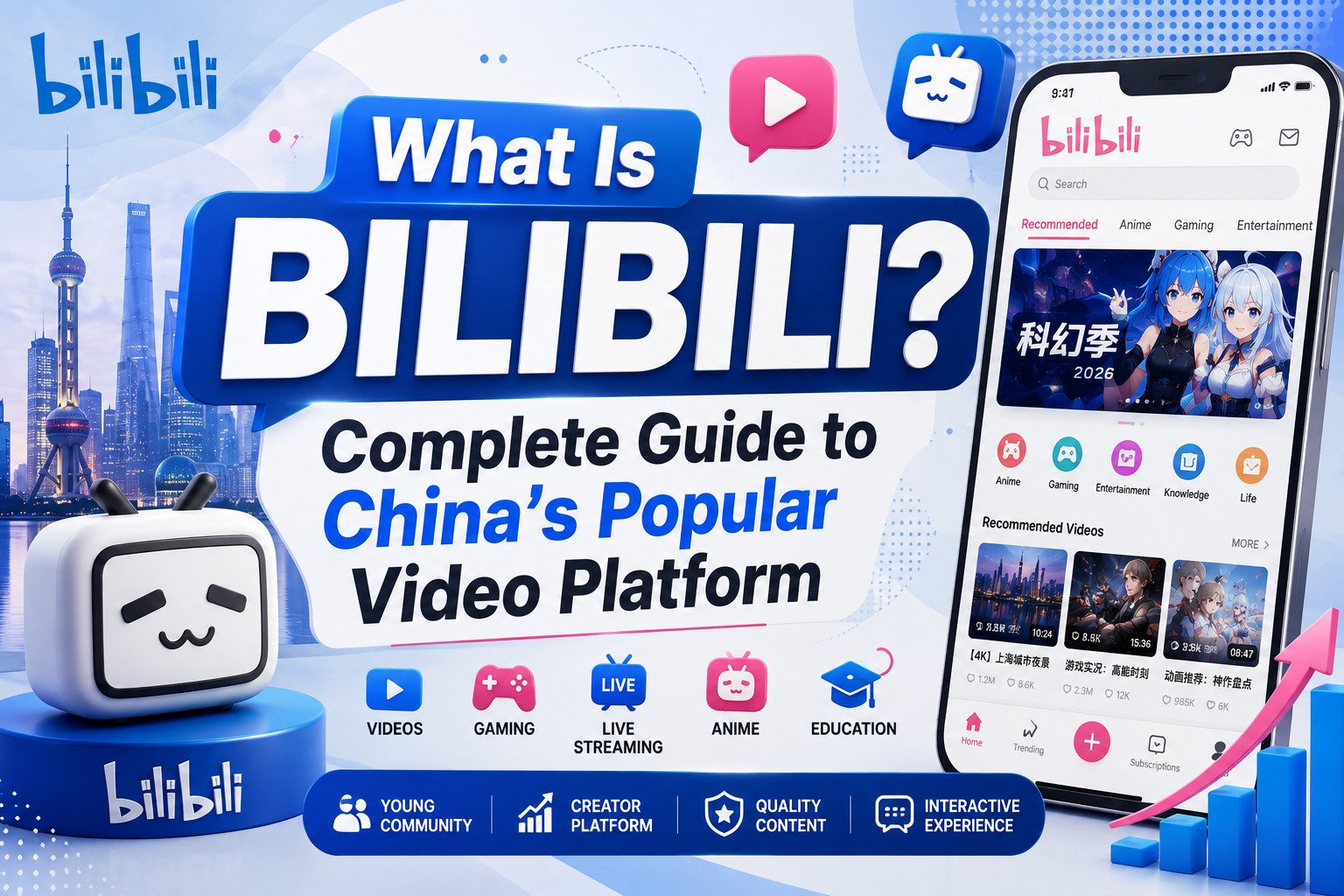
- Homepage – A personalized feed mixing followed creators, trending videos, and recommendations across categories like anime, gaming, tech, and life.
- Search – A conventional search bar for finding specific videos, creators, or topics.
- Categories (分区) – Bilibili organizes content into distinct zones (anime, gaming, tech, knowledge, music, life, etc.), each with its own sub-community and conventions.
- Recommendations – An algorithmic feed that surfaces videos based on watch history and engagement, similar in concept to YouTube’s “Up Next.”
- Following creators – Users subscribe to creators (“UP主,” short for “uploader”) to see their new content prioritized in their feed.
- Danmu and comments – Real-time scrolling bullet comments layered on the video itself, plus a traditional comment section underneath.
- Live streaming – A separate but integrated live section where creators stream and receive real-time chat and virtual gifts.
- Membership (大会员/Premium) – An optional paid tier unlocking HD/4K playback, ad-light viewing, early access to some series, and discounts on Bilibili-published games.
- Notifications – Standard alerts for new uploads, replies, and messages from followed accounts.
Registration is optional for casual viewing but required for uploading, commenting, liking, and watching some higher-resolution or members-only content.
What Can You Watch on Bilibili?
Bilibili’s content library is broad, but a few categories define the platform.
Anime
Bilibili is one of the largest licensed anime streaming destinations in China, offering both licensed Japanese anime (OGV, or “occupationally generated video”) and homegrown Chinese animation, alongside a huge volume of anime-related fan content, reviews, and clips.
Gaming
Gaming is a core pillar, spanning let’s-plays, esports broadcasts, game reviews, and creator commentary. Bilibili also operates its own mobile game publishing business, including titles like the Chinese version of Fate/Grand Order, and gaming remains one of its major revenue lines even as its contribution has fluctuated quarter to quarter.
Technology
Tech reviews, unboxings, software tutorials, and hardware deep-dives have become some of the platform’s fastest-growing categories, appealing to Bilibili’s tech-literate, younger user base.
Education
Bilibili hosts a large volume of educational content — academic lectures, exam-prep material, language learning, and general knowledge videos — which has helped it attract students and lifelong learners well outside its original ACG niche.
Entertainment
Music, comedy sketches, commentary, and general entertainment content sit alongside the platform’s niche categories, broadening its appeal to a mainstream audience.
Vlogs and Lifestyle
Creator-led lifestyle content — daily vlogs, cooking, travel, fashion, and personal commentary — has grown into one of Bilibili’s larger and more commercially valuable categories.
Live Streaming
Bilibili’s live-streaming ecosystem lets creators broadcast in real time, chat with viewers, and receive paid virtual gifts, functioning as both an entertainment format and a direct monetization channel.
User-Generated Content
The majority of what’s watched on Bilibili is user-generated (PUGV) rather than professionally licensed content — user uploads reportedly account for the large majority of total video views on the platform, underscoring how central independent creators are to the experience.
Why Is Bilibili So Popular?
Bilibili’s popularity, particularly among younger Chinese users, comes from a combination of factors rather than any single feature:
- A strong, opinionated community culture built around shared reactions via danmu comments
- A deep, loyal creator ecosystem across niche and mainstream categories
- Its anime and gaming roots, which built early brand loyalty that has carried forward
- Personalized recommendations that surface niche content effectively
- A large library of educational and knowledge content, unusual for an entertainment platform
- Integrated live streaming with real-time audience interaction
- Predominantly Chinese-language content, serving an audience underserved by Western platforms
Bilibili itself does not publicly claim to be “the most popular platform in China” — competitors like Douyin (TikTok’s Chinese counterpart), WeChat Video, and Tencent Video also command enormous audiences, and Bilibili’s strength lies more in engagement depth and cultural loyalty than in raw scale.
What Makes Bilibili Different From Other Video Platforms?
| Feature | Bilibili | YouTube | TikTok |
|---|---|---|---|
| Long-form video | Core format; anime, gaming, education, vlogs | Core format across nearly every genre | Limited; mostly short-form focused |
| Short-form video | Growing but secondary | Growing via YouTube Shorts | Core format |
| Live streaming | Deeply integrated, gift-based monetization | Available, growing feature | Available via TikTok LIVE |
| Community culture | Danmu (bullet comments) create shared, real-time viewing | Comment sections, less synchronous | Comments and duets, algorithm-driven |
| Anime/gaming focus | Historic core identity | General-purpose, no specific focus | General-purpose, trend-driven |
| Educational content | Large, established knowledge category | Massive, long-established category | Smaller, growing category |
| Main audience | Younger, Chinese-language, ACG-affiliated users | Global, all ages | Younger, global, short-attention-span |
Bilibili vs YouTube
Is Bilibili like YouTube? Broadly, yes — both are video-sharing platforms with creator ecosystems, recommendation algorithms, live streaming, and advertising-driven business models. But they differ meaningfully in geography, culture, and monetization maturity.
- Audience & geography: YouTube is a global platform available in nearly every market; Bilibili’s core user base remains China-centric, though its 2026 international relaunch is an explicit attempt to change that.
- Content: YouTube spans virtually every genre at massive scale; Bilibili is comparatively concentrated around ACG, gaming, tech, and youth culture, though it has broadened over time.
- User experience: Bilibili’s danmu bullet-comment overlay is its signature differentiator and has no true equivalent in YouTube’s interface.
- Creators: Both platforms depend on independent creators, but YouTube’s creator monetization tools (AdSense, memberships, Super Chat) are far more mature and globally available than Bilibili’s, which is still building out international creator payments.
- Monetization & advertising: YouTube’s advertising business is a mature, multi-billion-dollar global operation; Bilibili’s advertising revenue is growing quickly but from a much smaller base, and it only recently became consistently profitable.
- Community: Bilibili’s comment culture is arguably more communal and real-time, given danmu; YouTube’s comment sections are asynchronous.
- International availability: YouTube is essentially everywhere; Bilibili’s international presence is expanding but still incomplete, with gaps like India and parts of the EU as of August 2026.
Is Bilibili Better Than YouTube?
Neither platform is objectively “better” — it depends on what you’re looking for. YouTube offers unmatched scale, mature monetization, and global availability. Bilibili offers a distinctive, tightly-knit community culture, strong anime and gaming content, and real-time bullet comments. For Chinese-language content or ACG culture, Bilibili often wins; for global reach and creator tools, YouTube remains dominant.
Is Bilibili Free?
Yes, Bilibili is free to use. Most videos can be watched, and accounts created, at no cost. An optional paid membership tier (often called “Premium” internationally or “大会员” in China) removes some ads, unlocks HD/4K playback, grants early access to select series, and offers discounts on Bilibili-published games.
Beyond membership, Bilibili also generates revenue from advertising, in-app purchases such as virtual gifts during live streams, and in-game purchases within the mobile games it publishes. Pricing for premium membership varies by region and currency, and international pricing (introduced alongside Bilibili’s 2026 global app relaunch) differs from domestic Chinese pricing, so users should check current rates in the app for their own market rather than rely on a fixed figure.
Is Bilibili Available Outside China?
Yes, with expanding but still incomplete coverage. Bilibili has historically been accessible outside mainland China through its global-facing app and bilibili.tv, and in August 2026 it relaunched a new international app on Android with simplified sign-up and no identity-verification requirement.
As of this expansion, some markets are not yet supported — for example, India and Romania were cited as regions where the new international app was not available at launch — and an iOS version had not yet shipped, with Bilibili stating it was “coming soon.” An English-language version of the main website is reportedly in development. Bilibili has also been hiring community managers in cities including Los Angeles, London, Mexico City, São Paulo, Istanbul, and Tokyo as part of this push, alongside building AI-powered content moderation. Because international availability is actively changing, readers should check current app store listings for their own country rather than assume access. This guide does not provide instructions for circumventing regional restrictions.
How to Create a Bilibili Account
- Visit the official Bilibili website or download the official app (bilibili.com for the Chinese edition, or the international app/bilibili.tv for the global edition) from your country’s app store.
- Select the registration or sign-up option.
- Enter the required information, such as an email, phone number, or linked account.
- Complete any verification steps requested by the platform.
- Set up your profile, including a username and avatar.
- Start following creators, browsing categories, and exploring recommended content.
Exact registration requirements — including whether identity verification is required — can vary by region and have changed recently as part of Bilibili’s international expansion, so always follow the current steps shown in the app.
How to Upload Videos to Bilibili
- Create and verify a Bilibili account.
- Access the platform’s creator tools or “creation center.”
- Upload your video file.
- Add a clear title and description.
- Select the appropriate content category or zone.
- Add relevant tags and metadata to help with discovery.
- Upload a thumbnail or cover image.
- Review your content for accuracy and compliance with platform guidelines.
- Publish the video.
Available creator tools, upload limits, and monetization eligibility can vary by account type, region, and channel history, so new creators should review Bilibili’s current creator guidelines before publishing.
Can You Make Money on Bilibili?
Yes, it’s possible to earn money as a creator on Bilibili, but income is not automatic and depends on audience size, engagement, and eligibility for specific monetization programs.
Common monetization paths on Bilibili include:
- Advertising revenue-sharing through creator programs
- Channel memberships and fan subscriptions
- Live-streaming gifts, where viewers purchase and send virtual items to streamers
- Sponsorships and brand partnerships arranged directly with advertisers
- E-commerce integrations, linking video content to product sales
- Paid or exclusive content for eligible creators
It’s important to distinguish between platform-supported monetization (built-in tools like ad-revenue sharing and live gifting) and external business opportunities (brand deals, merchandise, or sponsorships that creators arrange independently). Bilibili does not guarantee income for any creator, and international creator payment infrastructure was still being built out as of the platform’s 2026 global expansion.
Bilibili Statistics 2026
The figures below come from Bilibili’s own quarterly financial disclosures. The most recent reporting period is Q2 2026 (quarter ended June 30, 2026), announced on August 27, 2026; Q1 2026 figures are shown for trend comparison.
| Bilibili Metric | Q2 2026 (reported Aug 27, 2026) |
|---|---|
| Monthly active users (MAU) | 371 million |
| Daily active users (DAU) | 116.5 million (average), described by the CEO as reaching 117 million |
| Average daily time spent | 113 minutes per user |
| Total net revenue | RMB 7.94 billion (approx. US$1.17 billion), +8% year-over-year |
| Advertising revenue | RMB 3.13 billion (approx. US$461.4 million), +28% year-over-year |
| Gross profit | RMB 2.95 billion (approx. US$435.5 million), +10% year-over-year |
| Gross margin | 37.2%, up from 36.5% a year earlier |
For additional context, Q1 2026 (ended March 31, 2026) showed 376 million MAU, 115.2 million average DAU (+8% YoY), RMB 7.47 billion in revenue (+7% YoY), and a swing to net profit of RMB 202 million, with adjusted net profit up 62% year-over-year to RMB 585 million. Note that MAU can fluctuate quarter to quarter due to seasonality, so the Q1-to-Q2 change from 376 million to 371 million reflects normal variation rather than a sustained decline. Monthly paying users (MPU) reached a record of roughly 35 million in Q3 2025, the most recent period for which that specific figure has been separately verified. Because Bilibili does not disclose every metric — such as total creator counts or total video uploads — every quarter, this article only reports figures the company has directly confirmed, with the applicable reporting period clearly noted.
Bilibili Business Model — How Does Bilibili Make Money?
Bilibili’s revenue comes from several distinct streams that together made up its roughly RMB 7.94 billion in Q2 2026 net revenue:
- Advertising – The fastest-growing segment, up 28% year-over-year in Q2 2026, driven by both brand and performance advertising across the platform.
- Value-added services (VAS) – Includes premium membership subscriptions and live-streaming virtual gifts; historically Bilibili’s largest single revenue category.
- Mobile games – Revenue from games Bilibili publishes on its platform, including licensed titles; this segment has been more volatile, with gaming revenue actually declining year-over-year in Q1 2026 due to a high prior-year base before rebounding in other periods.
- E-commerce – Revenue tied to product sales integrated with video and live-stream content.
- Other channels – Additional smaller revenue lines tied to IP licensing, offline events, and partnerships.
The company has emphasized that improved monetization — particularly in advertising — has been the primary driver behind its shift from consistent losses to sustained profitability through 2025 and into 2026.
Bilibili for Creators
Bilibili appeals to creators for reasons that go beyond raw reach:
- A highly engaged, niche-savvy audience that rewards depth over virality
- A distinctive community feedback loop via danmu, giving creators real-time signal on what resonates
- Creator tools for uploading, editing metadata, and tracking performance
- Strong niche communities in anime, gaming, tech, and education that reward specialization
- Fan engagement features, including channel memberships and live interaction
- Multiple monetization paths, from ad-sharing to live gifting to brand deals
- Long-term audience building, since Bilibili’s culture tends to favor sustained, loyal followings over one-off viral hits
Creators working in ACG-adjacent niches, education, technology, or Chinese-language content are generally best positioned to benefit from Bilibili’s specific audience and culture.
Bilibili for Businesses and Marketing
Is Bilibili Good for Marketing?
Bilibili can be effective for brands targeting younger, Chinese-speaking, or ACG-affiliated audiences, especially through creator (KOL) partnerships and community-driven campaigns. It’s less suited to broad, global campaigns until its international infrastructure — including English-language tools and international creator payments — matures further.
For marketers, Bilibili offers:
- Access to a young, engaged Chinese-market audience that skews toward students and young professionals
- Influencer and KOL (Key Opinion Leader) campaigns, a well-established format on the platform
- Content marketing opportunities through branded video and live-streaming
- Community-driven engagement, where danmu comments give real-time feedback on brand content
- Growing advertising infrastructure, reflected in 28% year-over-year ad revenue growth in Q2 2026
- Emerging international reach, following the August 2026 global app relaunch, though this channel is still early-stage for brands outside China
Bilibili SEO — How Search Works on the Platform
Discoverability on Bilibili depends on a mix of factors familiar to creators on other platforms, though Bilibili does not use the same ranking system as Google:
- Titles that clearly describe content and match how users search
- Descriptions that provide context and relevant keywords
- Category selection, since Bilibili’s zone-based structure affects who sees a video
- Thumbnails, which strongly influence click-through in a crowded feed
- Engagement signals, including danmu volume, likes, and shares
- Watch time and audience retention, which influence recommendation placement
- Posting consistency, which helps build channel authority and audience habit
- Topical relevance, matching content to trending or evergreen interests within a niche
Creators optimizing for Bilibili should treat it as its own ecosystem rather than assuming YouTube SEO tactics translate directly.
Is Bilibili Safe?
Bilibili is a mainstream, publicly traded platform with standard account security, privacy controls, and content moderation systems, including newly built AI-powered moderation as part of its 2026 international expansion. That said, as with any large user-generated content platform, some general cautions apply:
- Account security – Use strong, unique passwords and enable available security features.
- Privacy – Review what personal information is required for registration, particularly as international sign-up requirements have recently changed.
- User-generated content – As with any UGC platform, content quality and moderation can vary by category and creator.
- Copyright – Bilibili has faced copyright-related scrutiny in the past over user-uploaded content, and licensing terms can differ by region.
- Community moderation – Comment and content moderation practices are platform-managed and evolving, especially as the international audience grows.
- Scam awareness – As with any platform involving virtual gifts and payments, be cautious of unofficial third-party payment or “top-up” services.
- Official app usage – Download Bilibili only through official app stores or its verified website to avoid unofficial or modified versions.
No platform can be described as completely risk-free, and users should apply the same general precautions they would on any major video or social platform.
Bilibili Pros and Cons
| Pros | Cons |
|---|---|
| Strong, distinctive community culture (danmu comments) | Language barrier for many international users; English site still in development |
| Large content library across anime, gaming, tech, and education | International availability is uneven; some countries not yet supported |
| Deep anime and gaming ecosystem with loyal audiences | Some features and content require premium membership |
| Growing educational and knowledge content | Interface and conventions can feel unfamiliar to new, non-Chinese-speaking users |
| Established, multi-channel creator ecosystem | International creator monetization tools are still maturing |
| Recently profitable, publicly traded, financially stable company | Smaller global scale and less mature advertising infrastructure than YouTube |
Who Should Use Bilibili?
Bilibili is likely to appeal most to:
- Anime and manga fans looking for a platform built around ACG culture
- Gamers interested in esports, let’s-plays, and gaming commentary
- Students seeking educational and knowledge-based video content
- Technology enthusiasts following reviews, tutorials, and product coverage
- Content creators targeting Chinese-speaking or ACG-affiliated audiences
- Chinese-language learners wanting authentic, native-language content
- Researchers and marketers studying Chinese internet culture or the creator economy
- Brands targeting younger Chinese consumers or ACG-affiliated communities
- Anyone curious about Chinese internet culture, given Bilibili’s cultural significance and 2026 global expansion
Frequently Asked Questions About Bilibili
What is Bilibili?
Bilibili is a Chinese video-sharing and entertainment platform founded in 2009, known for anime, gaming, live streaming, educational content, and its signature real-time “danmu” bullet comments layered over videos.
What is Bilibili used for?
Bilibili is used for watching and uploading videos, live streaming, and community discussion, spanning anime, gaming, technology, education, vlogs, and general entertainment.
Is Bilibili a Chinese company?
Yes. Bilibili Inc. was founded in Shanghai, China, in 2009 and remains headquartered there, though it’s incorporated in the Cayman Islands and publicly traded on Nasdaq and the Hong Kong Stock Exchange.
Is Bilibili like YouTube?
It’s broadly comparable — both are video platforms with creators, recommendations, and live streaming — but Bilibili has a more concentrated ACG and Chinese-language focus, plus its distinctive bullet-comment culture.
Is Bilibili free?
Yes, Bilibili is free to use for browsing and watching most content. An optional paid premium membership unlocks extras like HD/4K playback, ad-light viewing, and early access to select shows.
Can I use Bilibili outside China?
Yes, with growing but incomplete coverage. Bilibili relaunched an international app in August 2026 with simplified, ID-free sign-up, though some countries and an iOS version were not yet available at that time.
Is Bilibili available in English?
Partial English support exists in the international app, and a fully English-language website was reported to be in development as of Bilibili’s 2026 global expansion, but it was not yet fully live.
Who uses Bilibili?
Bilibili’s core audience is young, Chinese-speaking internet users interested in anime, gaming, technology, and education, though its international user base is growing following its 2026 global relaunch.
What kind of videos are on Bilibili?
Bilibili hosts anime, gaming content, technology reviews, educational lectures, vlogs, music, comedy, live streams, and a large volume of independent creator uploads.
Is Bilibili an anime website?
Not exclusively. Bilibili began with strong anime roots and remains a major licensed anime platform, but it has expanded into gaming, tech, education, and general entertainment.
Can you make money on Bilibili?
Yes, through advertising revenue-sharing, live-streaming gifts, channel memberships, and brand partnerships, though earnings are not guaranteed and depend on audience size and eligibility.
How does Bilibili make money?
Bilibili earns revenue primarily through advertising, value-added services like memberships and live gifts, mobile game publishing, and e-commerce integrations.
How many users does Bilibili have?
As of Q2 2026, Bilibili reported 371 million monthly active users and an average of 116.5 million daily active users.
Is Bilibili safe?
Bilibili is a mainstream, regulated, publicly traded platform with standard security and moderation systems, though users should follow the same general safety precautions as on any major video platform.
How do I create a Bilibili account?
Download the official app or visit the official website, select registration, provide the required information, complete any verification steps, and set up your profile.
Can I upload videos to Bilibili?
Yes. After creating an account, you can access Bilibili’s creator tools to upload videos, add titles, descriptions, and categories, and publish content.
Does Bilibili have live streaming?
Yes. Live streaming is a core, deeply integrated feature, allowing real-time audience interaction and virtual gifting to creators.
What is Bilibili known for?
Bilibili is best known for its anime and gaming content, its real-time scrolling “danmu” bullet comments, and its tightly-knit, youth-oriented creator community.
Is Bilibili better than YouTube?
Neither is definitively better; it depends on the user’s goals. Bilibili offers a distinctive community culture and strong ACG content, while YouTube offers greater global scale and more mature monetization tools.
Why is Bilibili popular in China?
Bilibili is popular in China because of its strong community culture, deep anime and gaming roots, personalized recommendations, growing educational content, and integrated live streaming, all delivered in Chinese for a largely Chinese-speaking audience.
Final Verdict: Is Bilibili Worth Exploring in 2026?
Bilibili is a mature, financially stable, and culturally significant video platform that has grown from a niche anime community into a major Chinese entertainment company reaching over 370 million monthly users. Its biggest strengths are its distinctive community culture, built around real-time bullet comments, and its deep content roots in anime, gaming, and education. Its main limitations for international users are an incomplete global rollout, a still-developing English-language experience, and creator monetization tools that remain less mature than YouTube’s outside China.
Compared with YouTube, Bilibili isn’t a direct replacement — it’s a complementary platform with its own identity, especially strong for anime and gaming fans, Chinese-language learners, and brands or creators targeting younger Chinese-speaking audiences. With its August 2026 international app relaunch, simplified sign-up, and active recruitment of overseas creators, Bilibili is clearly positioning itself for broader global relevance. If its content categories, community style, or business opportunities match your interests, it’s a platform worth exploring now, while its international presence is still taking shape.