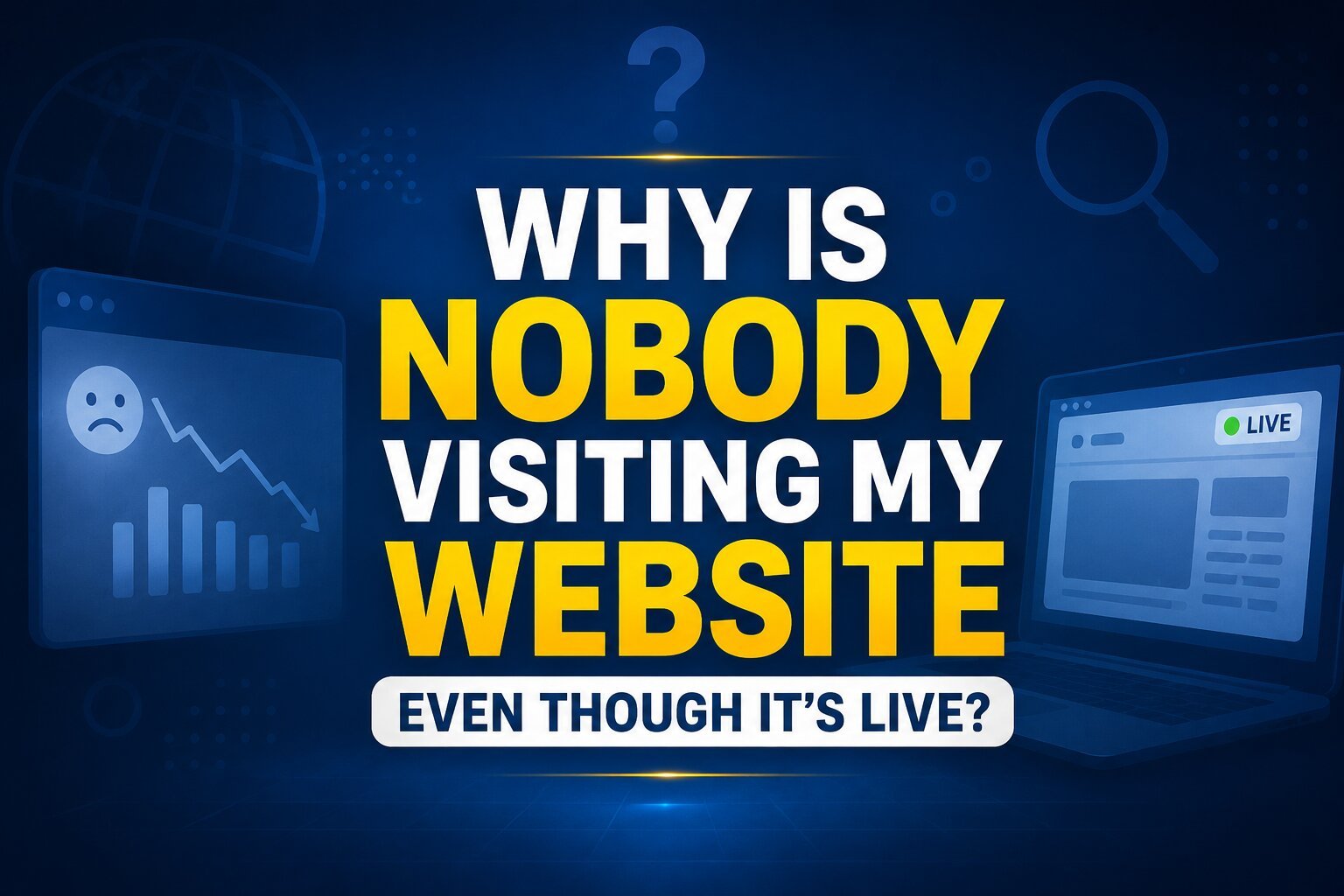
It’s a uniquely frustrating kind of disappointment. You did the “right” thing — you invested in a website, the way every business advisor told you to — and yet nothing changed. No new inquiries. No new calls. Just a website sitting quietly online, doing absolutely nothing for your business.
Here’s the misconception at the heart of it: “if you build it, they will come.” It sounds reasonable, but it’s simply not how the internet works. A website doesn’t announce itself to the world the moment it goes live. Without the right steps taken afterward, it can sit invisible for months — or indefinitely.
The good news? There’s usually a reason people aren’t finding your website — and in most cases, it’s fixable.
Stop waiting for customers to magically find your website. Let’s walk through exactly what’s going on, and how to fix it.
Table of Contents
ToggleThe Truth About Websites Most Business Owners Don’t Know
Here’s what most web developers won’t tell you when they hand over your finished site:
- Websites don’t automatically rank on Google. Ranking is earned, not automatic.
- Google needs to discover, crawl, and index your pages before they can appear in search results at all.
- SEO is required to generate consistent, ongoing traffic — a website is the foundation, not the whole structure.
- Visibility takes time and consistent effort, not a one-time setup.
Think of it this way:
“A website without SEO is like opening a shop in the middle of a desert — it’s there, but nobody knows it exists.”
You can have the most beautifully designed website in Pakistan, but if Google hasn’t indexed it, and it isn’t optimized for the searches your customers are actually using, it will remain exactly that: a shop in the desert.
15 Reasons Nobody Is Visiting Your Website
1. Your Website Isn’t Indexed by Google
If Google hasn’t added your pages to its index, they simply cannot appear in search results — no matter how good the content is.
2. You’re Not Targeting Any Keywords
Without keyword-focused content, your website has no clear signal to tell Google what searches it should appear for.
3. Your Website Has Technical SEO Issues
Broken links, missing meta tags, duplicate content, or poor site structure can quietly prevent Google from properly understanding or ranking your pages.
4. Your Competitors Rank Higher
If competitors have stronger SEO, more content, and more backlinks, they’ll consistently outrank you for the searches that matter most.
5. You Have No Google Business Profile
For local businesses, this is often a major missed opportunity — many local searches are answered directly through Google Business Profiles rather than websites.
6. Your Content Is Weak or Outdated
Thin, generic, or outdated content gives Google little reason to consider your pages valuable or relevant to searchers.
7. Your Website Is Too Slow
Slow-loading pages hurt both your search rankings and your visitors’ patience — many leave before the page even finishes loading.
8. It’s Not Mobile-Friendly
With the majority of searches happening on mobile devices, a website that isn’t mobile-optimized loses both rankings and real visitors.
9. You Have Poor Internal Linking
Without clear internal links connecting your pages, Google — and visitors — struggle to discover and navigate your full website.
10. You’re Not Building Backlinks
Backlinks from other websites act as trust signals to Google. Without them, your website has little external authority to help it rank.
11. You Aren’t Creating Helpful Blog Content
Blog content is one of the most effective ways to target additional keywords, answer customer questions, and attract ongoing organic traffic.
12. Your Website Is Brand New
New websites naturally take time to earn Google’s trust — a lack of traffic in the first few weeks or months is often completely normal.
13. You’re Not Promoting Your Website Anywhere
If your website isn’t linked from your social media, Google Business Profile, or business cards, you’re relying entirely on Google to find it for you.
14. You Don’t Appear in Local Search Results
Without Local SEO, your website may be technically fine but still invisible for the “near me” and location-based searches your customers are actually using.
15. You’re Not Tracking Website Performance
Without analytics and search console data, you have no way to know what’s actually happening — or what to fix first.
Get a free SEO audit from SEO Digix and find out exactly which of these 15 issues is holding your website back.
How to Check If Google Knows Your Website Exists
Before diagnosing anything else, confirm the basics — is Google even aware your website exists?
- Search
site:yourdomain.comin Google — if no results appear, your site likely isn’t indexed at all. - Use Google Search Console — a free tool that shows exactly how Google sees your website.
- Check your indexing status directly within Search Console’s “Pages” report.
- Review your XML sitemap to confirm it’s submitted and being read correctly by Google.
- Analyze crawl errors reported in Search Console, which can reveal technical issues blocking indexing.
If your website doesn’t appear at all with the site: search, this is usually the very first issue to resolve.
How to Get More Visitors to Your Website
Step 1: Submit Your Website to Google Search Console
This tells Google your website exists and gives you visibility into how it’s being crawled and indexed.
Step 2: Optimize Pages for Relevant Keywords
Make sure each page clearly targets the terms your potential customers are actually searching for.
Step 3: Create High-Quality Blog Content
Regularly publish content that answers real customer questions — this is one of the most reliable ways to attract new organic traffic over time.
Step 4: Improve Website Speed
Compress images, reduce unnecessary scripts, and choose reliable hosting to keep load times fast.
Step 5: Implement Local SEO
Optimize your website and listings for location-based searches relevant to your city and service area.
Step 6: Optimize Your Google Business Profile
A fully optimized profile drives additional traffic directly to your website through its “Website” link.
Step 7: Build Quality Backlinks
Earn links from relevant, reputable websites — directories, local publications, and industry partners are a good starting point.
Step 8: Share Content on Social Media
Every share is an additional path for potential visitors — and search engines — to discover your website.
Step 9: Track Results Using Google Analytics
Understand exactly where your traffic is coming from, and which pages are performing best.
Step 10: Perform a Complete SEO Audit
Identify every technical, content, and authority-related issue holding your website back — ideally before investing further time or budget.
Let SEO Digix identify why your website isn’t getting visitors — our audits go through every one of these steps for you.
Signs Your Website Has an SEO Problem
- Fewer than 100 monthly visitors, month after month.
- No rankings on Google for your core services or products.
- Zero inquiries or leads generated through the website.
- High bounce rate — visitors leave almost immediately.
- No impressions showing in Google Search Console.
- No traffic growth over time, despite the website being live for months.
If two or more of these apply to you, your website almost certainly has an underlying SEO issue worth investigating.
Common Mistakes Business Owners Make
- Thinking a website alone generates traffic — without realizing ongoing SEO work is required.
- Ignoring SEO entirely, treating it as optional rather than essential.
- Hiring cheap developers who build a website but never implement basic SEO fundamentals.
- Never updating content, leaving the website static and increasingly outdated.
- Ignoring Google Search Console, missing critical signals about indexing and performance issues.
- Focusing only on social media, while leaving the website itself unoptimized and undiscovered.
How Long Does It Take to Get Website Traffic?
| Activity | Timeline |
|---|---|
| Google Indexing | 1–14 Days |
| Initial Rankings | 1–3 Months |
| Local SEO Results | 2–6 Months |
| Significant Organic Traffic | 6–12 Months |
“SEO is not an overnight solution, but it’s one of the most sustainable ways to grow your business.”
Unlike paid ads, which stop working the moment you stop paying, SEO results tend to compound — the effort you put in today continues generating traffic and leads well into the future.
Industries Most Affected by Low Website Traffic
- Real estate
- Healthcare
- Legal services
- Restaurants
- Salons
- E-commerce
- Educational institutes
- Home services
These industries tend to be highly competitive online, meaning businesses without a deliberate SEO strategy are especially likely to be outranked and overlooked.
Real-Life Example
Consider a clinic in Lahore that had a website for over a year but received fewer than 20 visitors per month. Despite the website being live and functional, it had never been optimized — no targeted content, no Local SEO, and a largely neglected Google Business Profile.
After implementing SEO, publishing helpful, patient-focused content, and fully optimizing its Google Business Profile, the clinic’s website traffic increased by roughly 400% within six months — turning a mostly ignored website into a genuine source of new patient inquiries.
This kind of turnaround is common once the underlying visibility issues are properly identified and addressed.
Frequently Asked Questions
1. Why is my website not showing on Google? This is usually due to indexing issues, missing SEO fundamentals, weak or thin content, or technical problems preventing Google from properly crawling your site.
2. How do I know if my website is indexed? Search site:yourdomain.com in Google, or check the “Pages” report inside Google Search Console for a detailed indexing status.
3. How long does SEO take? Initial indexing can happen within days, but meaningful rankings typically take 1–3 months, with significant organic traffic growth building over 6–12 months.
4. Can I get traffic without SEO? Some traffic is possible through paid ads, social media, or direct referrals, but consistent, sustainable, low-cost traffic almost always requires SEO.
5. How important are backlinks? Very important — backlinks act as trust signals to Google, and websites with quality backlinks tend to rank significantly better than those without.
6. Does Google Business Profile help website traffic? Yes. A well-optimized profile frequently drives direct clicks to your website, in addition to generating calls and direction requests on its own.
7. Why is my website getting traffic but no leads? This often points to a conversion issue — unclear calls-to-action, confusing navigation, or a lack of trust signals like reviews and testimonials on the page.
8. Can SEO Digix help improve my website traffic? Yes. SEO Digix conducts full SEO audits for Pakistani businesses, identifying technical, content, and visibility issues, then implements the fixes needed to grow consistent, sustainable website traffic.
Ready to Turn Your Website Into a Lead-Generating Asset?
Having a website is only the first step. Without the right SEO foundation behind it, even the best-designed website can remain invisible to the very customers searching for what you offer.
SEO Digix helps Pakistani business owners:
- Identify exactly why their website isn’t getting traffic
- Fix technical and indexing issues holding their site back
- Build content and Local SEO strategies that attract real visitors
- Turn website traffic into genuine leads and customers
Start turning your website into a lead-generating asset today. Get in touch with SEO Digix for a free SEO audit and find out exactly what’s standing between your website and its first real wave of visitors.