
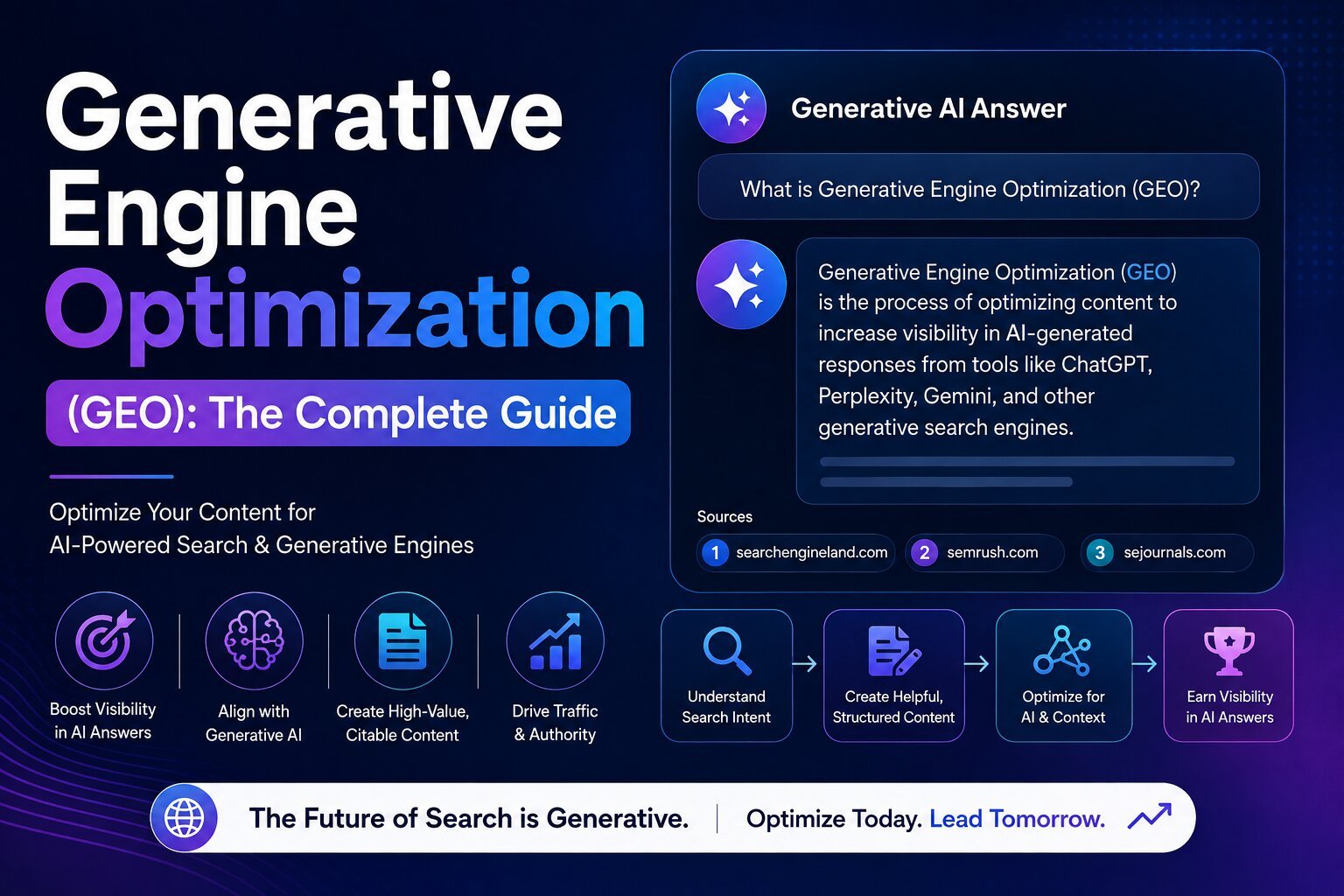
A growing share of questions never reach a traditional search results page at all. They’re typed into ChatGPT, asked inside Perplexity, or answered directly inside Google’s AI Overviews and AI Mode — and the response a person gets is a synthesized answer, not a ranked list of links. Generative Engine Optimization (GEO) is the practice of increasing the odds that your brand, product, or content shows up — accurately and favorably — inside those answers.
This guide goes beyond a single platform. It covers how different types of generative AI systems actually source their answers, why that distinction changes your optimization strategy, what metrics genuinely apply in a world without stable rankings, and where the real evidence — not speculation — currently points.
Quick Answer: What Is GEO and How Does It Work?
Generative Engine Optimization (GEO) is the practice of structuring content, brand presence, and digital signals so that generative AI systems — including ChatGPT, Google Gemini, Claude, and Perplexity — are more likely to reference, cite, or recommend you in their responses. Unlike SEO, where the goal is to rank in a list of results, GEO’s goal is to become part of the AI’s synthesized output itself. It builds directly on SEO fundamentals (crawlability, authority, quality content) but adds new considerations: how retrieval-augmented generation works, which AI crawlers can access your site, and how your brand shows up in the sources — Wikipedia, forums, review sites, news coverage — that AI systems draw from beyond your own website.
What Is GEO, Exactly? A Note on Terminology
The term “generative engine optimization” emerged as generative AI moved from standalone chatbots into mainstream search products — Google folding AI Overviews into its core results, Bing integrating Copilot, and dedicated tools like Perplexity building entire products around synthesized answers. As the practice matured, several overlapping terms emerged to describe roughly the same discipline: Answer Engine Optimization (AEO), Artificial Intelligence Optimization (AIO), AI SEO, and Large Language Model Optimization (LLMO).
In practice, these terms describe the same underlying work with slightly different emphasis — AEO leans toward structuring direct answers, LLMO leans toward influencing model training and knowledge, and GEO is often used as the umbrella term. Industry commentary has described the discipline as a multi-layered approach: structuring content around direct answers, maintaining consistent entity information about your brand across the web, and reinforcing authority signals across third-party sources — not just your own site — to support inclusion in AI-generated responses.
The Three Types of Generative AI Engines (And Why It Matters)
Not all AI systems find their answers the same way, and this is arguably the single most important — and most commonly overlooked — factor in building a GEO strategy. Generative engines generally fall into three categories:
1. Training-Based Systems
These models answer primarily from what they learned during training, without searching the live web for most queries. You can only influence what they “know” indirectly and over a long time horizon — through a stable, credible presence across the sources likely to be included in future training data (major publications, Wikipedia, well-established industry sites). There is no way to update these models’ knowledge on demand.
2. Search-Based (Retrieval) Systems
These systems — including Google AI Overviews, Google AI Mode, and Perplexity — pull from a live, continuously updated web index at the time of the query. This is where traditional SEO fundamentals matter most directly: your content needs to already be crawlable, indexed, and competitive enough to be among the sources selected for retrieval.
3. Hybrid Systems
Systems like Google Gemini and ChatGPT with browsing enabled blend both approaches — foundational understanding comes from training data, while current facts, prices, or recommendations are pulled from live retrieval when the model determines it needs them. Notably, not every query triggers a web search even in these hybrid systems. Simple, stable, “encyclopedic” questions are often answered entirely from internal knowledge, with no retrieval and no citation opportunity at all. Retrieval tends to be triggered specifically for time-sensitive facts, multi-perspective questions, or highly specific data the model can’t confidently answer from memory alone — which means content built around current prices, comparison data, original research, or frequently updated specifics has a meaningfully higher chance of being retrieved and cited than generic explainer content the model can already answer internally.
This distinction should directly shape what you invest in: if you’re targeting a training-based model, your best lever is long-term authority-building and digital PR. If you’re targeting a search-based or hybrid system, technical SEO and content freshness matter enormously more.
How Retrieval-Augmented Generation (RAG) Actually Works
Most citation-generating AI answers rely on an architecture called retrieval-augmented generation, or RAG. Rather than relying solely on frozen training data, RAG systems retrieve relevant external documents at query time, break them into semantically meaningful segments, and feed those segments to the model alongside the user’s question — letting it generate an answer grounded in current, retrievable information rather than what it memorized months or years earlier.
This matters for GEO in a very concrete way: content isn’t retrieved as a whole page. It’s retrieved as a chunk — a self-contained passage that answers a specific question clearly, without depending on surrounding paragraphs for context. A page built as one long, meandering narrative is harder for a RAG system to extract cleanly than a page built from distinct, well-labeled sections that each fully answer one sub-question. This is why clear subheadings, direct topic sentences, and self-contained paragraphs aren’t just good writing practice — they directly affect how retrievable your content is.
It’s also worth knowing that different generative engines commonly draw on different underlying web indexes for this retrieval step — for example, ChatGPT’s search features have relied on Bing’s index, Gemini draws on Google’s, and Perplexity maintains its own index. Practically, this means strong visibility in one traditional search engine doesn’t automatically translate to strong visibility across every generative platform.
Why Training Data Cutoffs Matter
For systems that lean more heavily on training data than live retrieval, the model’s knowledge cutoff becomes a real constraint. A model’s most recent training data can be many months old even at launch, and if a query doesn’t trigger a live search, the model answers from that older snapshot regardless of what’s changed since.
| Consideration | Why It Matters for GEO |
|---|---|
| Training cutoff | Content published after a model’s cutoff can’t influence its baseline knowledge until the model is retrained or the query triggers live retrieval |
| Live retrieval | Time-sensitive, comparative, or highly specific queries are more likely to trigger a live search, creating a real citation opportunity |
| Caching | Frequently asked queries may increasingly be served from a validated, cached answer rather than a fresh retrieval, reducing the marginal value of very recent changes to already-cached topics |
The practical implication: influencing a model’s baseline training knowledge is a long-term brand-building effort with no guaranteed timeline, while influencing what a model retrieves live is a more immediate, SEO-adjacent effort. Most realistic GEO strategies need to pursue both simultaneously.
SEO vs. GEO: What Actually Changes
| Dimension | SEO | GEO |
|---|---|---|
| Primary goal | Rank in search engine results pages | Be referenced, cited, or recommended inside an AI-generated answer |
| Unit of competition | Individual web pages | Ideas, facts, and brand associations synthesized into one response |
| Core tactics | Crawlability, keyword targeting, search-intent alignment, backlinks | Extractable content structure, consistent entity signals, third-party mentions, AI crawler access |
| Success metrics | Keyword rankings, organic traffic, CTR | AI mention frequency, citation share, answer accuracy, AI-influenced conversions |
| Stability | Rankings are relatively stable day to day | The same query can produce different AI answers within minutes of each other |
The overlap between the two is substantial — strong SEO fundamentals (crawlable architecture, genuine expertise, quality backlinks) remain much of the foundation GEO is built on. But GEO adds work that has no real SEO equivalent: making sure your brand is described consistently and accurately across sources you don’t control, understanding which AI crawlers can even access your site, and accepting that there’s no stable “position” to track the way there is in organic search.
AI Crawlers You Need to Know About
Traditional SEO revolves almost entirely around Googlebot. GEO requires awareness of a broader set of crawlers, each associated with a different AI system:
- GPTbot — OpenAI’s crawler, relevant to ChatGPT’s browsing and training data collection
- Google-Extended — controls whether your content can be used for Google’s AI features, separate from standard Googlebot indexing
- PerplexityBot — used by Perplexity to retrieve and cite web content
- ClaudeBot / anthropic-ai — Anthropic’s crawlers, relevant to Claude’s data collection
If any of these are blocked in your robots.txt — deliberately or by accident — your content becomes structurally invisible to that specific engine, regardless of content quality. Auditing robots.txt for AI-crawler-specific rules, not just Googlebot, is now a standard part of a GEO technical audit. It’s also worth confirming that important content isn’t rendered exclusively via client-side JavaScript, since AI crawlers have historically had more difficulty executing JavaScript than Googlebot does — content that depends entirely on client-side rendering risks being invisible to several AI systems even when it renders perfectly for human visitors.
Metrics That Actually Apply to GEO
Standard SEO metrics — keyword rank, click-through rate, monthly search volume — don’t translate cleanly to generative search, for a simple reason: there are no stable rankings to track, since the same query can return a different synthesized answer within minutes, and a growing share of AI-influenced interactions never produce a click at all.
A more useful way to frame GEO success is around three questions:
Are you being seen? How often does your brand appear at all when AI tools answer questions in your category? This requires running the same prompts repeatedly over time, since a single check isn’t representative given how much answer variance exists.
Are you being represented accurately? When your brand is mentioned, is the AI describing it correctly — accurate pricing, accurate features, accurate positioning? Inaccurate AI representation can actively hurt a brand’s credibility, and unlike a web page you control, you can’t directly edit an AI’s answer.
Is it actually driving business outcomes? Ultimately, visibility and accuracy matter because they should influence whether someone chooses you — whether that shows up as direct traffic, branded search, or a conversion that’s difficult to attribute back to a specific AI interaction.
A category of dedicated monitoring tools has emerged specifically to track these signals — tracking brand mentions, citation frequency, and share of voice across multiple AI platforms simultaneously, since checking manually across ChatGPT, Gemini, Claude, and Perplexity individually doesn’t scale.
Practical Levers That Influence AI Citations
Beyond core content quality, several more specific factors have emerged as meaningful levers, based on early industry testing and available research:
- Unlinked brand mentions carry more weight than you’d expect. Because generative systems reason about entities and their associations rather than purely following hyperlinks, being mentioned by name — even without a link — appears to contribute to how strongly an AI system associates your brand with a topic.
- Content backed by concrete quotes and statistics tends to be favored. One analysis of a large sample of real-world AI queries found that pages containing direct quotes and statistics had meaningfully higher visibility in AI-generated responses than comparable content without them — likely because specific, attributable claims are easier for a model to extract and present with confidence.
- A presence on Wikipedia and major UGC platforms matters disproportionately. Because Wikipedia and platforms like Reddit and YouTube make up a substantial share of what large models are trained on, an accurate, well-maintained presence on these platforms can meaningfully increase the odds of accurate, favorable mention — independent of what’s on your own website.
- Freshness correlates strongly with AI citation. One industry analysis of AI-referred traffic found the large majority went to pages updated within roughly the past two years, with only a small fraction going to pages older than four years — reinforcing that genuine, substantive content updates (not just a changed timestamp) matter more in generative search than they historically did in traditional SEO.
- Digital PR and third-party editorial coverage function as authority signals. Because generative systems draw on the broader web, not just your own domain, earning genuine coverage in credible industry publications extends your influence into sources an AI model is more likely to trust and cite than brand-owned content alone.
Being Indexed Isn’t the Same as Being Recommended
It’s worth stating plainly: technical eligibility to be crawled and retrieved is a floor, not a strategy. A page can be perfectly indexable and still never get cited, because indexation alone doesn’t give a generative model a specific reason to surface your brand over a competitor’s in a synthesized answer.
The more useful mental model is to ask: does this piece of content give an AI system a clear, specific, differentiated reason to mention us — an original data point, a genuinely useful comparison, a first-hand insight — rather than simply restating information the model can already generate from dozens of other, interchangeable sources? Content that could have been written by anyone about anyone is easy for a model to synthesize without ever needing to cite a specific source.
Does GEO Replace SEO?
No — and treating them as separate, competing disciplines is generally the wrong frame. Much of the work that earns visibility in AI-generated answers is the same work that earns strong organic rankings: crawlable architecture, genuinely useful content, and credible backlinks and mentions.
Some early research supports this directly: one analysis found a moderately strong correlation between a brand’s page-one Google rankings and how often that brand gets mentioned by large language models. That correlation doesn’t prove causation — a brand might rank well and get cited well for the same underlying reason (genuine authority and relevance) rather than one directly causing the other — but it does suggest that businesses already investing seriously in SEO are, in practice, already doing much of the work GEO requires.
Where the Evidence Gets Murkier: Bias and Limitations
Generative search isn’t a neutral, comprehensive window into “the best” information — and it’s worth being clear-eyed about that. Academic research auditing generative AI search engines has found that these systems draw heavily on news and media sources specifically, and that citation patterns can exhibit measurable commercial and geographic bias — meaning certain types of sources and certain regions are systematically overrepresented or underrepresented in AI-generated answers, independent of actual content quality.
This has practical implications: a smaller, highly credible source in an underrepresented region or format may struggle to be cited even with genuinely excellent content, simply because of how these systems’ underlying training and retrieval patterns are structured. GEO can improve your odds, but it can’t fully overcome structural biases in how a given AI system was built and trained.
The Traffic and Attribution Problem
One of the more uncomfortable realities of generative search is its effect on click-through behavior. As AI-generated answers increasingly resolve a user’s question directly, fewer of those interactions result in a click to any website at all — a pattern sometimes described as “zero-click” search. Analysts have projected meaningful declines in traditional search engine referral volume as AI-driven answer experiences absorb queries that previously required visiting a results page.
In practice, total search activity hasn’t necessarily declined — if anything, some data suggests people are searching more often, asking additional follow-up questions across both traditional search and AI tools. What’s changed is the path: more research and comparison now happens inside the AI interaction itself, with users increasingly going directly to a brand’s website, searching for the brand by name, or converting through channels that are difficult to trace back to a specific AI-driven interaction.
This means click-through rate and last-click attribution, while still useful, increasingly understate the real influence of AI search on a purchase decision. Businesses evaluating GEO’s return on investment should expect attribution to be harder, not impossible — tracking branded search volume, direct traffic trends, and AI-specific monitoring tools alongside traditional analytics gives a more complete picture than website traffic figures alone.
Should Your Business Invest in GEO Right Now?
A reasonable, honest answer depends heavily on how strong your existing SEO foundation already is:
- If your SEO is weak or inconsistent, prioritize fixing that first. GEO builds directly on SEO fundamentals, and investing heavily in AI-specific tactics before your site is even reliably crawlable and well-structured is unlikely to pay off.
- If your SEO is already strong, incremental investment in GEO-specific work — brand mention tracking, digital PR aimed at AI-cited source types, Wikipedia and UGC presence, AI crawler access audits — is a reasonable extension of an already solid program, and several practitioners suggest allocating a modest additional share of an existing SEO budget (commonly cited in the 20-25% range) as a starting point, to be adjusted based on how much AI-driven visibility actually matters in your specific industry and audience.
The technology and its impact on any given industry are still evolving quickly, so treating GEO as a fixed, one-time project rather than an ongoing, adaptive practice will serve most businesses better.
A Practical GEO Action Framework
Audit
- Confirm your
robots.txtdoesn’t unintentionally block GPTbot, Google-Extended, PerplexityBot, or Claude’s crawlers. - Check whether key pages depend on client-side JavaScript rendering that AI crawlers may struggle with.
- Run a sample of your priority industry questions across ChatGPT, Gemini, Claude, and Perplexity to see whether — and how — your brand currently appears.
Structure
- Rewrite key pages so each section is a self-contained, clearly labeled answer to one specific question, rather than one long undifferentiated narrative.
- Add concrete, attributable data points, statistics, and direct quotes where genuinely relevant.
- Ensure consistent entity information (business name, description, key facts) across your website, Wikipedia (if applicable), business listings, and structured data.
Amplify
- Pursue genuine coverage in credible industry publications and digital PR opportunities, since third-party mentions extend your influence beyond your own domain.
- Maintain an accurate, well-sourced presence on Wikipedia where notability genuinely supports it, and on relevant UGC platforms like Reddit and industry-specific forums.
- Treat unlinked brand mentions as valuable, not just traditional backlinks.
Measure
- Track AI mention frequency and citation accuracy across your priority platforms on an ongoing basis, not as a one-time check.
- Monitor branded search volume and direct traffic trends alongside standard organic metrics, since some AI-influenced conversions won’t show up as trackable referral traffic.
- Reassess quarterly — generative search behavior and platform capabilities are changing quickly enough that a strategy built a year ago likely needs revisiting.
Frequently Asked Questions
Is GEO the same as AEO? They’re closely related and often used interchangeably. AEO tends to emphasize structuring content around direct question-and-answer formats, while GEO is generally used as the broader umbrella term covering optimization for generative AI systems overall. The practical work involved overlaps heavily.
Does GEO replace the need for SEO? No. GEO builds on SEO fundamentals — crawlability, content quality, authority — rather than replacing them. Businesses with weak SEO foundations generally see limited benefit from GEO-specific tactics until those fundamentals are addressed.
Do unlinked brand mentions really help with AI visibility? Early evidence suggests they can, since generative systems often reason about brand entities and associations rather than relying purely on hyperlinks. This doesn’t make traditional backlinks unimportant, but it does mean brand mentions without links shouldn’t be dismissed as valueless.
Should I try to get my business on Wikipedia? If your business genuinely meets Wikipedia’s notability standards, an accurate presence there can meaningfully help, since Wikipedia represents a substantial share of many models’ training data. Attempting to create a promotional or non-notable entry is likely to be rejected and isn’t a reliable GEO tactic for most businesses.
Which AI crawlers should I make sure aren’t blocked? At minimum, review your robots.txt for rules affecting GPTbot, Google-Extended, PerplexityBot, and Anthropic’s crawlers. Blocking any of these limits your visibility specifically within that platform’s AI features, separate from standard search indexing.
Can I track my brand’s visibility across different AI platforms? Yes, through a combination of manually running representative prompts across major platforms and using dedicated AI-visibility monitoring tools designed to track mentions, citations, and share of voice at scale across multiple systems.
Why did my page stop getting cited after ranking well for months? Generative AI answers can vary significantly between requests for the same query, and platforms continuously update their retrieval and ranking behavior. A drop in citation frequency doesn’t necessarily indicate a problem with your content — it may reflect normal variance or a broader platform-level change.
Is there a guaranteed way to get cited by ChatGPT or Google AI Overviews? No. No tactic guarantees citation on any generative platform. The realistic goal is to consistently improve the underlying factors — technical accessibility, content quality, third-party authority, and brand consistency — that make citation more likely over time.
Conclusion
Generative Engine Optimization isn’t a replacement for SEO, and it isn’t a single tactic you implement once. It’s an extension of the same underlying goal — being genuinely useful and credible enough that others choose to reference you — applied to a new set of systems that don’t rank pages so much as synthesize answers from many sources at once, some of which you control and many of which you don’t.
The businesses likely to do well here are the ones already doing SEO seriously, who now also pay attention to how their brand is represented on Wikipedia, in forums, in press coverage, and across the specific AI crawlers that decide whether their content is even eligible to be considered. There’s no finish line and no confirmed formula — only an ongoing practice of making your content, and your brand’s presence across the wider web, genuinely worth citing.



What do you think?
[…] SEO audits, and citation management, paired with emerging AEO (Answer Engine Optimization) and GEO (Generative Engine Optimization) practices that help businesses stay visible as more local searches are answered directly through AI-powered […]
Comments are closed.