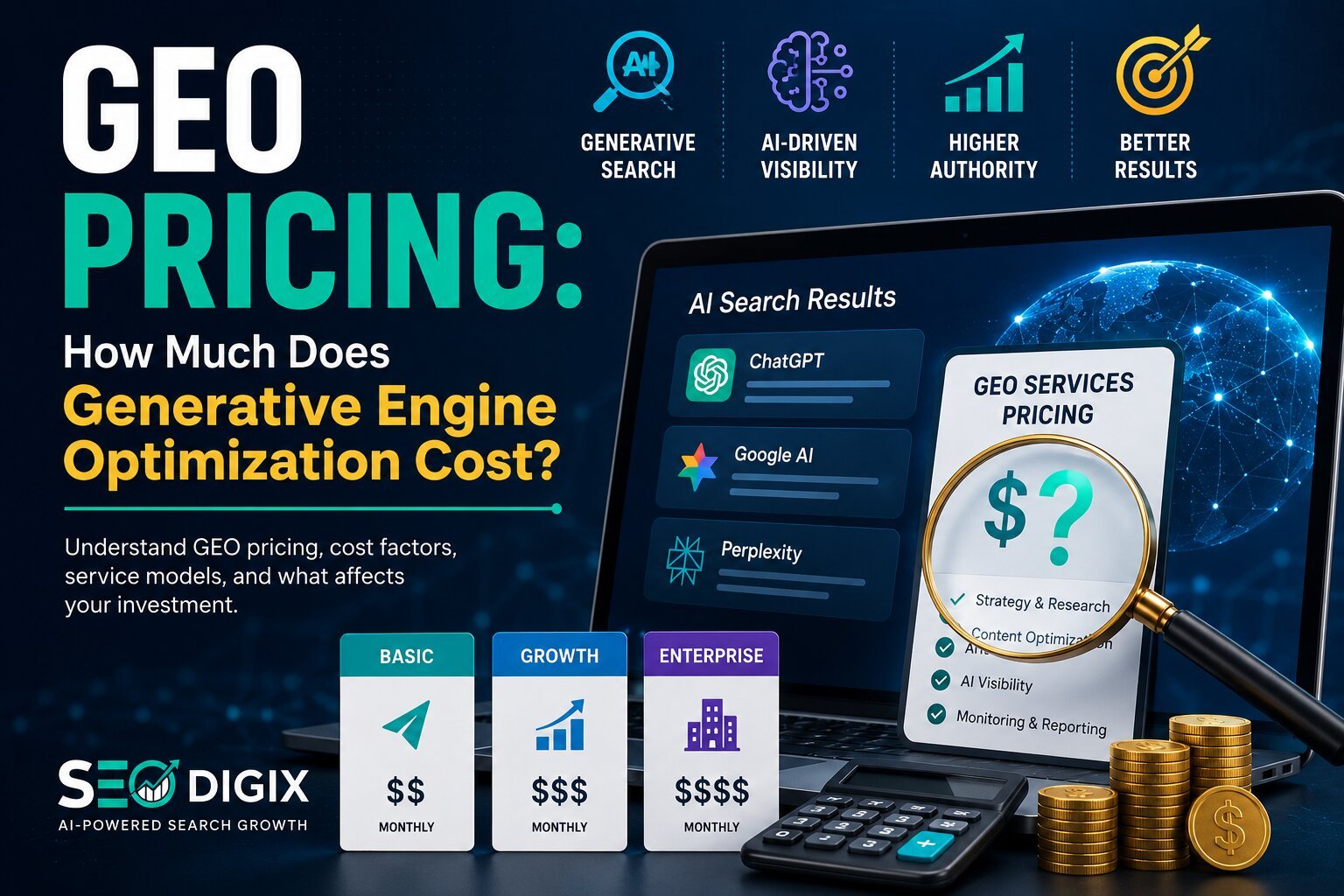
Generative Engine Optimization (GEO) services typically range from a few hundred dollars (USD) for an initial AI-search visibility audit to several thousand dollars per month for an ongoing, comprehensive GEO campaign. Where a business falls in that range depends on business size, industry competition, website size, geographic targeting, existing SEO performance, content requirements, brand authority, number of products or services, number of locations, and how much ongoing monitoring and optimization the strategy calls for.
Unlike traditional SEO, which has had roughly two decades to develop shared pricing conventions, GEO is still a young, fast-moving category. There’s no single “industry standard” rate, and providers structure pricing differently — some sell GEO as a standalone audit or project, others fold it into a broader SEO and AEO retainer, and enterprise organizations with large content libraries and multiple markets typically pay substantially more than a single-location local business.
Below is a practical breakdown of typical GEO pricing models, what actually drives cost up or down, what a professional GEO engagement should include, and how to evaluate whether a provider’s pricing and scope genuinely make sense for your business.
Table of Contents
ToggleHow Much Does GEO Cost?
The ranges below reflect general market patterns for GEO and AI-search optimization work. They’re approximate market estimates for budgeting purposes — not fixed or universal industry prices, since no such standard currently exists for this category.
| GEO Service | Approximate Cost (USD) | Best For | Typical Deliverables |
|---|---|---|---|
| GEO Audit | $500 – $1,800 (one-time) | Businesses starting with GEO and wanting a baseline first | AI-search visibility analysis, competitor research, opportunity identification, prioritized report |
| GEO Consultation | $100 – $250 / hour | Businesses with an internal team needing strategic guidance | Strategy sessions, roadmap development, internal training, ad hoc reviews |
| One-Time GEO Optimization | $1,200 – $5,000 (one-time) | Smaller websites optimizing a defined set of pages | Content, entity, and structured data optimization for a specific scope |
| Monthly GEO Services | $700 – $3,500+ / month | Growing businesses wanting ongoing optimization and monitoring | Content updates, entity refinement, monitoring, monthly reporting |
| Comprehensive GEO Campaign | $2,000 – $7,000+ / month | Competitive industries needing a full AI-search visibility strategy | Content strategy, technical SEO, digital PR/authority building, ongoing monitoring |
| Enterprise GEO | Custom (typically $7,000+ / month) | Large organizations with complex, multi-market content needs | Cross-team strategy, large-scale content and entity work, multi-market optimization, dedicated reporting |
These figures are meant to support budgeting conversations, not serve as a quote. SEO Digix determines actual pricing after reviewing a business’s website, industry, competitive landscape, and goals — since two businesses of similar size in the same industry can require very different scopes of work depending on their starting point.
Curious where your business would realistically land on this spectrum? Talk to SEO Digix about your specific goals and we’ll walk through a realistic scope and budget together.
What Is Generative Engine Optimization?
Generative Engine Optimization is the practice of improving the likelihood that a business, brand, website, product, or organization is represented accurately — and, where relevant, prominently — within generative AI search and answer experiences. This includes platforms like ChatGPT, Google AI Overviews, Google AI Mode, Perplexity, and other AI-powered search and assistant experiences that generate synthesized answers rather than a traditional list of links.
GEO overlaps meaningfully with both SEO and AEO but isn’t identical to either. Traditional SEO is largely built around ranking a page in a results list. Answer Engine Optimization (AEO) focuses on getting content surfaced in direct-answer formats like featured snippets or voice results. GEO goes a step further, focusing on how a brand or source gets referenced, cited, or represented within a generated response — which may summarize, paraphrase, or synthesize information from multiple sources rather than linking to just one.
It’s worth being precise about what GEO can and can’t do. These platforms don’t share a single ranking algorithm. Google’s AI Overviews draw on Google’s own search index and systems. ChatGPT’s browsing and citation behavior depends on the version and how it’s configured. Perplexity works differently again. A business’s visibility across these systems can vary by platform, by the specific query asked, by user context and location, by what sources are available on a given topic, and by a range of technical and authority signals — which is exactly why GEO pricing and scope vary so much between providers and engagements.
GEO vs SEO vs AEO
| Traditional SEO | AEO | GEO | |
|---|---|---|---|
| Primary objective | Search visibility | Answer visibility | Generative AI visibility |
| Main environment | Search engines | Answer engines (snippets, voice) | Generative AI/search experiences |
| Focus | Rankings and organic visibility | Useful, direct answers | Brand/source representation and visibility |
| Content approach | Search-optimized content | Question-and-answer-focused content | Content designed to be genuinely useful and citable |
| Technical SEO | Important | Important | Important |
| Authority | Important | Important | Important |
These three disciplines share the same underlying foundation — technical health, content quality, and authority — and work best as layers built on top of each other rather than isolated, competing services. A business investing heavily in GEO while neglecting basic technical SEO is unlikely to see meaningful results, since AI systems still depend on many of the same signals traditional search engines use to evaluate a site.
What Does a GEO Agency Actually Do?
AI Search Visibility Audit
An agency reviews where a brand currently appears — or doesn’t appear — across relevant AI-search experiences for its most important topics and queries, establishing a baseline before any work begins.
Generative Search Query Research
This involves researching the actual questions and prompts potential customers might use when looking for a business’s products, services, or recommendations — often phrased more conversationally than traditional keyword searches.
Content Optimization
Existing content gets reviewed and improved for clarity, usefulness, topical depth, entity clarity, and how directly and accurately it answers the questions people are actually asking.
Entity Optimization
This means clearly establishing what a business is, what it offers, where it operates, and how it relates to other relevant topics and entities — helping AI systems build an accurate understanding of the brand.
Structured Data and Technical SEO
Schema markup, crawlability, indexing, and clean site architecture form the technical foundation that supports visibility across both traditional search and generative AI experiences.
Topical Authority
Comprehensive, genuinely useful coverage of a business’s core subject areas — rather than a handful of isolated pages — helps establish a site as a credible source AI systems are more likely to draw from.
Digital PR and Brand Mentions
Third-party references, authoritative mentions, and credible citations across the web can matter for how AI systems perceive a brand’s authority and trustworthiness on a given topic.
Competitor Analysis
Understanding which sources are currently being referenced in AI-generated responses for relevant queries — and why — helps identify realistic opportunities and gaps.
AI Search Monitoring
Ongoing tracking of relevant prompts, mentions, citations, and sources over time helps a business understand whether its visibility is genuinely improving, where tools and methods allow for that kind of tracking.
What Factors Affect GEO Pricing?
Industry Competition
Highly competitive industries — legal services, healthcare, financial services — typically require more research, content depth, and ongoing authority development to stand out, since well-established competitors are often already being cited as sources.
Website Size
A small business website with a dozen core pages requires a very different scope than a large enterprise site with thousands of pages, product listings, or content assets.
Existing SEO Foundation
A business with strong technical SEO, deep content, and established authority may need targeted GEO refinement. A newer site with limited content or authority typically needs foundational work addressed first or alongside GEO, which affects both scope and cost.
Content Volume and Quality
The amount of content that needs to be created, optimized, or expanded to properly answer relevant questions has a direct effect on pricing — this is often the single biggest cost driver in a GEO engagement.
Geographic Targeting
Local GEO campaigns tend to require a narrower scope than national or international campaigns, which need to account for multiple markets, languages, or regional search behavior.
Brand Authority
Established brands with existing citations and mentions may need a different strategy — and often a smaller lift — than newer companies working to build authority and recognition from a limited starting point.
Number of Products or Services
A business offering a handful of core services requires a more contained strategy than one offering hundreds of products or service variations, each of which may need its own optimized content.
Monitoring Requirements
Ongoing AI-search monitoring and reporting — tracking mentions, citations, and visibility changes over time — adds recurring work that affects monthly retainer pricing.
Not sure which of these factors matter most for your business? Request a GEO assessment from SEO Digix and we’ll help you understand where your actual scope and budget should focus.
GEO Pricing Models
One-Time GEO Audit
A focused, one-time engagement that assesses current AI-search visibility, researches relevant queries and competitors, and delivers a prioritized set of recommendations. Suitable for businesses wanting to understand their starting point before committing to ongoing work.
Fixed-Price GEO Project
A defined, one-time optimization project covering a specific set of pages, entities, or content gaps. This works well for smaller businesses or those wanting to address a clearly scoped set of issues without an open-ended retainer.
Monthly GEO Retainer
Since AI-search visibility isn’t a “set it and forget it” outcome, many businesses opt for an ongoing monthly engagement covering continuous content optimization, monitoring, competitor tracking, and authority development as the landscape evolves.
Hourly GEO Consulting
For businesses with an internal marketing or content team, hourly consulting can provide strategic direction and expertise without full agency management — useful for teams that can execute the work themselves once given a clear roadmap.
Enterprise GEO
Larger organizations with complex content ecosystems, multiple markets, or many stakeholders typically require customized pricing built around their specific scale and structure rather than a standard package.
How Much Should a Business Budget for GEO?
These examples are illustrative starting points, not quotes or guarantees — actual budgets should reflect a business’s specific competition, goals, and current visibility.
- Small local businesses — Often a good fit for a GEO audit plus a smaller, focused monthly retainer or one-time project, particularly when paired with existing Local SEO work.
- Small and medium-sized businesses — Typically benefit from a moderate monthly retainer combining content optimization, entity work, and basic monitoring.
- Competitive national businesses — Usually need a more comprehensive monthly campaign given the number of competitors likely already being referenced in relevant AI-generated answers.
- Ecommerce companies — Budget needs often scale with catalog size, since product and category-level optimization can require significant content work.
- SaaS companies — Frequently need ongoing investment in comparison content, use-case documentation, and technical clarity, given how often AI systems are used to compare software options.
- Enterprise organizations — Generally require custom, larger-scale budgets reflecting multi-market complexity, content volume, and internal coordination needs.
The right budget isn’t about finding the cheapest available option — it’s about matching scope and investment to a business’s actual competitive position, content needs, and goals.
Is GEO Worth the Cost?
The most useful way to evaluate GEO isn’t by counting impressions or chasing a specific AI mention — it’s by tracking meaningful business outcomes over time:
- Qualified leads generated through organic and AI-referred channels
- Overall brand visibility across both traditional and AI-powered search
- AI-search mentions and citations
- Growth in credible third-party citations and brand mentions
- Referral traffic from AI platforms, where trackable
- Organic search performance more broadly
- Conversions from organic and AI-referred visitors
- Customer acquisition cost relative to other marketing channels
- Broader revenue opportunities tied to increased visibility
- General brand awareness and recognition
AI-search visibility is only one component of a complete search strategy — it shouldn’t be evaluated in isolation from a business’s broader SEO, content, and brand-building efforts, since these all reinforce each other.
Who Needs GEO Services?
- Local businesses — benefit from GEO that reinforces consistent business information and local relevance across AI-search experiences.
- Law firms — need GEO built around practice-area questions and jurisdiction-specific accuracy, given the sensitivity of legal topics.
- Contractors — benefit from GEO addressing common project and service questions homeowners actually ask.
- Healthcare businesses — require particularly careful GEO given YMYL content standards, with accuracy and credible sourcing central to the strategy.
- Real estate companies — need GEO spanning both transactional and hyper-local market questions.
- Financial services — require GEO with a strong emphasis on accuracy, compliance, and credible sourcing given the sensitivity of financial topics.
- SaaS companies — benefit from GEO focused on product comparisons and use-case clarity, common territory for AI-assisted research.
- Ecommerce brands — need GEO addressing product- and category-level questions at scale.
- Professional service firms — benefit from GEO built around service explanation and credibility.
- B2B companies — often need GEO addressing complex buying-committee questions and comparison research.
- Multi-location businesses — need GEO that scales sensibly across locations without producing thin, duplicated content.
GEO for Local Businesses
GEO doesn’t replace Local SEO for a local business — it complements it. Many of the same signals that support strong Local SEO also support GEO: consistent business information across the web, genuine local authority, real customer reviews, accurate location relevance, well-built service pages, locally relevant content, clear entity information, credible brand mentions, and consistent local citations.
Google Business Profile optimization in particular remains foundational, since accurate, complete business information continues to feed both traditional local search and the broader signals AI systems draw on when representing a business. Local businesses shouldn’t abandon proven Local SEO fundamentals just because AI search is growing — the two work together, with GEO extending a business’s visibility into newer AI-driven search behaviors on top of a solid local foundation.
How GEO Works With SEO and AEO
SEO Digix generally approaches these as connected layers rather than separate, competing services:
SEO → AEO → GEO → AI Search Visibility
Technical SEO, high-quality content, genuine authority, clear entity information, and consistently useful information form the foundation that supports visibility across multiple search experiences — traditional organic results, direct-answer formats, and generative AI responses alike. Treating GEO as an isolated add-on, disconnected from a business’s broader SEO and content strategy, tends to produce weaker, less durable results than an integrated approach.
How to Choose a GEO Agency
Before committing to any provider, it’s worth asking directly:
- What exactly does your GEO service include?
- Which AI/search platforms do you monitor?
- How do you measure GEO performance?
- Do you provide an initial visibility audit?
- Is content creation included, or only optimization of existing content?
- Is technical SEO included, or handled separately?
- Do you monitor competitors and their AI-search presence?
- How often do you report results, and what does that reporting include?
- Can you show relevant examples of the type of work involved?
- Do you guarantee AI rankings or recommendations?
That last question is the most important one. Be cautious of any agency promising guaranteed ChatGPT recommendations, guaranteed Google AI Overview placement, or a specific position within any generative AI platform. No legitimate provider can make that promise, since AI-search visibility depends on many factors — including some entirely outside any single website’s control — and results can vary by platform, query, and context.
Why Choose SEO Digix for GEO Services?
SEO Digix approaches GEO as one connected part of a broader, practical search strategy — not a trend-driven service sold in isolation. The focus stays on the fundamentals that genuinely support AI-search visibility: solid technical SEO, clearly structured and genuinely useful content, accurate entity information, and credible authority signals, paired with Local SEO where relevant.
A typical engagement can bring together SEO, technical SEO, content optimization, AEO, and GEO into one customized strategy rather than a fixed, one-size-fits-all package. Every engagement starts with an honest, specific assessment of a business’s current search visibility, competitive landscape, and content — since that starting point is what actually determines realistic scope and pricing. Reporting stays transparent and tied to meaningful business metrics rather than vanity numbers, and strategy is shaped around what a business’s specific industry and goals genuinely call for.
Want to know how visible your business currently is in generative search? Contact SEO Digix for a customized GEO and AI Search Visibility assessment.
The SEO Digix GEO Process
- Discovery and consultation — understanding your business, goals, and current concerns around AI-search visibility.
- Website analysis — reviewing technical health, content depth, and structure.
- AI-search visibility audit — assessing where and how your brand currently appears across relevant AI platforms.
- Competitor analysis — understanding who’s currently being cited or referenced for your key topics and why.
- Query and topic research — mapping the real questions and prompts your potential customers are likely using.
- Content and entity optimization — improving clarity, depth, and answerability of key content.
- Technical improvements — addressing structured data, crawlability, and site architecture as needed.
- Authority and mention strategy — building credible third-party citations and brand mentions over time.
- AI-search monitoring — tracking visibility and mentions on an ongoing basis where tools allow.
- Reporting and continuous optimization — refining the strategy based on real performance data as platforms and competitive landscapes evolve.
Frequently Asked Questions About GEO Pricing
How much does GEO cost? GEO pricing typically ranges from roughly $500 (USD) for a one-time audit to several thousand dollars per month for a comprehensive, ongoing campaign, depending on business size, industry competition, and scope of work. These are estimated ranges, not fixed rates.
What is the average cost of GEO services? There isn’t yet a single reliable industry-wide average, since GEO is a newer service category without standardized pricing conventions. Costs are better understood through the specific factors driving them — website size, competition, content needs — than a single average figure.
Is GEO more expensive than SEO? Not inherently. GEO and SEO overlap significantly and are often priced together as part of one strategy rather than fully separate services. Standalone GEO work can cost less than a full SEO campaign, while a comprehensive combined strategy typically costs more than either alone.
Is GEO a monthly service? It can be either a one-time audit or project, or an ongoing monthly retainer. Because AI-search visibility can shift over time as platforms and competitors change, many businesses opt for continuous monitoring and optimization rather than a single one-time engagement.
Can a small business afford GEO? Often yes — a smaller, focused engagement like an audit or a modest monthly retainer can be appropriate for a small business, particularly when GEO is built on top of existing Local SEO work rather than treated as a large standalone investment.
Is GEO worth paying for? GEO can be worth the investment when evaluated against meaningful business outcomes like qualified leads, brand visibility, and citations — rather than in isolation from a business’s broader SEO and content strategy. The right fit depends on a business’s competition, goals, and current visibility.
What is included in GEO services? A typical GEO engagement includes an AI-search visibility audit, query and topic research, content and entity optimization, technical SEO support, authority-building, competitor analysis, and ongoing monitoring and reporting.
What is the difference between GEO and AEO? AEO generally focuses on getting content surfaced in direct-answer formats like featured snippets and voice search. GEO focuses more broadly on how a brand or source is represented within generative AI-produced answers. In practice, the two overlap heavily and are often addressed together.
What is the difference between GEO and SEO? Traditional SEO focuses on ranking in a list of search results. GEO focuses on how a brand is represented and cited within AI-generated, synthesized answers. Both rely on similar technical and content foundations but target different search experiences.
Can GEO help my business appear in ChatGPT? GEO practices — clear content, strong entity signals, credible authority — can support how AI systems like ChatGPT reference a business, but no agency can guarantee inclusion in ChatGPT’s responses, since this depends on many factors outside any single website’s control.
Can GEO help with Google AI Overviews? Similarly, GEO can support a business’s chances of being referenced in AI Overviews through strong technical SEO, clear content, and topical authority, but placement can’t be guaranteed and varies by query and context.
How long does GEO take? Initial technical and content improvements can often begin within weeks, but meaningful shifts in AI-search visibility typically take longer and vary by competition, content volume, and platform. No provider can guarantee a fixed timeline.
Do GEO agencies guarantee AI visibility? Legitimate agencies should not guarantee specific AI visibility, rankings, or recommendations, since no one has full control over how generative AI platforms select and represent sources. Be cautious of any provider that makes this kind of promise.
How do I choose a GEO agency? Look for a provider that’s transparent about what’s included, how performance is measured, and which platforms are considered — and be wary of anyone promising guaranteed AI placements, since that kind of guarantee isn’t realistic given how these systems work.