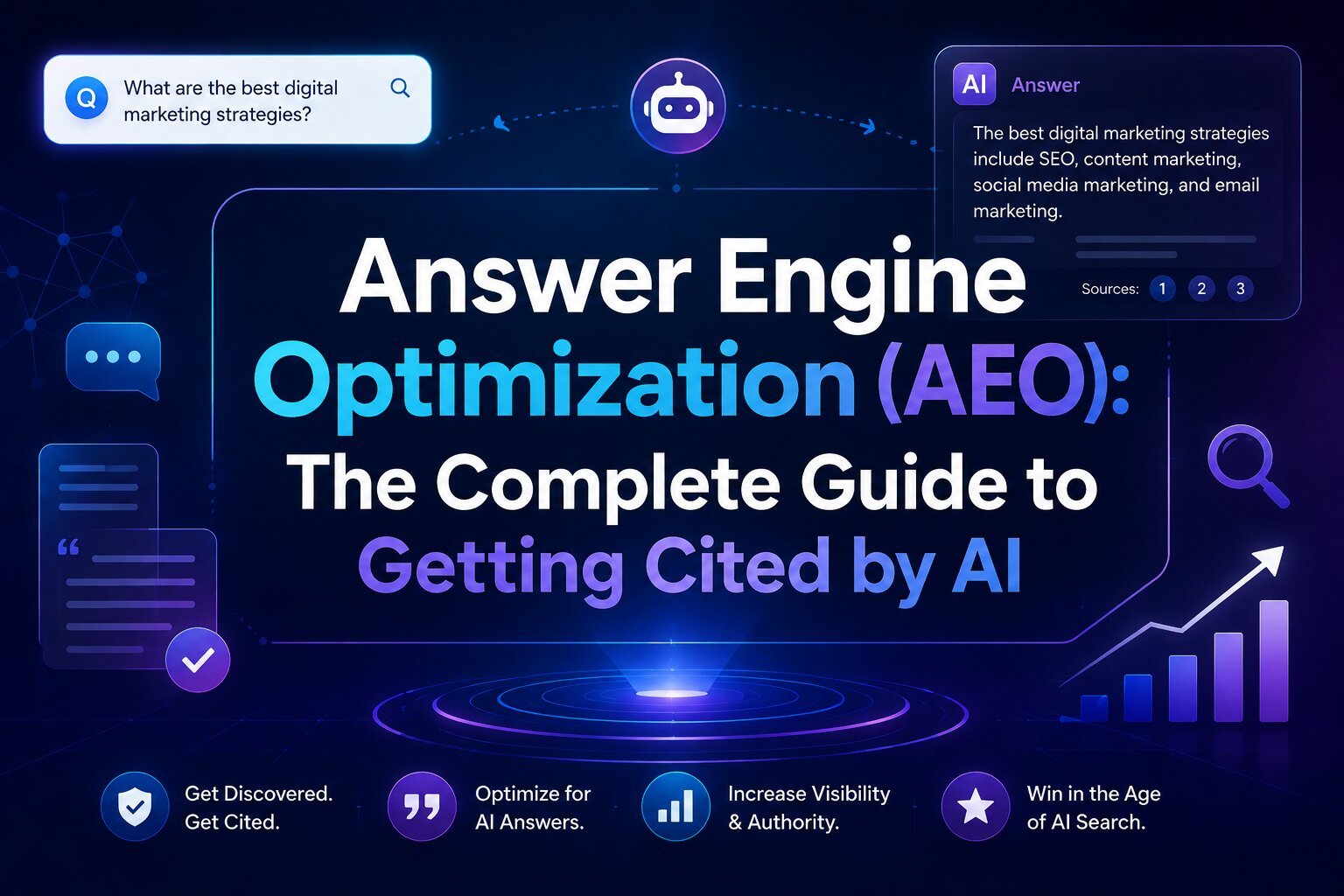
A search results page used to be the finish line. Now, for a growing share of queries, it’s not even part of the race. Someone asks “what’s the best project management tool for a 10-person team” inside ChatGPT, or Google fires an AI Overview before a single blue link loads, and the only businesses that matter are the ones the AI actually names. Answer Engine Optimization (AEO) is the discipline built around that shift: structuring content, data, and brand signals so AI-powered answer engines — Google AI Overviews, ChatGPT, Perplexity, Gemini, Copilot, and voice assistants like Siri and Alexa — choose to cite you directly, instead of someone else.
This guide covers what AEO actually means, how it’s genuinely different from SEO and GEO (not just a rebrand of either), what the current data says about why it matters, and a practical, non-generic framework for building answer engine optimization into a content program that already has a lot on its plate.
Quick Answer: What Is Answer Engine Optimization?
Answer engine optimization (AEO) is the practice of structuring content so it can be directly extracted, quoted, or cited by AI-powered answer engines and voice assistants when they respond to a user’s question. Where traditional SEO competes for a ranked position in a results page, AEO competes to become the actual answer — the sentence an AI reads back to the user, along with the source it credits. AEO strategy centers on direct-answer content structure, schema markup, semantic HTML, evidence-backed claims, and cross-platform brand consistency, and its success is measured through citation frequency and AI share of voice rather than keyword rankings alone.
Why Answer Engine Optimization Matters Right Now
The scale of the shift toward answer-first search is no longer theoretical — it’s showing up clearly in usage data.
By early 2026, roughly a quarter of Google searches were triggering an AI Overview, based on a large-scale study spanning nearly 22 million search queries. Separately, AI-powered search visits grew by close to 43% year over year — climbing from around 15.6 billion to 27.4 billion visits between Q1 2025 and Q1 2026 — while traditional Google search visits grew only marginally over the same period. The ratio of people using traditional search versus AI-powered search tools has been narrowing steadily as a result.
The click-through impact is measurable too. Research from Ahrefs found that AI Overviews can reduce the organic click-through rate for a page ranking in position one by more than half. But the flip side matters just as much: brands that do get cited inside an AI-generated answer tend to see meaningfully higher organic and paid click volume than brands whose content is technically indexed but never referenced by name.
There’s also a quality argument, not just a volume one. According to Semrush’s analysis of AI-referred traffic, visitors arriving through AI search convert at roughly 4.4 times the rate of the average organic search visitor. A separate 2026 benchmark study of B2B technology firms found AI-referred visitors converting at 14.2%, compared to 2.8% for Google organic traffic — and while AI traffic made up a small share of total sessions, it accounted for a disproportionate share of qualified inbound pipeline. This pattern shows up anecdotally too: some publishers have reported meaningful revenue growth even as raw website traffic declined, suggesting that people aren’t consuming less information — they’re consuming more of it inside the AI interaction itself, and arriving at websites later and more decisively.
AEO vs. SEO vs. GEO: Untangling Three Overlapping Terms
These three terms get used almost interchangeably in casual conversation, but they describe genuinely different — if overlapping — objectives.
| Dimension | SEO | AEO | GEO |
|---|---|---|---|
| Primary goal | Rank a page in search results | Get directly cited inside an AI-generated answer | Shape how a brand is represented across generative AI outputs broadly |
| Main surface | Search engine results pages | AI Overviews, answer boxes, featured snippets, voice assistants | AI chatbots, conversational search engines, research assistants |
| Content priority | Keyword relevance, backlink volume | Direct, quotable, structured answers | Comprehensive, citable, contextual authority |
| Success metric | Rankings, organic traffic, CTR | Citation frequency, answer box captures, AI referral traffic | AI mention frequency, share of voice, brand accuracy across platforms |
| User outcome | Visit the website | Read the answer, possibly without visiting | Trust and consider the brand, even without a direct click |
In practice, ranking well in traditional search still matters for AEO — most content cited inside AI Overviews already performs reasonably well organically. But ranking first no longer guarantees citation, and a page can hold the top organic position while going completely unmentioned in the AI-generated summary sitting above it. There’s effectively no “second prize” in an answer box: for a given query, your content is either the cited source or it’s invisible to that specific answer.
The realistic takeaway for most content teams isn’t to build three separate strategies. It’s to build one program — technically sound, genuinely authoritative, clearly structured — that happens to satisfy SEO, AEO, and GEO requirements simultaneously, since the underlying qualities they all reward overlap substantially.
How Answer Engines Actually Decide What to Cite
Several consistent patterns have emerged from citation research, and they point to specific, actionable choices rather than vague “write good content” advice.
Structure outperforms prose. Tables, numbered steps, and bulleted comparisons get extracted far more reliably than the same information buried in narrative paragraphs, because they’re already segmented into the kind of discrete, self-contained units a retrieval system can lift cleanly.
Evidence increases citation odds. Content backed by concrete statistics and direct quotations tends to be favored over content making the same claims without support — one industry visibility study found that adding statistics increased AI citation likelihood by roughly 22%, and adding quotations by around 37%, compared to otherwise similar content without them.
Placement matters more than most writers assume. Analysis of ChatGPT citation patterns found that a large share — around 44% — of cited passages came from the first third of a page’s text. Content that saves its most direct, quotable answer for deep in the page gives the model less reason to extract and credit it.
Confident phrasing gets quoted more. Cited passages are reportedly close to twice as likely to use direct, unhedged language (“X causes Y”) rather than heavily qualified phrasing (“X may potentially contribute to Y in some cases”). This doesn’t mean overstating certainty where genuine nuance exists — it means stating what you actually know plainly, and reserving hedged language for what’s genuinely uncertain.
Freshness drives crawl priority. A large share of AI crawler activity — commonly cited around two-thirds — targets content published or substantively updated within roughly the past year, reinforcing that a “publish once and forget it” approach underperforms in answer engine environments even more than it does in traditional SEO.
Top-10 rankings no longer guarantee citation. Where AI-cited sources once tracked closely with top-10 organic rankings, that correlation has been weakening — some analyses now put the share of AI-cited URLs actually coming from a query’s top 10 organic results well under half. This reinforces that AEO requires distinct, purpose-built content decisions rather than simply waiting for strong SEO to translate automatically.
The Four Search Intents Behind Every AEO Query
Effective AEO starts with understanding why someone is asking a question, not just what they’re asking. Most queries fall into one of four intent categories:
- Informational intent — the user wants to understand something (“how does compound interest work,” “what is answer engine optimization”). Content here should lead with a direct, standalone definition or explanation.
- Navigational intent — the user is trying to reach a specific destination (“Slack login,” “[brand name] pricing page”). AEO has limited influence here beyond ensuring your own branded assets are unambiguous and correctly indexed.
- Transactional intent — the user is ready to act (“buy noise-cancelling headphones online,” “sign up for project management software”). Answer-ready content should make the next step obvious alongside the direct answer.
- Commercial investigation intent — the user is comparing options before deciding (“best CRM for a 10-person sales team,” “AEO vs SEO vs GEO”). This is where structured comparisons, tables, and clearly stated trade-offs perform best, since answer engines frequently synthesize comparative queries into side-by-side summaries.
A practical technique for understanding intent at scale is reverse-engineering current answer patterns: type your priority questions directly into ChatGPT, Perplexity, and Google’s AI Overview, and study how they currently respond — what structure they use, which sources they cite, and what specific phrasing they favor. This tells you, empirically, what “a good extractable answer” looks like for your exact topic today, rather than guessing from general best practices alone.
On-Site AEO: Structuring Content So It Can Be Extracted
On-site answer engine optimization covers everything within your direct control — the content itself and the technical scaffolding around it.
- Lead with a direct-answer capsule. Open the page or section with a concise, self-contained answer — commonly recommended in the 40-to-60-word range — before expanding into supporting detail. This capsule should make sense read entirely on its own, since that’s frequently what gets extracted.
- Use question-based headings. Structure sections around the actual phrasing a user would type or speak, not abstract topic labels — “How much does local SEO cost for a small business?” extracts more cleanly than a generic heading like “Pricing Considerations.”
- Implement structured data deliberately. FAQPage, HowTo, Product, LocalBusiness, and Organization schema all help answer engines parse what type of content they’re looking at and extract it with the correct context. Schema should describe content that’s genuinely present and visible on the page — not content that exists only in the markup.
- Build strong internal linking. A common practical benchmark is three to five contextual internal links per URL, connecting related answers and reinforcing topical relationships that help both crawlers and readers navigate related questions.
- Treat semantic HTML and accessibility as AEO infrastructure, not a separate initiative. This is a genuinely underrated connection: proper heading hierarchy, descriptive alt text, and clean semantic markup serve screen readers and AI extraction systems in nearly identical ways. A site that’s been optimized for accessibility compliance is, almost as a byproduct, better structured for answer engine extraction — fixing one class of issue tends to fix the other.
- Support claims with real evidence. Named sources, specific statistics, and properly attributed quotations all increase both credibility and extractability. Avoid vague claims an answer engine has no specific detail to quote.
Off-Site AEO: Building the Footprint Answer Engines Trust
Content on your own site is only part of the picture. Off-site signals shape whether an AI system treats you as a credible enough source to cite in the first place.
- Earn backlinks from genuinely relevant, credible sources, since link profiles remain a meaningful trust signal even in an AI-mediated search environment.
- Maintain accurate local listings if location matters to your business — inconsistent name, address, or phone information across directories undermines the kind of entity clarity answer engines rely on.
- Manage reviews and user-generated validation actively. Reviews, testimonials, and community discussion — including on platforms like Reddit — function as external validation signals that can influence how confidently an AI system represents your brand.
- Pursue consistency across multiple authoritative sources. A brand described the same way, with the same core facts, across several independent, credible sites builds the kind of cross-source agreement that answer engines appear to treat as a trust signal — inconsistent claims about your own product across different sources can actively work against you.
Voice Search: The Original Answer Engine
Voice search optimization is often treated as its own category, but it’s more accurate to think of it as AEO’s oldest subset. Voice queries are inherently conversational and longer than typed searches — closer to “what’s the best beginner yoga pose for lower back pain” than “yoga poses back pain” — which makes the same direct-answer, question-based structure that serves AI Overviews and chatbot citations equally valuable for voice assistant results. Because a large share of voice queries carry local intent, ensuring accurate local business information and location-specific content remains a meaningful part of a complete AEO strategy, alongside the mobile responsiveness and fast load times voice interactions depend on.
The Monitoring Gap: Why Your Existing Tools Can’t See This
Here’s a structural problem most content and marketing teams run into almost immediately: Google Search Console and traditional rank-tracking tools were built to measure position in a results page. They have no visibility into whether ChatGPT is recommending your product, whether Perplexity is summarizing your content accurately, or whether Gemini just cited a competitor instead of you for a query central to your business.
This creates what’s sometimes called a monitoring gap — a real disconnect between what your measurement infrastructure can see and what’s actually happening to your content inside AI-generated answers. Closing it requires a different kind of process: running the same priority questions across ChatGPT, Perplexity, Gemini, and Google’s AI experiences on a recurring basis, documenting who gets cited, noting where your brand is described inaccurately, and treating that as a baseline to track over time — either manually or through a dedicated AI visibility monitoring tool built for this specific purpose.
Skipping this step and jumping straight to content optimization is a common mistake. Without a monitoring baseline, there’s no way to know whether a content change actually improved citation frequency or whether any apparent change was just normal variance in how these systems respond from one query to the next.
Measuring AEO Success: Metrics That Actually Apply
Because there’s no stable “rank” in an AI-generated answer, AEO measurement has to look past traditional SEO metrics toward a different set of indicators:
- Citation frequency — how often your brand or content is referenced across a defined set of priority questions, tracked over time rather than as a single snapshot.
- AI share of voice — how your citation frequency compares to competitors’ for the same category of queries.
- Answer box and featured snippet captures — a more traditional but still relevant metric for Google-specific answer surfaces.
- AI referral traffic — sessions arriving from AI platforms, ideally isolated into its own tracked channel rather than blended into general referral or direct traffic, since much of it can otherwise go unattributed.
- Answer accuracy — whether, when you are cited, the AI is representing your product, pricing, or claims correctly. This is easy to overlook but matters enormously, since an inaccurate but confident AI-generated answer can actively damage a brand’s credibility.
AEO for Regulated and Enterprise Brands: The Compliance Dimension
For businesses in healthcare, financial services, and other regulated categories, AEO carries a layer of risk that goes beyond simply losing visibility to a competitor. When an answer engine inaccurately describes what a financial product covers, misstates a medical treatment’s risks, or oversimplifies a regulated claim, the brand associated with that information carries real reputational and potentially legal exposure — regardless of whether the brand itself ever published the inaccurate version. This isn’t a hypothetical concern: dozens of U.S. states introduced AI-related healthcare legislation in 2025 alone, much of it focused specifically on disclosure and accuracy requirements.
For these industries, AEO reasonably becomes a cross-functional responsibility rather than a marketing-only initiative — involving content teams to structure answer-ready material, technical teams to implement and maintain schema markup correctly, analytics teams to build monitoring infrastructure, and compliance or legal teams to review how the brand is being represented in AI-generated summaries on an ongoing basis, not just at launch.
Common AEO Challenges Worth Setting Expectations About
AEO isn’t a guaranteed-results tactic, and it’s worth being direct about its limitations:
- No citation is guaranteed. Answer engine selection criteria change frequently and aren’t publicly documented in full, so no single tactic reliably secures a citation for a given query.
- Direct answers can reduce click volume even when they help visibility. If an AI Overview or voice assistant delivers your answer directly, the user may never click through to your site — visibility and traffic aren’t the same outcome, and businesses need to decide which one matters more for a given piece of content.
- Results take time to materialize. Early, modest citation gains sometimes appear within a few weeks of structural changes, but meaningful, consistent citation presence more typically develops over several months of sustained effort.
- Small businesses aren’t automatically disadvantaged. Local expertise and genuinely specific, well-answered niche questions can outperform larger, more generic competitors in answer engine citations — domain size alone isn’t the deciding factor the way backlink volume historically was in traditional SEO.
A Practical AEO Action Plan
Step 1 — Establish your monitoring baseline. Before changing anything, run your top 15-20 priority questions across ChatGPT, Perplexity, Gemini, and Google AI Overviews. Document who’s currently cited and where your brand is missing or misrepresented.
Step 2 — Prioritize based on gaps, not guesses. Focus first on high-value questions where you’re currently absent but a competitor is consistently cited, and on questions your audience clearly asks but your existing content doesn’t answer directly at all.
Step 3 — Restructure for extraction. Rewrite priority pages with direct-answer capsules up top, question-based subheadings, tables for comparative data, and properly matched schema markup.
Step 4 — Strengthen the evidence layer. Add specific statistics, named sources, and relevant quotations to claims that are currently unsupported or vague.
Step 5 — Extend beyond your own site. Pursue relevant backlinks and digital PR, keep local listings and reviews accurate and current, and check that your brand is described consistently across the other authoritative sources that mention it.
Step 6 — Re-run your monitoring baseline on a recurring schedule. Treat this as ongoing measurement, not a one-time audit — track citation frequency and accuracy changes over weeks and months, and adjust based on what the data actually shows rather than assumptions about what should be working.
Frequently Asked Questions
Is AEO the same as SEO? No. Traditional SEO optimizes content to rank as a link in a search results page; AEO optimizes content to be directly cited inside an AI-generated answer. They share technical foundations — crawlability, authority, quality content — but success is measured differently: SEO by rankings and clicks, AEO by citation frequency and AI share of voice.
Does AEO replace SEO? No, and it’s unlikely to anytime soon. Traditional search still drives the majority of discovery for most businesses, and strong SEO fundamentals directly support AI citation eligibility. The more realistic framing is that AEO extends SEO into a new surface, rather than replacing it.
What’s the difference between AEO and GEO? AEO generally targets specific, structured answer formats — featured snippets, answer boxes, voice responses, direct AI citations for a defined question. GEO is the broader discipline of shaping how generative AI systems represent a brand across conversational, synthesized outputs more generally, including cases where no direct link or citation is shown at all. In practice, the two overlap heavily and are usually pursued together.
How is AEO different from voice search optimization? Voice search optimization is essentially a subset of AEO focused specifically on spoken, conversational queries and voice assistant responses. AEO is the broader category, covering featured snippets, AI Overviews, chatbot citations, and voice results together.
How long does it take to see AEO results? Early, modest improvements in answer visibility sometimes appear within a few weeks of structural changes, but consistent, meaningful citation growth typically takes several months of sustained work, since answer engines continuously reassess sources and citation patterns shift over time.
How do I measure whether my AEO efforts are working? Track citation frequency and accuracy across your priority questions on a recurring basis, monitor AI-specific referral traffic as its own tracked channel, and compare your citation presence against competitors for the same query set — traditional rank tracking alone won’t capture this.
Can small businesses compete in answer engine optimization? Yes. Specific, well-answered local or niche expertise frequently outperforms larger, more generic competitors in AI citation, since answer engines are looking for the clearest, most directly useful answer to a specific question rather than simply the largest or most authoritative domain overall.
Do I need special tools to track AEO performance? Not strictly — manually running priority questions across major AI platforms on a schedule can build a workable baseline. Dedicated AI visibility monitoring tools make this more scalable by tracking citation frequency, competitor comparisons, and brand sentiment automatically, which becomes more valuable as the number of priority queries and platforms grows.
Conclusion
Answer engine optimization isn’t a rebrand of SEO, and it isn’t a separate, competing discipline requiring an entirely new content team. It’s a distinct set of requirements — direct-answer structure, evidence-backed claims, semantic clarity, cross-platform consistency, and dedicated monitoring — layered on top of the SEO fundamentals most content programs already have. The businesses that adapt fastest won’t be the ones chasing every new acronym; they’ll be the ones who start actually measuring what AI systems currently say about them, and treat that gap — between what’s true and what the machine is telling users — as the thing worth closing first.