
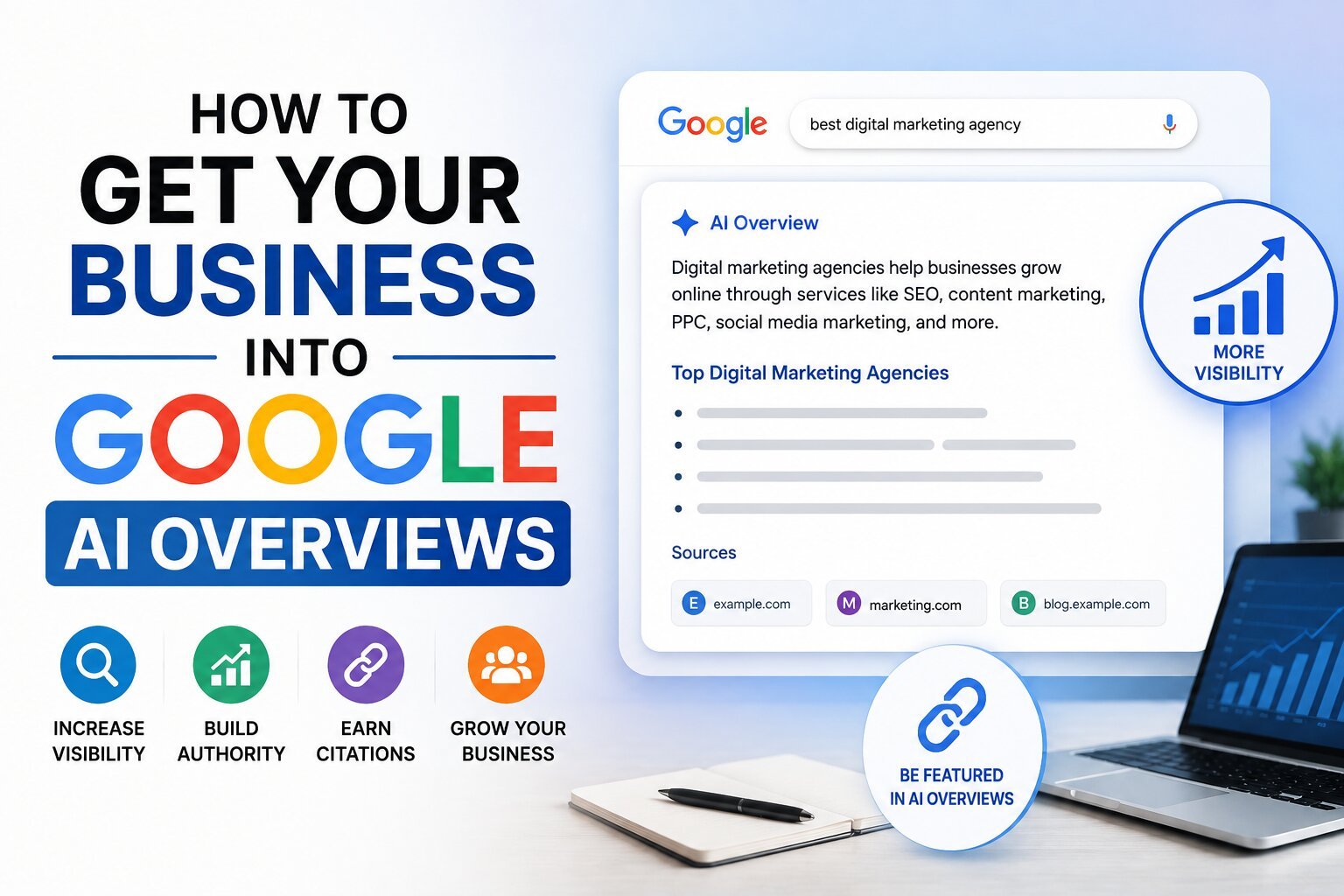
You search for a product, a service, or a question related to your own industry, and instead of ten blue links, Google shows a generated summary at the top of the page — with a handful of sources cited underneath. Your competitor is one of them. You aren’t.
That single moment has become one of the most common frustrations in modern SEO. Businesses that have spent years building solid rankings are watching a new layer appear above those rankings, and they don’t have a clear playbook for it. Some agencies are selling “AI Overview optimization” as if it’s a separate discipline with its own secret checklist. Others are telling clients to add exotic files or rewrite every page in bullet points to please the AI.
Here’s what actually matters: Google has published official guidance on this, and it’s more straightforward — and more demanding — than most of the shortcuts being sold. There is no separate ranking system to game. There is a foundation to strengthen, and a specific way that foundation gets used differently than it used to be.
This article walks through how AI Overviews actually work, what Google has explicitly confirmed and denied, and what a business can realistically do to improve its odds of being included.
Quick Answer
There’s no dedicated submission process, special file, or unique markup that gets a business into Google AI Overviews. According to Google’s own documentation, a page must meet the same core requirements as ranking in classic Search — it needs to be crawlable, indexed, and eligible to appear with a normal snippet — and there are no additional technical requirements beyond that. What changes is how content gets used once it clears that bar: AI Overviews pull from multiple pages at once using a technique called query fan-out, favor content that directly and clearly answers a specific question, and don’t guarantee inclusion even for well-ranked pages, since Google states indexing and serving are never guaranteed. The rest of this article breaks down what that means in practice, what actually moves the needle, and what to ignore.
What Are Google AI Overviews and How Do They Actually Work?
AI Overviews are the AI-generated summaries that appear above traditional search results for certain queries. They’re built using retrieval-augmented generation (RAG) — instead of relying purely on a model’s internal training knowledge, the system retrieves current information from Google’s search index and uses it to construct the answer, then attaches links to the pages it drew from.
Google’s own documentation describes the underlying mechanism as a “query fan-out” technique: rather than running a single search, the system issues multiple related searches across different subtopics and data sources, then synthesizes a response from what it finds. This is a meaningful detail, because it means a single AI Overview isn’t built from one search result page — it can pull from a much wider set of pages than a person would ever see on a traditional results page. Google explicitly notes that this lets it display “a wider and more diverse set of helpful links” than classic search typically shows for a single query.
AI Overviews don’t appear on every search. Google states they’re only shown when its systems determine the feature is additive to classic Search — meaning many queries, especially very simple or purely navigational ones, won’t trigger an AI Overview at all, no matter how well-optimized a site is.
The Official Answer: What Google Says About Getting Into AI Overviews
This is worth stating plainly, because it cuts against a lot of what gets sold as “AI Overview SEO.” In its official guidance for site owners, Google states directly: “There are no additional requirements to appear in AI Overviews or AI Mode, nor other special optimizations necessary.”
The technical bar is specific and limited: to be eligible to be shown as a supporting link, a page must be indexed and eligible to appear in regular Google Search with a snippet, meeting the standard Search technical requirements. Google is explicit that there are no additional technical requirements beyond that.
Google also directly addresses several tactics being marketed as AI-specific fixes:
- No new machine-readable files are needed. You don’t need to create an
llms.txtfile or any equivalent — Google doesn’t require it and doesn’t document special treatment for it. - No special schema.org markup exists for AI Overviews. Structured data still needs to match the visible content on the page (a general SEO requirement), but there’s no AI-specific structured data type to add.
- No unique formatting is required. Some GEO advice recommends breaking every page into extremely short paragraphs so an AI model can “read” it more easily. Google’s systems are built to identify relevant passages within longer, naturally structured pages covering multiple topics — there’s no single “ideal format” made specifically for AI retrieval.
What does still apply are the same foundational SEO best practices Google has always recommended: crawlability in robots.txt and hosting infrastructure, content that’s easily findable through internal links, a solid page experience, important content available in genuine textual form (not locked in images or inaccessible scripts), and accurate structured data and business information where relevant.
Why This Confuses So Many Businesses
If the requirements are “the same SEO fundamentals,” why does it feel like an entirely different game? Two reasons.
First, being eligible and being selected are different things. Meeting the technical bar gets a page into the pool of candidates a model can draw from — it doesn’t guarantee the model will use it. Google is explicit that indexing and serving are never guaranteed, even for pages that meet every requirement and follow every best practice.
Second, the selection process behaves differently than traditional ranking. Traditional SEO is largely a single-query, single-ranking-list exercise: a page competes against other pages for the same keyword. Query fan-out means a business might get cited in an AI Overview not because it ranked #1 for the exact phrase someone typed, but because one of its pages answered a related subtopic that the system searched for while building the answer. This is why a business can occasionally see AI Overview citations on pages that don’t rank particularly high in classic search for the visible query — and why a page that ranks #1 traditionally isn’t automatically guaranteed a citation either.
The Real Foundation: Why Ranking Well Still Matters (But Isn’t Enough on Its Own)
It’s tempting to conclude from “query fan-out sometimes pulls from lower-ranked pages” that traditional ranking no longer matters. That’s an overcorrection. Independent analyses of AI Overview citations have generally found that pages ranking well in classic organic search still make up a substantial share of what gets cited — though that share has been shifting as the systems mature, with a growing minority of citations coming from pages further down the results or outside the top 100 for the visible query, often because they answer a specific subtopic well.
The practical takeaway: strong organic rankings meaningfully increase your odds of being pulled into an AI Overview, but they aren’t a guarantee, and being ranked well for your primary keyword doesn’t mean you’ll be cited for every related question that a fan-out search might generate. Topical depth — having strong content across the full range of subtopics connected to a query — increasingly matters as much as ranking position on any single term.
The 6 Factors That Actually Influence Inclusion
None of these are a confirmed ranking formula — Google hasn’t published one, and no legitimate source can claim otherwise. But based on Google’s own documentation and how the system is described to function, these are the areas worth focusing on.
1. Basic eligibility. The page must be indexed, crawlable, and capable of appearing with a normal snippet in classic Search. If a page fails this bar, it can never appear in an AI Overview, regardless of content quality.
2. Direct, extractable answers. Content that answers a specific question clearly, near the top of the relevant section, is easier for a retrieval system to identify as a strong candidate passage. This doesn’t mean rewriting your whole site into fragmented one-line paragraphs — Google explicitly says its systems can find relevant passages inside normal, longer pages. It means making sure the actual answer to a likely question isn’t buried under three paragraphs of preamble.
3. Topical breadth around a subject. Because fan-out issues multiple related searches, a site with genuine depth across a topic — not just one page targeting one keyword — has more surface area to be pulled into different parts of an AI Overview’s synthesis.
4. Content accessible in text form. Google’s guidance specifically flags making sure important content is available in textual form, not locked behind interfaces that require interaction, or delivered only through images or inaccessible scripts.
5. Accurate supporting data. For ecommerce and local businesses, Google specifically calls out keeping Merchant Center and Business Profile information current, since these feed into how AI features represent products and local businesses.
6. Page experience and technical health. Standard technical SEO — page speed, mobile usability, clean crawlability — remains part of the foundation, because a page that struggles to meet basic Search requirements never becomes eligible in the first place.
Query Fan-Out in Practice: An Example
Example — “CloudLedger,” a fictional SaaS accounting tool. A user searches “best accounting software for freelancers.” Instead of matching that single phrase to a single best-ranking page, the system might fan out into related searches: “accounting software freelancer tax features,” “invoicing tools for freelancers,” “accounting software pricing comparison,” and “freelancer bookkeeping mistakes.”
CloudLedger doesn’t need to rank #1 for the exact phrase “best accounting software for freelancers” to get cited. If it has a strong, specific page comparing invoicing features for freelancers, and a separate page addressing common freelancer bookkeeping mistakes, either one could be pulled into the synthesized answer — even if CloudLedger’s homepage ranks below three competitors for the original broad phrase. This is why topical breadth, not just one hero page optimized for one keyword, increasingly determines visibility.
Common Mistakes Businesses Make Chasing AI Overviews
Mistake 1: Publishing an llms.txt file expecting preferential treatment. Why it doesn’t work: Google has stated it doesn’t require this file and gives it no documented special treatment in AI features. What to do instead: invest that time in strengthening actual page content and technical crawlability, which are the things Google confirms it evaluates.
Mistake 2: Rewriting entire pages into fragmented one-sentence paragraphs. Why it doesn’t work: Google’s systems are designed to extract relevant passages from normal, well-structured longer content. Breaking everything into disconnected fragments can actually hurt readability and page quality for human visitors without any confirmed AI benefit. What to do instead: keep content naturally structured, but make sure the direct answer to likely questions appears clearly, not buried three paragraphs deep.
Mistake 3: Adding AI-specific schema markup that doesn’t exist. Why it doesn’t work: there’s no dedicated schema type for AI Overviews. What to do instead: keep structured data accurate and matched to visible page content — the same general rule that’s always applied to schema, AI feature or not.
Mistake 4: Assuming one high-ranking page is enough. Why it doesn’t work: query fan-out draws from multiple related searches, not just the one visible query. A single optimized page misses the subtopic searches happening behind the scenes. What to do instead: build topical depth — a cluster of pages addressing the full range of related questions, not one page trying to cover everything.
Mistake 5: Trying to manufacture brand mentions or fake citations to seem more “citable.” Why it doesn’t work: this crosses into manipulation, and manipulating AI-generated answers has become explicitly treated as a spam violation under Google’s policies. What to do instead: pursue real editorial coverage and genuine third-party recognition, the same way legitimate authority has always been built.
Mistake 6: Ignoring pages that don’t rank #1 anyway. Why it doesn’t work: a page sitting at position 8 or 15 for a subtopic-level query can still be pulled into an AI Overview through fan-out, especially if it answers that subtopic more directly than higher-ranked competitors. What to do instead: audit content at the subtopic level, not just for your primary target keywords.
Step-by-Step Action Plan
Step 1 — Confirm basic eligibility
Use Search Console’s URL Inspection tool to verify your priority pages are indexed and free of crawl or snippet-blocking issues. A page that isn’t eligible for a normal snippet can’t appear in an AI Overview.
Step 2 — Map the subtopics around your core queries
For each important topic, list the related questions a fan-out search might generate — not just your primary keyword, but the adjacent questions a real user (or an AI system building an answer) would also want covered.
Step 3 — Audit content for direct answerability
Read your top pages as if scanning for a single-sentence answer to a specific question. If the real answer is buried under generic introductions, restructure so the direct answer appears clearly near the relevant heading.
Step 4 — Close topical gaps
Where subtopics from Step 2 have no dedicated content, build it — rather than trying to cram every related question into one already-crowded page.
Step 5 — Verify textual accessibility
Confirm that important information isn’t locked in images, PDFs without extractable text, or interface elements that require clicking to reveal.
Step 6 — Keep supporting data current
If applicable, review Merchant Center feeds and Business Profile details for accuracy, since Google draws directly from these for product and local information.
Step 7 — Monitor and adjust
Since inclusion isn’t guaranteed and isn’t static, treat this as an ongoing process rather than a one-time project.
How to Measure Whether You’re Appearing in AI Overviews
Google reports AI Overview appearances within the standard Search Console Performance report, under the “Web” search type — there isn’t a separate dashboard exclusively for AI features. Track:
- Impressions and clicks in Search Console, watching for shifts tied to queries known to trigger AI Overviews in your industry.
- Click quality, not just click volume. Google has noted that clicks arriving from AI Overview-enabled results tend to reflect users spending more time on-site, so a modest traffic dip alongside stronger engagement isn’t necessarily a bad sign.
- Manual query testing for your priority topics and subtopics, logging whether an AI Overview appears, whether your site is cited, and which competitors show up instead.
- Branded vs. non-branded query performance, since AI Overviews interact differently with searches that already include your company name versus generic category searches.
What these metrics don’t tell you: a single test of a query is a snapshot, not a permanent state — AI Overviews are triggered dynamically and can change between sessions, model updates, and query phrasing.
AI Overviews vs. AI Mode vs. Other AI Search Platforms
| Platform | How It Selects Sources | Best Way to Influence It |
|---|---|---|
| Google AI Overviews | RAG over Google’s own index, using query fan-out across subtopics | Standard SEO fundamentals + direct, extractable answers + topical depth |
| Google AI Mode | Similar RAG approach, used for more exploratory, multi-step queries | Comprehensive content that supports comparisons and follow-up questions |
| ChatGPT Search | Retrieval via OpenAI’s OAI-SearchBot and web search, separate from Google’s index | Crawlability for OAI-SearchBot, clear entity information, external authority |
| Perplexity / Copilot | Each uses its own retrieval and source-selection process | Same underlying fundamentals — accessibility, clarity, and credible content |
The overlap across all of these is real: none of them replace the need for solid technical SEO, clear content, and genuine authority. SEO, AEO (answer engine optimization), GEO (generative engine optimization), and “AI SEO” are best understood as different lenses on the same underlying work, not four separate strategies competing for budget.
Frequently Asked Questions
Do I need to submit my site to Google for AI Overviews? No. There’s no separate submission process. If your site is indexed and eligible to appear in regular Search results, it’s automatically eligible to be considered for AI features.
Does ranking #1 in Google guarantee I’ll appear in AI Overviews? No. Ranking well increases your odds but isn’t a guarantee — Google states that indexing and serving are never guaranteed even when all requirements are met.
Do I need an llms.txt file? No. Google has confirmed it doesn’t require this file and gives it no documented special treatment for AI features.
Does adding more schema markup improve my chances? Only indirectly, by keeping your existing structured data accurate and matched to visible content — there’s no AI-Overview-specific schema type to add.
Why does my competitor appear for a search where I outrank them? Likely query fan-out: the AI Overview may be drawing from a subtopic-level page your competitor has covered more directly, even if you outrank them on the primary visible query.
Do AI Overviews reduce my organic traffic? Traffic patterns can shift when an AI Overview appears, since some users get their answer without clicking through. Businesses cited within the Overview, however, have generally seen the opposite effect on the clicks they do receive.
Is GEO a replacement for SEO? No. Google’s own guidance treats AI feature eligibility as an extension of standard SEO fundamentals, not a separate discipline requiring its own tactics.
How long does it take to start appearing in AI Overviews? There’s no fixed timeline, and Google notes that recrawling and reprocessing changes can take anywhere from days to months depending on how frequently a page is revisited.
Can small businesses appear in AI Overviews? Yes. Since fan-out pulls from many subtopic-level pages, a smaller site with genuinely specific, well-answered content on a narrow subtopic can be cited alongside much larger competitors.
How do I track AI Overview appearances over time? Use Search Console’s Performance report alongside manual, repeated query testing for your priority topics, logging results over time rather than relying on a single check.
Conclusion
The businesses treating “getting into AI Overviews” as a separate system to hack are chasing something that, by Google’s own account, doesn’t exist. The businesses making real progress are the ones treating it as what it actually is: the same SEO fundamentals, applied with more attention to how content gets used once a machine — not just a human — is scanning it for a direct, specific answer.
That means prioritizing genuine crawlability and indexing, building topical depth instead of single hero pages, making sure answers are clear and extractable without needing false structural gimmicks, and being honest that inclusion can’t be guaranteed no matter how well any of this is executed. It also means resisting the tactics being sold as shortcuts — special files, manufactured mentions, and fragmented formatting — that Google has already stated don’t do what they’re claimed to do.
This overlaps directly with SEO, AEO, GEO, and AI SEO more broadly, because none of these are separate battles. SEO Digix works with businesses on exactly this kind of foundational search visibility — technical SEO, content strategy, and topical authority — the work that continues to determine whether a business shows up, in classic Search results and in the AI-generated answers increasingly sitting above them.




What do you think?
[…] someone types “best accountant for small business in Chicago” into ChatGPT or gets a Google AI Overview instead of ten blue links, there’s no scrolling involved. The AI tool has already picked a […]
[…] search tools — Google AI Overviews, ChatGPT, Gemini, Claude, Perplexity — increasingly generate direct answers and recommendations […]
Comments are closed.