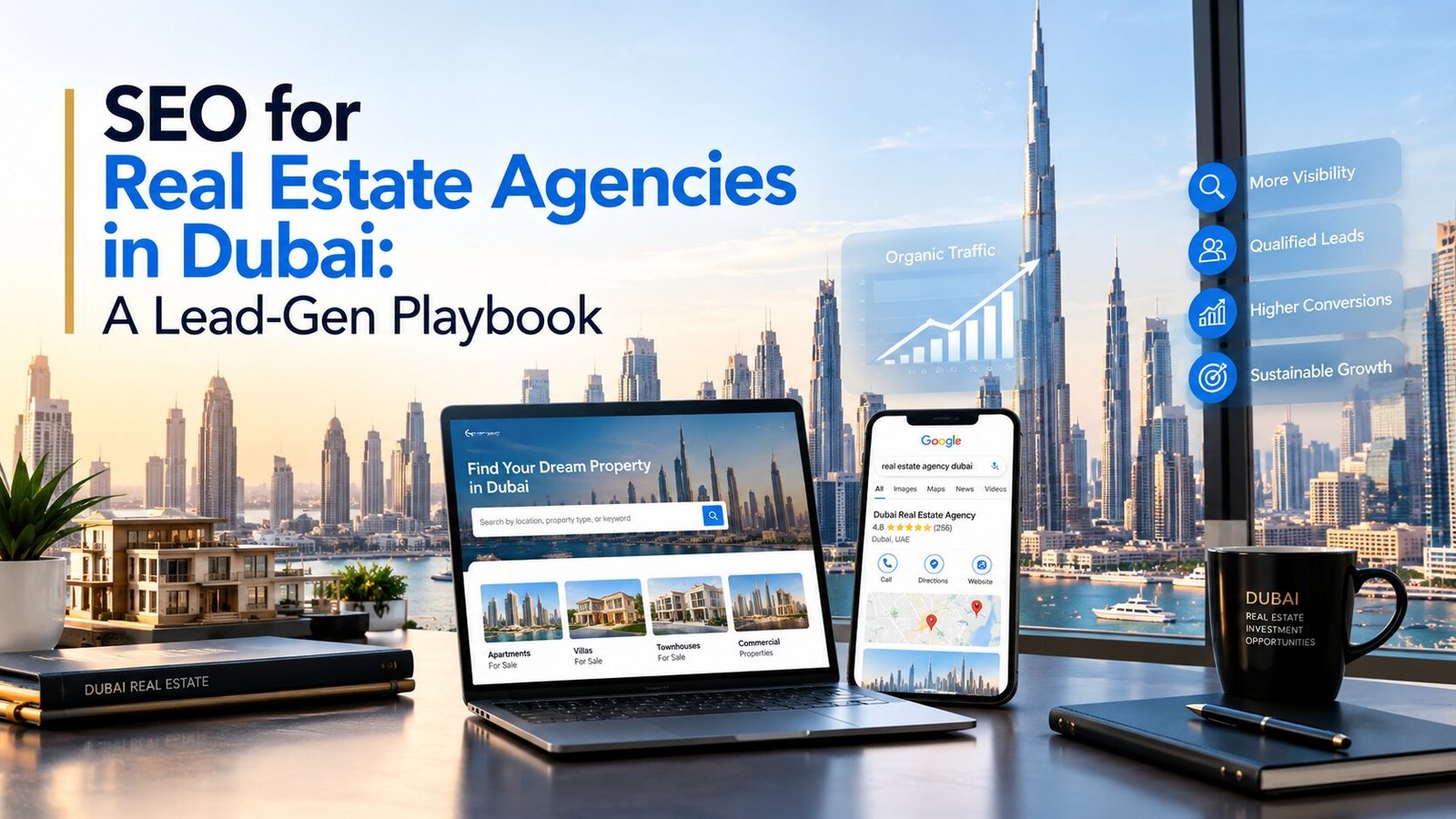
Most Dubai real estate agencies run on borrowed traffic. Property Finder and Bayut generate the leads, agencies pay for the privilege, and the moment the subscription lapses, the pipeline goes with it. That’s a fragile way to build a business. SEO is the alternative — a channel an agency actually owns, where visibility compounds over time instead of resetting every renewal cycle.
This playbook is built for agency owners, brokers, and marketers who want a genuine, sustainable source of organic leads alongside — not necessarily instead of — portal traffic. It covers the full framework: research, technical foundations, content, local SEO, link building, conversion, and a 90-day plan to actually execute it.
Table of Contents
ToggleWhy SEO Matters for Real Estate Agencies in Dubai
Cost, ROI, and Lead Quality
| Factor | SEO | Google Ads | Property Portals |
|---|---|---|---|
| Cost structure | Upfront investment, low marginal cost over time | Pay per click, ongoing | Subscription or per-lead fee, ongoing |
| Traffic stops when spend stops | No | Yes | Yes |
| Lead ownership | Full — your site, your data | Full | Shared — same lead often sold to competitors |
| Long-term ROI | High, compounds over time | Moderate, resets each month | Moderate, capped by portal terms |
| Brand building | Strong — builds your agency’s authority | Limited | Minimal — portal brand dominates |
| Time to results | Slower (months) | Immediate | Immediate |
Portal leads have a structural problem: the same lead is often sold to multiple competing agencies simultaneously, meaning you’re not just competing for the property, you’re racing other agents for the exact same inquiry. SEO leads that come directly to your website are yours alone.
SEO also builds a compounding asset. A well-ranked area guide or property page keeps generating inquiries months or years after it’s published, at zero incremental cost. Paid ads and portal subscriptions offer none of that residual value.
Understanding Dubai Real Estate Search Intent
Buyers and renters move through three broad intent stages, and your content needs to address each one differently.
Informational searches happen early in the journey — “is Dubai a good place to invest in property,” “how does off-plan payment work in Dubai.” These buyers aren’t ready to transact, but they’re forming the opinions that shape their eventual decision.
Commercial searches reflect active comparison — “best areas to buy apartment Dubai,” “Dubai Marina vs JBR for investment.” These searchers are evaluating options and increasingly close to reaching out.
Transactional searches signal high, immediate intent — “apartments for sale Dubai Marina,” “villa for rent Arabian Ranches,” “off-plan properties Downtown Dubai.” These are the searches that convert fastest into genuine inquiries.
A strong SEO strategy builds content across all three stages — not just transactional listing pages, which are the most competitive and hardest to rank without supporting authority content behind them.
The Real Estate SEO Lead Generation Framework
A structured approach, in order:
- Market Research — understand which areas, property types, and buyer segments represent your actual business focus, and size the search demand around them.
- Competitor Analysis — identify which agencies and portals currently rank for your priority keywords, and assess the content and authority gaps you can exploit.
- Keyword Research — build a full keyword map across informational, commercial, and transactional intent, organized by area and property type.
- Content Strategy — plan area guides, investment guides, and listing pages that address each stage of buyer intent.
- Technical SEO — ensure your website’s foundation (speed, crawlability, mobile experience) supports ranking at scale.
- Local SEO — optimize for location-based visibility, particularly for buyers searching with a specific area or neighborhood in mind.
- Authority Building — earn backlinks and citations that build topical and domain authority over time.
- Conversion Optimization — ensure the traffic you earn actually converts into genuine inquiries, not just page views.
Each stage feeds the next. Skipping technical SEO undermines even the best content strategy; skipping conversion optimization wastes the traffic you’ve worked to earn.
Keyword Strategy for Dubai Real Estate Agencies
| Keyword | Search Intent | Funnel Stage | Lead Potential |
|---|---|---|---|
| “is Dubai Marina a good investment” | Informational | Top of funnel | Low-medium, builds trust |
| “Dubai Marina vs Downtown for investment” | Commercial | Middle of funnel | Medium |
| “apartments for sale Dubai Marina” | Transactional | Bottom of funnel | High |
| “off-plan projects Downtown Dubai” | Transactional | Bottom of funnel | High |
| “Palm Jumeirah villa prices 2026” | Commercial/Informational | Middle of funnel | Medium |
| “villas for sale Palm Jumeirah” | Transactional | Bottom of funnel | High |
| “JVC apartments for rent” | Transactional | Bottom of funnel | High |
| “is JVC a good area to live” | Informational | Top of funnel | Low-medium, builds trust |
| “Business Bay off-plan payment plans” | Commercial | Middle of funnel | Medium-high |
| “Arabian Ranches villas for sale” | Transactional | Bottom of funnel | High |
The highest-potential strategy isn’t chasing only the highest-volume transactional terms — it’s building a complete cluster around each area, so your site captures buyers at every stage of their decision rather than only the ones already searching to buy.
Local SEO for Real Estate Agencies
Even for agencies operating city-wide, local SEO signals matter — particularly for buyers searching with a specific neighborhood or a “near me” intent for viewings and consultations.
Google Business Profile optimization should include your exact office address, complete service categories, and regularly updated photos.
NAP consistency — your name, address, and phone number — needs to match exactly across your website, Google, social platforms, and any property directories you’re listed on.
Local citations on UAE business and real estate directories reinforce legitimacy and support local ranking signals.
Review acquisition matters heavily in real estate, where trust is a major factor in a high-stakes financial decision. Actively request reviews from closed transactions.
Google Maps rankings benefit from all of the above combined, plus consistent local activity and engagement over time.
Local SEO Checklist
| Task | Priority |
|---|---|
| Complete and verify Google Business Profile | High |
| Fix NAP consistency across all platforms | High |
| Build citations on relevant UAE directories | High |
| Actively collect client reviews post-transaction | High |
| Add area-specific landing pages | Medium |
| Respond to all reviews, positive and negative | Medium |
| Monitor and correct duplicate listings | Medium |
Technical SEO Checklist
Real estate websites are often visually heavy — high-resolution property photos, virtual tours, interactive maps — which makes technical performance a common weak point.
| Technical Area | What to Check | Why It Matters |
|---|---|---|
| Core Web Vitals | Loading speed, interactivity, visual stability | Directly affects both rankings and user experience |
| Mobile optimization | Full functionality and speed on mobile devices | Majority of property searches happen on mobile |
| Crawlability | Ensure search engines can access all key pages | Prevents important listings from being missed entirely |
| Indexation | Confirm important pages are indexed, not blocked | A blocked page can’t rank, regardless of content quality |
| XML sitemaps | Updated and submitted to Search Console | Helps search engines discover new listings quickly |
| Canonical tags | Correctly implemented on similar/duplicate listings | Prevents duplicate content issues across similar property pages |
| Internal linking | Logical structure connecting related listings and guides | Distributes authority and helps users navigate naturally |
| Image optimization | Compressed, properly tagged property photos | Reduces load time without sacrificing visual quality |
| Structured data | Real estate and property schema implemented | Helps search engines understand listing details precisely |
Content Marketing Strategy
Real estate content performs best when organized into topic clusters, rather than a scattered mix of unrelated blog posts.
Area guides — comprehensive pages covering a specific neighborhood’s lifestyle, amenities, and property types.
Community pages — deeper dives into specific developments or gated communities within a broader area.
Property investment guides — content addressing ROI, rental yields, and market trends for investment-focused buyers.
Market reports — regular, data-backed updates on pricing trends, which build authority and earn natural backlinks from press and industry sites.
Off-plan project pages — dedicated pages for each major off-plan development you represent, covering payment plans, timelines, and developer details.
Buyer and seller guides — practical, process-focused content addressing the mechanics of a transaction in Dubai specifically.
Example Content Cluster: Dubai Marina
- Pillar page: “Dubai Marina Real Estate Guide”
- Supporting page: “Apartments for Sale in Dubai Marina”
- Supporting page: “Is Dubai Marina a Good Investment in 2026?”
- Supporting page: “Dubai Marina vs JBR: Which Is Better for Buyers?”
- Supporting page: “Best Off-Plan Projects in Dubai Marina”
Each supporting page links back to the pillar page and to each other where relevant, building both topical authority and a clear navigation path for both users and search engines.
GEO & AI Search Optimization
AI-powered search tools — Google AI Overviews, ChatGPT, Gemini, Claude, Perplexity — increasingly generate direct answers and recommendations for real estate queries, citing sources based on clarity and demonstrated authority rather than keyword density alone.
Entity optimization means ensuring your agency, agents, and key service areas are clearly and consistently represented across your website and third-party listings, so AI systems can confidently identify who you are and what you specialize in.
Structured answers — content that directly and concisely answers specific questions (“what’s the average price per square foot in Dubai Marina”) is more likely to be extracted and cited by AI tools.
FAQ schema helps both traditional search engines and AI systems identify direct question-and-answer content efficiently.
Author authority matters increasingly — attributing content to named, credentialed agents or market analysts strengthens trust signals for both search engines and AI tools.
Topical authority built through comprehensive area and market content increases the likelihood of being cited as a reliable source on Dubai real estate topics specifically.
Semantic relevance — using the full range of related terms naturally throughout your content, rather than repeating a single exact keyword, helps AI systems understand the full scope of what you cover.
Link Building for Real Estate Websites
| Link Opportunity | How to Pursue It | Value |
|---|---|---|
| Digital PR | Pitch market data and trend reports to journalists | High authority, strong relevance |
| Local partnerships | Cross-link with mortgage brokers, interior designers, relocation services | Medium authority, highly relevant audience |
| Property publications | Contribute expert commentary or guest content | High relevance, strong authority |
| Guest posting | Write for relevant UAE business or lifestyle sites | Medium authority, broader audience reach |
| Industry directories | List on UAE real estate and business directories | Lower authority, supports overall citation consistency |
| Resource link building | Create genuinely useful tools or guides other sites want to reference | Variable, potentially very high if content is unique |
Digital PR tends to offer the strongest return for real estate specifically, since market data and trend reporting are genuinely newsworthy and regularly sought by journalists covering the Dubai property market.
Conversion Optimization
Traffic without conversion is wasted effort. A few elements consistently affect how well real estate sites turn visitors into genuine inquiries:
Lead forms should be short, clearly placed, and specific to the property or guide being viewed, not a single generic contact form buried in the footer.
Property inquiry forms work best directly on listing pages, with minimal required fields to reduce friction.
WhatsApp integration is particularly effective in the UAE market, where buyers frequently prefer messaging over phone calls or forms.
Call tracking lets you measure which pages and keywords actually generate phone inquiries, not just form submissions.
Trust signals — agent credentials, RERA registration details, years in business — matter significantly in a high-value, trust-dependent transaction.
Reviews and social proof displayed prominently on key pages reduce hesitation at the exact moment a visitor is deciding whether to reach out.
Conversion Checklist
| Element | Implemented? |
|---|---|
| Short, specific lead forms on key pages | ☐ |
| WhatsApp click-to-chat integration | ☐ |
| Call tracking set up on key landing pages | ☐ |
| Agent credentials and RERA details visible | ☐ |
| Client reviews displayed on relevant pages | ☐ |
| Clear, prominent calls-to-action throughout | ☐ |
Common SEO Mistakes Real Estate Agencies Make
- Relying entirely on portal traffic — with no owned organic channel, the agency has no protection if portal terms or pricing change.
- Thin, duplicate listing pages — copy-pasted descriptions across dozens of similar properties, diluting relevance for all of them. Fix: write unique, detailed descriptions for each listing.
- Ignoring informational content — only targeting transactional keywords, missing the larger pool of earlier-stage searchers. Fix: build genuine area guides and investment content.
- Weak technical foundations — slow-loading, image-heavy sites that lose visitors before they browse. Fix: prioritize Core Web Vitals and image optimization.
- No local SEO investment — treating real estate as purely transactional, missing local search visibility. Fix: fully optimize Google Business Profile and local citations.
- No structured data — missing an easy opportunity to help search engines understand listings precisely. Fix: implement real estate schema markup.
- Outdated listings left live — sold or rented properties still showing as available, damaging trust and user experience. Fix: implement a process for prompt listing updates.
- No lead tracking — no visibility into which pages or keywords actually drive inquiries. Fix: set up proper conversion and call tracking.
- Generic, unattributed content — no named authors or credentials behind market content, weakening trust signals. Fix: attribute content to real agents or analysts.
- No link-building strategy — relying solely on on-page SEO with no active authority-building effort. Fix: pursue digital PR and local partnership opportunities systematically.
- Ignoring mobile experience — a beautiful desktop site that underperforms badly on mobile, where most property searches happen. Fix: audit and optimize mobile usability specifically.
- No consistent publishing cadence — a content strategy that starts strong and stalls after a few months. Fix: build a realistic, sustainable publishing schedule instead of a short burst.
90-Day SEO Action Plan
Weeks 1–2: Foundation and Research
- Complete a full technical SEO audit
- Finalize keyword research across target areas and property types
- Set up conversion tracking and analytics properly
Weeks 3–4: Technical Fixes
- Resolve Core Web Vitals and mobile usability issues
- Implement structured data and schema markup
- Fix indexation and crawlability issues identified in the audit
Weeks 5–6: Google Business Profile and Local SEO
- Fully optimize Google Business Profile
- Fix NAP consistency across all platforms
- Build initial local citations
Weeks 7–9: Content Foundation
- Publish 2–3 pillar area guides for priority neighborhoods
- Build supporting pages for each pillar (community pages, investment guides)
- Implement FAQ schema across key pages
Weeks 10–11: Authority Building
- Launch initial digital PR outreach with market data or trend reporting
- Establish 2–3 local partnership cross-linking relationships
- Pursue relevant industry directory listings
Weeks 12–13: Conversion Optimization
- Audit and improve lead forms across key pages
- Implement WhatsApp integration where not already present
- Add trust signals and reviews to priority landing pages
Ongoing (Week 13+)
- Maintain a consistent content publishing cadence
- Continue building backlinks and local citations
- Review analytics monthly and adjust strategy based on what’s actually converting
FAQ: SEO for Real Estate Agencies in Dubai
How long does SEO take for real estate agencies? Most agencies see initial movement within 3 to 6 months. Given Dubai real estate’s competitive keyword landscape, stronger, more stable results typically build over 6 to 12 months.
Is SEO better than Property Finder leads? They serve different purposes. Portal leads offer immediate volume but are often shared with competing agencies. SEO leads take longer to build but are exclusively yours and continue compounding over time.
What keywords should Dubai brokers target? A mix of transactional keywords (specific property types and areas), commercial keywords (comparisons and investment questions), and informational keywords that build trust earlier in the buyer journey.
How much does real estate SEO cost in Dubai? Real estate SEO in Dubai typically ranges from AED 5,000 to AED 20,000+ per month, depending on the number of target areas, content volume, and competition level.
Can local SEO generate property leads? Yes, particularly for buyers searching with a specific neighborhood or “near me” intent for viewings and in-person consultations.
Should agencies stop using property portals if they invest in SEO? Not necessarily. Most successful agencies use both — portals for immediate volume, SEO for a sustainable, owned channel that reduces long-term dependency.
What’s the biggest SEO mistake real estate agencies make? Relying entirely on thin, duplicate listing pages while ignoring informational and investment-focused content that captures earlier-stage buyers.
Do I need separate pages for every neighborhood I serve? Yes, ideally. Dedicated area guides and community pages capture much more specific search intent than one broad, generic service area page.
How important are Google reviews for real estate SEO? Very important. Real estate is a high-trust, high-stakes transaction, and reviews significantly influence whether a prospective client reaches out.
Does AI search change how real estate agencies should approach SEO? Yes. AI tools increasingly generate direct answers to real estate questions, making clear, well-structured, authoritative content more important for both traditional rankings and AI citation.
Should content be written by named agents, or is generic content fine? Named, credentialed authorship significantly strengthens trust signals, both for site visitors and for how search engines and AI systems evaluate content authority.
What’s the fastest way to start generating SEO leads? Begin with technical fixes and Google Business Profile optimization, since these often produce visible improvement fastest, while content and authority-building compound over a longer timeframe.
Is video content worth investing in for real estate SEO? Yes, particularly property walkthroughs and area overview videos, which support both user engagement and can be optimized to appear in video-specific search results.
Conclusion
Dubai’s real estate market is too competitive, and portal dependency too fragile, for agencies to treat SEO as optional. The agencies that build genuine organic visibility — through solid technical foundations, real local SEO, structured content across the buyer journey, and consistent authority-building — end up with something portals can never fully replace: a lead-generation channel they actually own.
Start with the fundamentals. Fix your technical foundation. Build out your priority area content clusters. Optimize your Google Business Profile. Then keep going, consistently, over the months that follow. Real estate SEO isn’t fast, but it compounds — and the agencies that start earliest build the biggest lead over everyone still waiting to begin.