
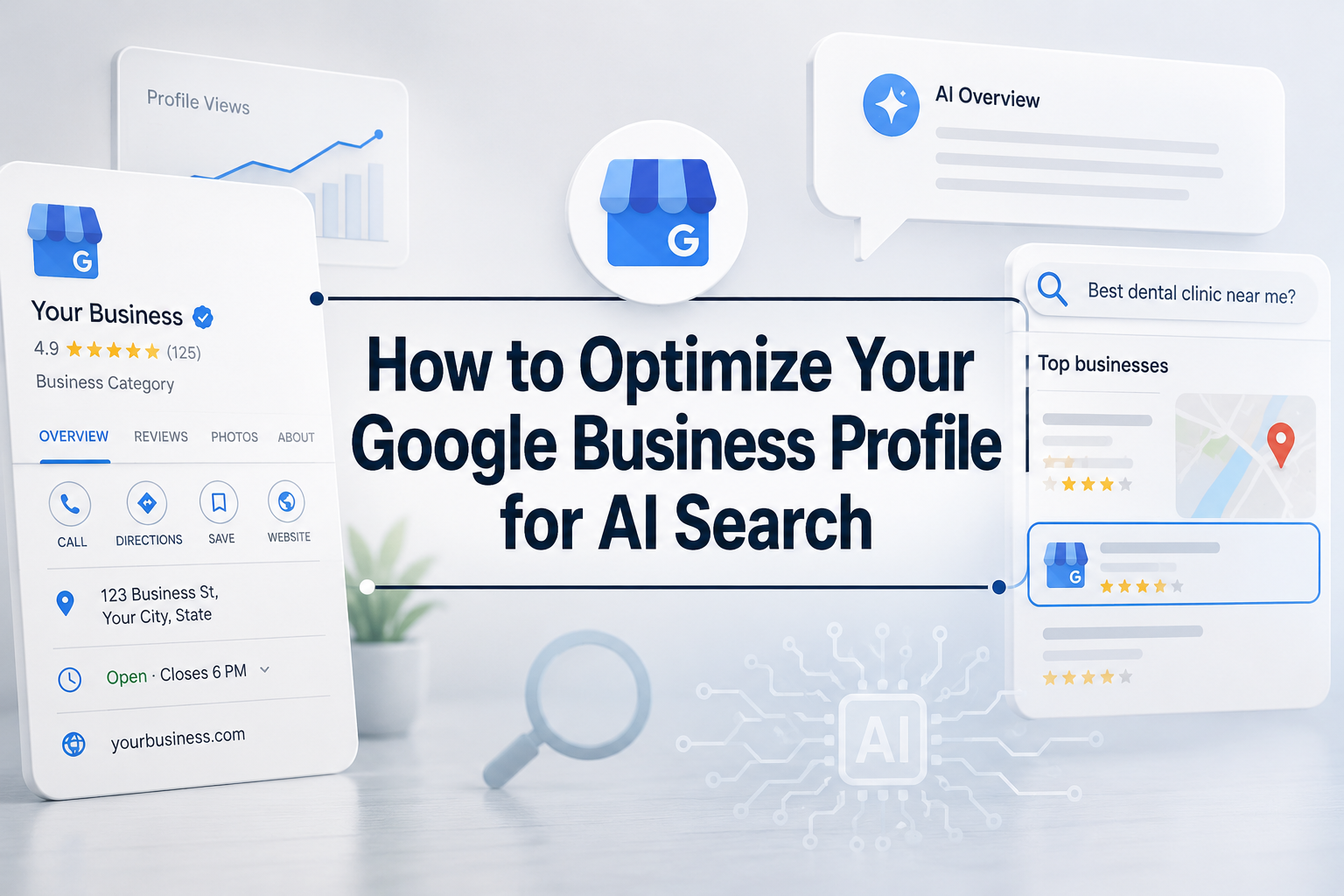
Keep your business information accurate and consistent, choose the correct primary and secondary categories, clearly describe your services, keep hours current, earn genuine reviews, upload real photos, and match your website content to what your profile claims. None of this guarantees inclusion in Google AI Overviews or other AI-generated answers — but it builds the kind of accurate, corroborated local presence these systems are more likely to draw from.
Table of Contents
ToggleIntroduction
Someone asks an AI search engine, “What’s the best plumber near me?” The answer depends partly on how clearly that plumber’s business — hours, service area, reputation, services — can be understood by the systems pulling that information together.
Google Business Profile (GBP) sits at the center of that picture, feeding Google Search, Google Maps, and increasingly the AI summaries layered on top of both: GBP → Google Search → Google Maps → Local SEO → AI-powered search. No AI system uses one published ranking formula, but an accurate, complete, and consistent profile is a stronger foundation than one that isn’t.
What Is a Google Business Profile?
GBP is the free listing controlling how a business appears on Google Search and Maps — name, category, address or service area, phone, website, hours, services, photos, reviews, and a description. If you already manage one, you know this part; what matters more is how each piece gets used, covered below.
Does Google Business Profile Matter for AI Search?
Yes — but as one input among several, not a direct lever on any specific AI model. Optimizing GBP doesn’t “optimize ChatGPT.” It strengthens the accuracy and consistency of your business information across the web: GBP + website + reviews + local citations + mentions + local content + authority. Treat “GBP ranking” and “AI citation” as related but separate outcomes.
Complete GBP Optimization Checklist
| GBP Element | What to Do | Why It Matters |
|---|---|---|
| Business Name | Use the real-world business name | Trust & accuracy |
| Primary Category | Choose the most accurate category | Business relevance |
| Secondary Categories | Add genuinely relevant categories | Context |
| Business Description | Clearly explain what you do | Entity understanding |
| Services | List services you actually offer | Service relevance |
| Hours | Keep them accurate | Customer experience |
| Phone | Use the correct business number | Trust |
| Website | Link to the correct page | More business context |
| Photos | Upload authentic images | Business credibility |
| Reviews | Earn genuine reviews | Reputation |
| Q&A | Answer real customer questions | Useful information |
Choose the Right Primary Category
According to Whitespark’s 2026 survey of local search experts, choosing the wrong primary category is the single most damaging negative local ranking factor — ahead of duplicate listings or missing information. A cleaning company should be listed as a cleaning service, not “home services” generally. A plumber should use the specific plumbing category available, not a broader contractor category. An SEO agency should choose the most accurate marketing/advertising category Google offers.
Takeaway: pick the category that best describes what you actually do — not the one you think gets searched more often.
Use Secondary Categories Carefully
Secondary categories add context when a business genuinely offers more than one line — a cleaner that also does carpet cleaning can add it. Don’t add categories to capture unrelated traffic.
Write a Clear Business Description
State what you do, main services, service area, who you serve, and what sets you apart — in plain language.
Weak: “We are the best company providing amazing services at affordable prices.”
Better: “ABC Cleaning provides residential and commercial cleaning services in Karachi, including deep cleaning, sofa cleaning, carpet cleaning, and office cleaning.”
The second gives concrete, extractable facts. The first gives nothing verifiable. Don’t stuff repeated keywords here.
Add and Maintain Your Services
List services you actually provide, with real names and short accurate descriptions — not a padded list chasing extra search terms. This builds a clear business → service → location relationship. Remove services you’ve stopped offering.
Keep Business Information Consistent (NAP)
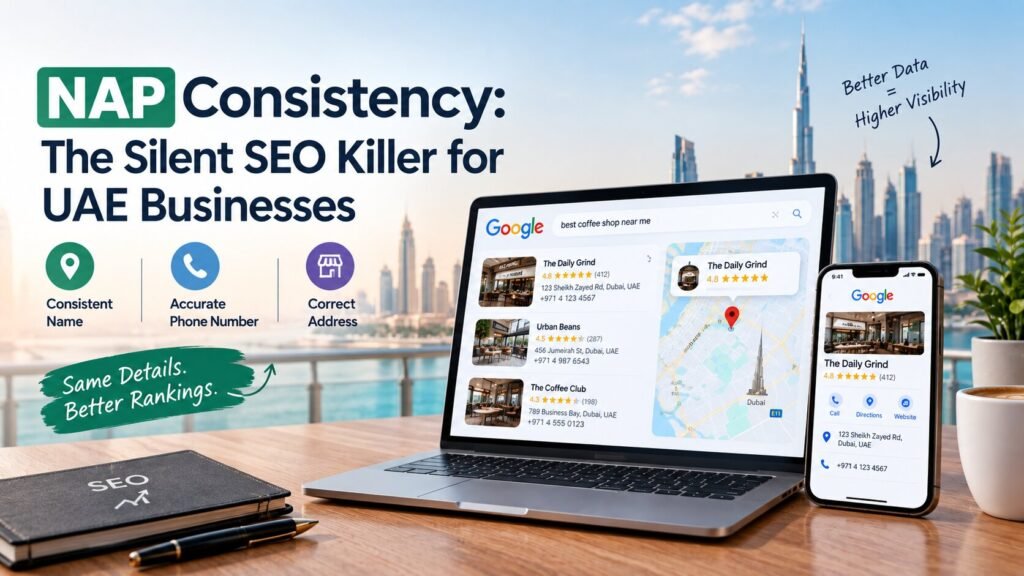
Name, address, and phone should match exactly across your website, GBP, directories, and social profiles. Small mismatches — “St.” vs. “Street,” an old number still live elsewhere — create doubt about which listing is authoritative. Service-area businesses without a storefront should use Google’s service-area setting instead of a public address.
Get Genuine Google Reviews
BrightLocal’s 2026 Local Consumer Review Survey found 97% of consumers read reviews before deciding. Detailed reviews carry more weight — “the team completed our office deep cleaning in Clifton and arrived on time” tells more than “Great service.” Ask satisfied customers directly, but never fabricate or pay for reviews — Google can suspend profiles for this.
Respond to Reviews Properly
Positive: thank the customer specifically, referencing what they mentioned. Negative: acknowledge the issue professionally and offer a path to resolve it, ideally off the public thread. Don’t argue, stuff keywords into replies, reuse the same response everywhere, or share private details publicly.
Upload Real Business Photos
Upload actual exterior, interior, team, and completed-project photos. 2026 data cited by SQ Magazine found listings with 100+ photos received markedly more calls and clicks than minimal-photo profiles. Real photos confirm you’re active and legitimate; stock imagery does the opposite.
Use Google Posts Strategically
Post when there’s something worth saying — a new service, a seasonal offer, a genuinely useful tip — not on a fixed schedule. Examples: extended holiday hours, a limited-time discount, or a short post on a lesser-known service.
Answer Customer Questions
Use Q&A for what customers actually ask: emergency call-outs? DHA Karachi coverage? Same-day service? This improves the customer experience and adds context — a useful supporting signal, not a guarantee of AI citations.
Connect Your GBP With Your Website
A GBP claiming “commercial cleaning in Karachi” needs a website that supports it — a dedicated service page, not just a homepage mention. Build: GBP → website → service pages → location pages → about page → contact info, so each piece confirms the others.
Build Local Authority Outside Google
Local citations, industry directories, local news, relevant backlinks, partnerships, and digital PR reinforce the same facts elsewhere. A handful of relevant mentions outweighs dozens of low-quality directory listings.
GEO: Google Business Profile + Generative Search
GEO is about improving how a brand’s information gets understood inside AI-generated answers, drawing on: GBP + website + reviews + citations + authority + content + entity consistency. It’s built on the same accurate information Local SEO already requires, not a separate system to chase instead.
AEO vs. Local SEO vs. GEO
| Strategy | Main Goal |
|---|---|
| Local SEO | Improve local search visibility |
| AEO | Provide direct answers |
| GEO | Improve visibility in generative/AI search |
| GBP Optimization | Strengthen local business presence |
These overlap heavily — a well-optimized GBP supports all three at once.
Example: Local Cleaning Business
ABC Cleaning, Karachi — GBP: correct category, accurate service area, complete services, real photos, genuine reviews. Website: a Karachi cleaning page plus individual service pages, an FAQ, and a real About page. Authority: relevant local directory citations and a local business association mention. Together these describe one consistent entity rather than scattered facts.
Example: Plumber
Targeting “emergency plumber near me” calls for the specific plumbing category (not general contracting), emergency availability stated directly, accurate after-hours coverage, and a dedicated emergency-service page with response-time expectations. Reviews mentioning fast response times reinforce that claim from a third party.
Common GBP Optimization Mistakes
❌ Keyword stuffing the business name ❌ Fake reviews ❌ Incorrect categories ❌ Fake or padded service areas ❌ Duplicate profiles ❌ Outdated hours ❌ Stock photos ❌ Ignoring negative reviews ❌ Inconsistent NAP ❌ Buying spammy local links ❌ Posts with no real content
Each either misleads customers directly or creates inconsistencies that undermine trust signals both Google and AI systems rely on.
30-Day GBP Optimization Plan
Week 1: Audit the profile, correct business information, review category selection, update hours.
Week 2: Improve the description, complete the services list, upload real photos, align website content.
Week 3: Request genuine reviews, respond to existing ones, build a few relevant citations.
Week 4: Publish a useful post, improve service pages, monitor visibility, note remaining gaps.
Quick Answers About GBP and AI Search
Does Google Business Profile help with AI search? Indirectly — it strengthens accurate, consistent local information that AI systems and Google’s own products can draw on, without being a direct input to any specific model.
Can my GBP appear in Google AI Overviews? Business information from GBP can surface there, but there’s no guaranteed inclusion mechanism — accuracy and completeness improve the odds, not the certainty.
Does Google Business Profile affect Local SEO? Yes, significantly — BrightLocal’s 2026 research attributes roughly 32% of local pack ranking factors to GBP signals directly.
Do Google reviews help AI search visibility? Reviews are a strong trust and reputation signal supporting overall local authority, which contributes to broader search visibility.
Should I add keywords to my business name? No — Google’s guidelines prohibit this, and it risks suspension.
How often should I update my GBP? Whenever anything changes — hours, services, address — plus a periodic check every few months.
Do GBP photos help SEO? Yes — complete, photo-rich profiles show stronger engagement than sparse ones.
Should I create multiple Google Business Profiles? No, unless you have genuinely separate physical locations — duplicates for one location violate Google’s guidelines.
Does GBP optimization guarantee Google Maps rankings? No. It’s one of the strongest levers available, but rankings also depend on proximity, competition, and overall authority.
What is GEO for local businesses? Making business information clear and consistent enough for generative AI tools to understand and reference accurately, built on standard Local SEO practices.
Statistics Worth Knowing
- Choosing the wrong primary category is the most damaging negative local ranking factor, according to a 2026 Whitespark survey of local search experts.
- GBP signals account for roughly 32% of local pack ranking factors — more than on-page, review, or backlink signals individually (BrightLocal, 2026).
- 97% of consumers read reviews for local businesses before making a decision (BrightLocal 2026 Local Consumer Review Survey).
- Google states that AI Overviews are used by more than 1 billion people and were available in 200+ countries/territories and 40+ languages as of May 2025.
- 46% of all Google searches now carry local intent, according to 2026 research compiled from Google, BrightLocal, and Moz data (BizIQ).
Official Google Guidance
For policy specifics, rely on Google’s own documentation rather than third-party summaries — particularly the Google Business Profile Help Center, guidelines on representing your business, and Google’s guidance on local ranking factors. These are the authoritative sources for what’s currently allowed and how Google says ranking works.
Related Reading
Businesses building this out further may also want to look at local SEO services, local SEO pricing, general SEO services, AEO services, and GEO services to understand how GBP work fits into a broader local visibility strategy.
Final Checklist
Google Business Profile AI Search Optimization Checklist
☐ Accurate business name
☐ Correct primary category
☐ Relevant secondary categories
☐ Complete services
☐ Accurate hours
☐ Correct phone number
☐ Correct website
☐ Clear business description
☐ Authentic business photos
☐ Genuine customer reviews
☐ Professional review responses
☐ Useful GBP posts
☐ Consistent NAP information
☐ Strong website service pages
☐ Relevant local citations
☐ Local authority and mentions
☐ Clear entity information
☐ No keyword stuffing
☐ No fake reviews
☐ No fake locations
Final Conclusion
Optimizing a Google Business Profile for AI search isn’t about finding a secret ranking trick — there isn’t one. It’s about making your business information accurate, complete, trustworthy, locally relevant, and consistent everywhere it appears. The path runs GBP → Local SEO → website → reputation → authority → AI visibility, with each stage reinforcing the ones around it. Get the fundamentals genuinely right, and both traditional local search and AI-generated answers have a clearer, more trustworthy picture of your business to work from — without any guarantee of rankings or citations, because no legitimate method offers one.
FAQ
What is Google Business Profile optimization? Making a GBP listing accurate, complete, and well-maintained — correct category, services, hours, photos, and reviews — to improve local visibility.
How do I optimize my Google Business Profile for AI search? Focus on accuracy and consistency across category, description, services, and reviews, then match that on your website and local citations.
Does GBP help with AI search? Indirectly, by strengthening the accurate, corroborated business information AI systems and search engines both draw from.
Does Google Business Profile improve Local SEO? Yes — it’s one of the most heavily weighted local ranking factors, per 2026 BrightLocal research.
Do Google reviews help local rankings? Yes, both as a ranking signal and as a trust factor influencing whether customers act on what they find.
How often should I update my GBP? Immediately when something changes, plus a full review every few months.
Should I add keywords to my Google Business Profile name? No — this violates Google’s guidelines and risks suspension.
Can a service-area business use Google Business Profile? Yes — Google’s service-area setting lets businesses without a storefront list areas served instead of a public address.
How important are GBP photos? Very — complete, photo-rich profiles consistently outperform sparse ones on calls, clicks, and direction requests.
What is GEO for local businesses? Making business information clear enough for generative AI tools to understand and reference accurately, building on standard Local SEO practices.


What do you think?
[…] Maps SEO (also called local SEO) is the practice of optimizing your Google Business Profile and website so your business appears prominently when people search for your products or services […]
[…] Fully optimize your Google Business Profile, listing your exact DIFC location, and build consistent local […]
Comments are closed.