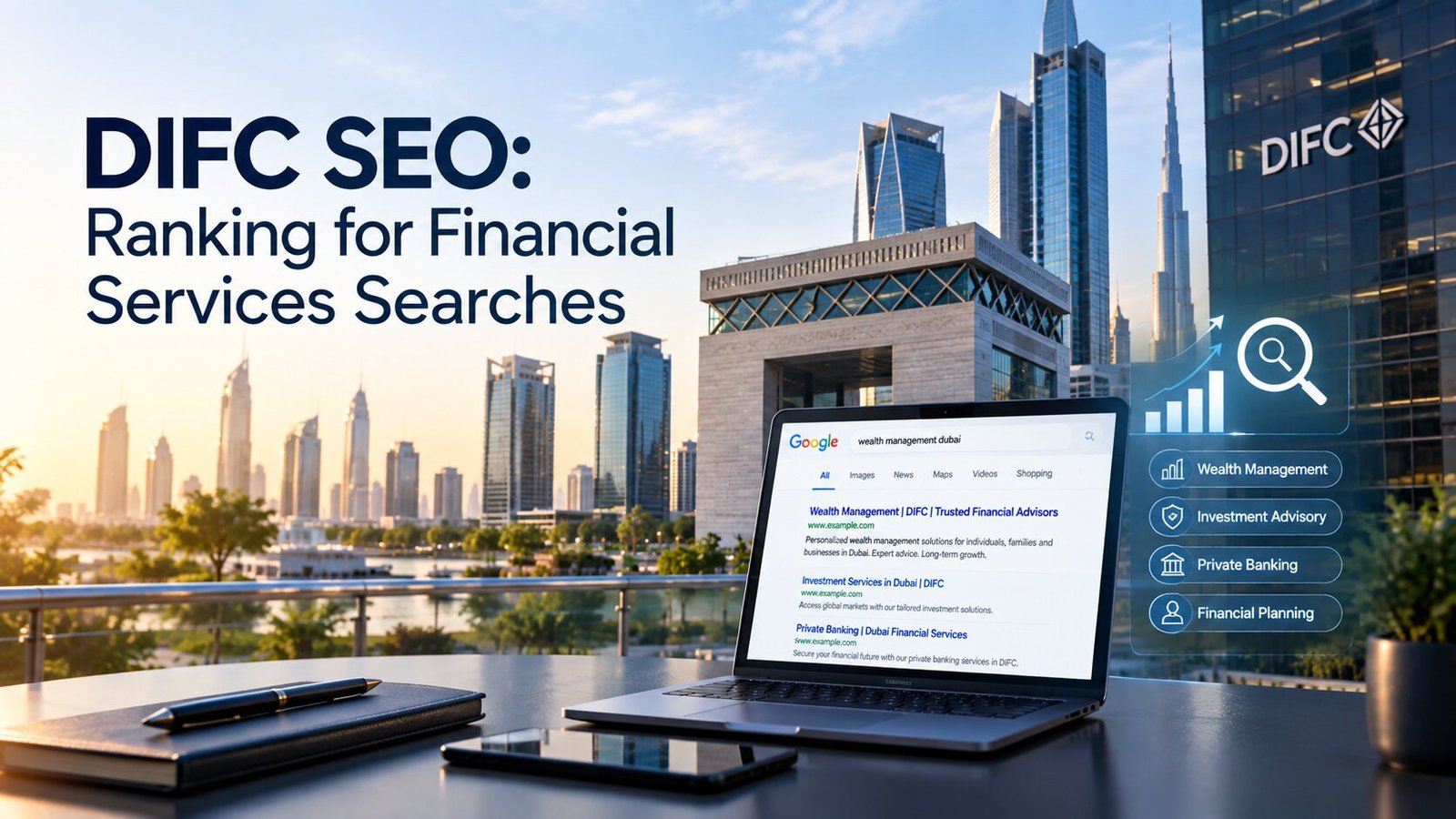
The Dubai International Financial Centre houses some of the region’s most established banks, asset managers, wealth advisors, and fintech firms. It’s also one of the most competitive digital environments in the UAE. Every firm in DIFC is chasing the same high-value clients, often through the same handful of search terms. Ranking well here isn’t optional if you want a steady flow of qualified inbound leads — it’s a prerequisite.
This guide covers what DIFC SEO actually involves, why financial services search behavior is different from most other industries, and what a genuinely effective strategy looks like for firms operating in this specific market.
Table of Contents
ToggleWhat Is DIFC SEO?
DIFC SEO is the practice of optimizing a financial services firm’s website and online presence to rank for search terms used by clients looking for wealth management, investment advisory, corporate banking, and related services within Dubai International Financial Centre. It combines technical SEO, trust-focused content, local optimization, and compliance-aware messaging to attract high-value, qualified leads in one of the region’s most competitive digital markets.
Why SEO Matters for Financial Services Firms in DIFC
Financial services SEO isn’t like SEO for a restaurant or a retail store. The stakes, the sales cycle, and the buyer psychology are all different.
Leads are high-value. A single wealth management or corporate advisory client can represent significant lifetime revenue. Even a modest number of additional qualified leads per month can justify substantial SEO investment.
The search landscape is crowded. DIFC hosts hundreds of financial institutions, all targeting overlapping keywords like “wealth management Dubai” or “investment advisory DIFC.” Ranking requires genuine authority, not just basic on-page optimization.
Buying decisions are trust-based. Nobody chooses a wealth manager or a corporate bank on impulse. Prospective clients research extensively before making contact, and your website is often their first real signal of credibility.
Sales cycles are long. Financial services conversions rarely happen on a single visit. SEO needs to support a longer nurture journey, through content, retargeting-friendly pages, and trust-building signals, rather than a single conversion-focused landing page.
Client behavior is increasingly digital-first. Even ultra-high-net-worth clients and corporate decision-makers now research financial providers online before ever picking up the phone, making search visibility a genuine business-critical channel rather than a nice-to-have.
Understanding Financial Services Search Intent
Different financial search queries reflect very different points in the buyer’s journey. Recognizing this distinction is critical to building the right content for each.
| Search Intent | Example Query | Business Opportunity |
|---|---|---|
| Informational | “what is wealth management” | Early-stage education, builds topical authority |
| Informational | “how does corporate banking work in DIFC” | Attracts prospects researching before engaging |
| Commercial investigation | “best investment advisory firm DIFC” | Comparison-stage prospects close to a decision |
| Commercial investigation | “top fintech companies Dubai” | Positions your firm within a competitive shortlist |
| Local intent | “financial advisor near DIFC” | High-intent, location-specific searchers ready to engage |
| Transactional | “open corporate bank account Dubai” | Bottom-of-funnel, ready-to-convert searchers |
| Transactional | “book consultation wealth manager Dubai” | Direct conversion opportunity |
The Most Valuable Financial Services Keywords in DIFC
A strong DIFC SEO strategy targets keywords across all four intent categories, not just the obvious high-competition commercial terms.
| Keyword Type | Example Keywords | Intent |
|---|---|---|
| Commercial | “wealth management firm DIFC,” “investment advisory Dubai” | Comparison and consideration |
| Informational | “how to choose a wealth manager,” “DIFC company setup guide” | Early research, authority building |
| Local | “financial advisor DIFC,” “corporate bank near me Dubai” | High-intent, geographically qualified |
| Transactional | “book financial consultation Dubai,” “open investment account DIFC” | Ready to convert |
Balancing content across these categories helps a firm capture prospects at every stage, rather than only competing for the most contested, hardest-to-rank commercial terms.
10 Proven DIFC SEO Strategies for Financial Services Companies
1. Build Trust-Focused Website Content
Financial clients need reassurance before they engage. Your website content should clearly communicate credentials, regulatory standing, and track record, not just services offered.
Implementation: Include regulatory licensing details, team credentials, and years of operation prominently on key pages.
Common mistake: Generic “about us” copy that could apply to any financial firm anywhere, with no specific credibility markers.
2. Optimize Service Pages for Financial Search Intent
Each core service — wealth management, corporate banking, tax advisory — deserves its own dedicated, detailed page, not a single combined “services” page.
Implementation: Build individual pages targeting specific service keywords, with clear explanations of process, eligibility, and outcomes.
Common mistake: Combining multiple distinct services onto one thin page, which dilutes relevance for any single search term.
3. Create Authority Content Around Finance Topics
Regularly published, genuinely useful content — market commentary, regulatory updates, planning guides — builds topical authority over time.
Implementation: Publish consistently, ideally tied to your firm’s actual expertise and licensed activities.
Common mistake: Generic, templated finance content with no unique perspective or firm-specific insight.
4. Improve Technical SEO Performance
Site speed, mobile usability, and clean site architecture matter for every industry, but financial sites are often built on legacy platforms with unnecessary technical debt.
Implementation: Run a full technical audit covering site speed, indexing, and mobile performance, and fix issues systematically.
Common mistake: Treating technical SEO as a one-time setup task rather than ongoing maintenance.
5. Implement Financial Industry Schema Markup
Structured data helps search engines understand your services, credentials, and business type more precisely, which can improve how you appear in search results.
Implementation: Add relevant schema types — organization, service, FAQ, and review schema where applicable.
Common mistake: Skipping schema entirely, or implementing it incorrectly, which provides little benefit and occasionally causes indexing issues.
6. Strengthen E-E-A-T Signals
Google’s Experience, Expertise, Authoritativeness, and Trustworthiness framework matters more for financial content than almost any other industry category, given its direct impact on people’s money.
Implementation: Attribute content to named, credentialed authors. Link to regulatory registrations. Showcase genuine client outcomes where compliance allows.
Common mistake: Publishing unattributed or anonymously authored financial content, which weakens trust signals significantly.
7. Build High-Authority Financial Backlinks
Links from reputable financial publications, industry associations, and regulatory bodies carry substantial weight for a finance-focused site.
Implementation: Pursue coverage in financial news outlets, contribute expert commentary, and build relationships with relevant industry publications.
Common mistake: Pursuing high volumes of low-quality, irrelevant backlinks, which can do more harm than good for a trust-sensitive industry.
8. Optimize for Local SEO in DIFC
Even highly specialized financial firms benefit from strong local search presence, particularly for consultation-stage searches.
Implementation: Fully optimize your Google Business Profile, listing your exact DIFC location, and build consistent local citations.
Common mistake: Treating local SEO as irrelevant for B2B or high-net-worth-focused firms — many decision-makers still search locally before engaging.
9. Create Thought Leadership Content
Bylined articles, market outlook pieces, and original research position your firm as a genuine authority rather than just another service provider.
Implementation: Publish original analysis and perspective regularly, tied to real market events and your firm’s actual expertise.
Common mistake: Recycling generic industry news without adding original insight or firm-specific perspective.
10. Track Conversions Instead of Rankings Alone
Ranking position is a means to an end. For financial services, actual business impact — consultation requests, qualified leads — matters far more than vanity keyword rankings.
Implementation: Set up proper conversion tracking for consultation requests, contact form submissions, and phone calls, not just traffic and rankings.
Common mistake: Reporting only on keyword position and traffic volume, without connecting SEO activity to actual lead generation.
Local SEO for DIFC Financial Firms
Local SEO remains relevant even for firms serving a regional or international client base, since many prospects still begin their research with a local, DIFC-specific search.
| Task | Priority |
|---|---|
| Fully optimize Google Business Profile with exact DIFC address | High |
| Build consistent citations across relevant directories | High |
| Create a dedicated DIFC-focused landing page | High |
| Target local + service keyword combinations | Medium |
| Actively collect and respond to client reviews | Medium |
| Monitor and correct any duplicate or outdated listings | Medium |
Common SEO Challenges in the Financial Industry
Regulatory compliance. Marketing content in financial services must stay within regulatory boundaries around claims, guarantees, and disclosures. Solution: involve compliance review early in the content process, not as an afterthought.
High keyword competition. DIFC’s concentration of well-funded financial firms means competition for top commercial keywords is intense. Solution: build a broader content strategy across informational and local intent, not just the most contested commercial terms.
Trust and credibility requirements. Financial content faces a higher trust bar than most industries. Solution: prioritize E-E-A-T signals — named authors, credentials, regulatory transparency — throughout your content.
Long conversion cycles. Financial decisions take time. Solution: build nurture-stage content (guides, comparisons, FAQs) that keeps prospects engaged through a longer research process.
Limited content differentiation. Many financial firms publish similar, generic content. Solution: lean into original commentary, firm-specific case studies where compliance allows, and genuine subject-matter expertise.
How AI Search Is Changing Financial Services SEO
Search behavior is shifting. Google’s AI Overviews now answer many informational queries directly, sometimes reducing traditional organic clicks for broad, top-of-funnel questions. Tools like ChatGPT, Gemini, and Perplexity increasingly serve as research assistants for financial decisions too, citing and recommending sources based on how clearly authoritative and well-structured that content is.
This shift raises the importance of a few specific practices for financial firms:
- Entity clarity — making sure your firm, its services, and its credentials are unambiguously identifiable to search engines and AI systems alike
- Direct, well-structured answers — content that clearly answers specific questions is more likely to be cited by AI tools, not just ranked traditionally
- Genuine authority signals — AI systems, like traditional search, increasingly favor content backed by real credentials and expertise over generic marketing copy
Financial firms that adapt content structure toward this kind of clarity and authority are better positioned as AI-powered search becomes a larger share of how prospects research financial decisions.
Why Financial Firms Choose SEO Digix
Financial services SEO requires a different skill set than general SEO work — an understanding of compliance-sensitive content, long sales cycles, and trust-heavy buyer psychology. SEO Digix works with financial and professional services clients on exactly this kind of strategy, with a few specific areas of focus worth understanding if you’re evaluating providers.
Financial services SEO expertise means building content and keyword strategies specifically around how financial clients actually search and decide, rather than applying generic ecommerce or local-business tactics to a fundamentally different buyer journey.
Technical SEO capability covers the site speed, structured data, and indexing work that financial sites — often running on legacy platforms — frequently need.
Content strategy is built around trust and authority, prioritizing well-attributed, compliance-aware content over generic, templated finance articles.
Local SEO experience ensures firms show up for DIFC-specific and Dubai-wide searches, even when the ultimate client base is regional or international.
Lead generation focus means SEO activity is tied to actual consultation requests and qualified leads, not just traffic or ranking metrics in isolation.
Data-driven reporting keeps firms informed on what’s actually working, connecting SEO activity directly to business outcomes rather than vanity metrics alone.
It’s worth noting directly: SEO Digix is headquartered in Pakistan and serves DIFC and wider UAE clients remotely. For a financial firm evaluating providers, that’s a genuine factor to weigh — a remote model can offer strong value and specialized expertise, but it’s a different working relationship than a Dubai-based agency with an in-person presence. Firms should evaluate any SEO provider, including this one, based on demonstrated financial services experience and verifiable results, rather than location alone.
DIFC SEO ROI: What Firms Can Expect
| SEO Activity | Potential Business Impact |
|---|---|
| Trust-focused service pages | Higher-quality inbound consultation requests |
| Local SEO optimization | Increased visibility for DIFC-specific searches |
| Authority and thought leadership content | Stronger brand credibility and referral-worthy positioning |
| Technical SEO improvements | Better site performance and reduced friction in the research phase |
| Backlink building from financial publications | Increased domain authority and industry credibility |
Over time, well-executed financial services SEO tends to reduce client acquisition costs relative to paid channels, since organic visibility compounds rather than stopping the moment spend pauses. It also builds a durable form of brand authority that paid advertising alone doesn’t replicate.
FAQ: DIFC SEO for Financial Services
What is DIFC SEO? DIFC SEO is the practice of optimizing a financial services firm’s online presence to rank for search terms related to wealth management, investment advisory, banking, and related services within Dubai International Financial Centre.
Why do financial services firms need SEO? Financial decisions increasingly start with online research. Strong SEO ensures your firm is visible and credible at the exact moment prospective clients are evaluating providers.
How long does financial services SEO take to show results? Most firms see initial movement within 3 to 6 months. Given the competitive nature of DIFC’s market and longer B2B sales cycles, stronger results typically build over 6 to 12 months.
What are the best keywords for DIFC financial firms? A mix of commercial keywords (like “wealth management firm DIFC”), local keywords (like “financial advisor DIFC”), and informational keywords that support the research stage of a longer buying journey.
How does local SEO help financial businesses? Even firms serving international or high-net-worth clients benefit from strong local visibility, since many decision-makers still search locally before making initial contact.
How much do SEO services cost for financial companies in DIFC? Given the competitive landscape and specialized content requirements, financial services SEO in DIFC often starts around AED 8,000–15,000 per month, with enterprise or highly competitive campaigns exceeding that range.
Does SEO work for highly regulated financial content? Yes, but it requires care. Compliance review should be part of the content process from the start, ensuring marketing content stays within regulatory boundaries around claims and disclosures.
How is financial services SEO different from general SEO? It requires deeper trust-building, stronger E-E-A-T signals, longer-cycle content strategy, and compliance awareness that generic SEO approaches typically don’t account for.
Do AI Overviews affect financial services search visibility? Yes. AI-generated answers are increasingly present for informational financial queries, making clear, well-structured, authoritative content more important for both traditional rankings and AI citation.
Should a DIFC financial firm work with a local or remote SEO provider? Either can work well. What matters most is verifiable financial services experience and demonstrated results — evaluate providers on that basis rather than location alone.
Conclusion
DIFC’s financial services market is crowded, high-stakes, and increasingly research-driven before a single conversation happens. Ranking well here requires more than basic on-page optimization — it demands genuine trust signals, technical precision, compliance-aware content, and a strategy built specifically around how financial clients actually search and decide.
The firms that invest properly in this kind of specialized SEO strategy tend to build a durable, compounding source of qualified leads, rather than relying solely on referrals or paid channels that stop the moment spend pauses. If you’re evaluating your current SEO performance, it’s worth asking honestly whether your content, technical foundation, and local visibility are actually built for how DIFC clients search today — and whether your current approach is generating the qualified leads your firm’s growth actually depends on.