
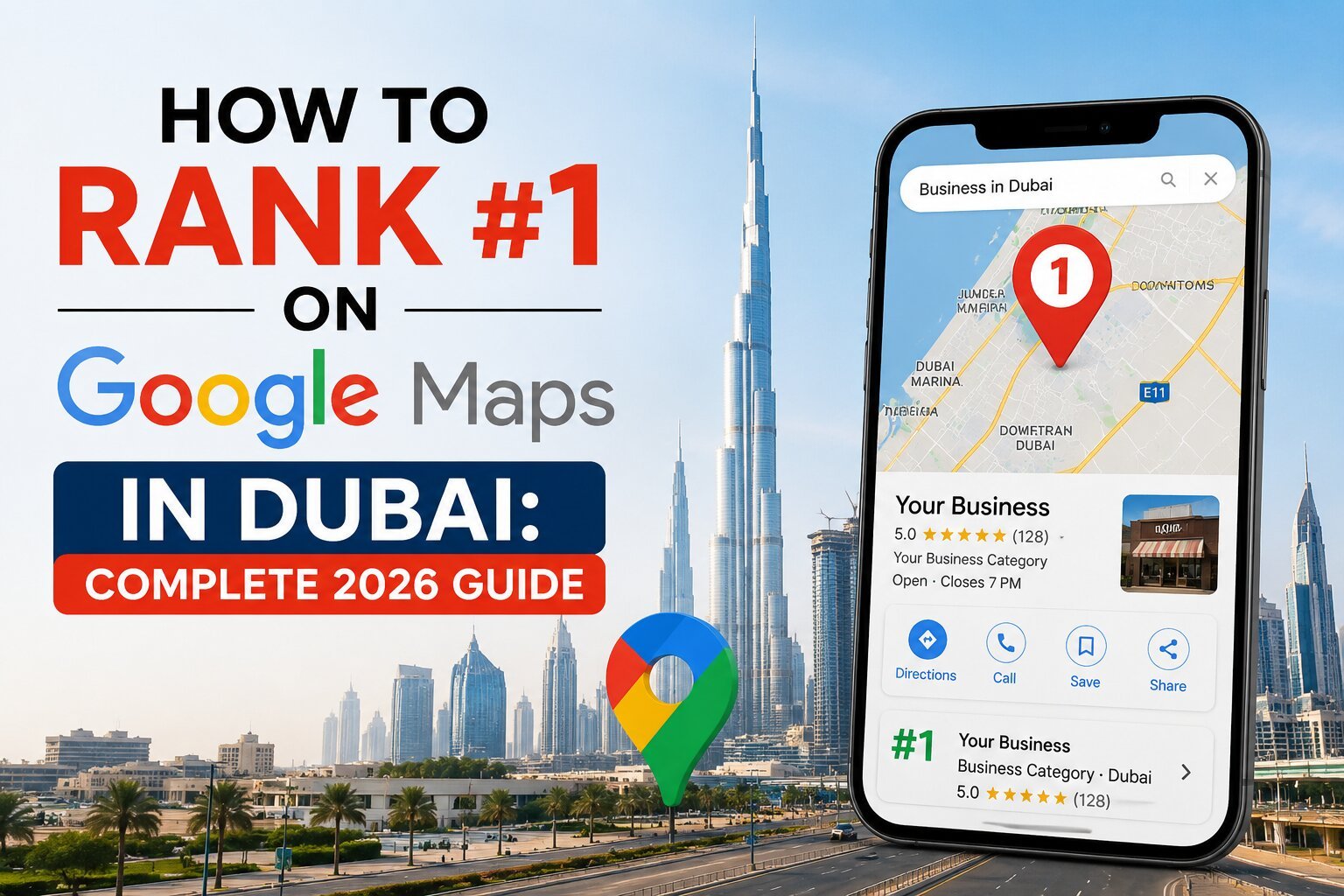
If you’ve ever searched “best salon in Business Bay” or “plumber near me” while standing somewhere in Dubai, you’ve used the Google Maps Local Pack — that block of three business listings with a map that appears above the regular search results. Getting your business into that pack, and ideally into the top spot, is one of the most valuable things a local Dubai business can do for its visibility.
So, how do you rank #1 on Google Maps in Dubai? There’s no single switch you can flip. Google Maps rankings are determined by three core factors — relevance, distance, and prominence — combined with how complete, accurate, and trusted your business profile and website are. No agency or tool can guarantee a permanent #1 position, because rankings shift based on who’s searching, where they’re standing, and what your competitors are doing. What you can do is systematically strengthen every factor Google uses to decide who deserves to be shown first. That’s what this guide walks through, step by step.
Table of Contents
Toggle1. What Is Google Maps SEO?
Google Maps SEO (also called local SEO) is the practice of optimizing your Google Business Profile and website so your business appears prominently when people search for your products or services on Google Maps and in Google’s local search results.
It’s different from traditional organic SEO in a few important ways:
- Traditional SEO focuses on ranking a website in the standard “blue link” results.
- Google Maps SEO focuses on ranking your business listing in the Local Pack (the map with three listings) and within Google Maps itself.
- Traditional SEO relies heavily on website content and backlinks. Google Maps SEO relies on those things plus your Google Business Profile, reviews, citations, and physical or service-area location.
For a Dubai business, this matters because a huge share of local searches — “accountant in JLT,” “best café Al Barsha,” “dentist near Sheikh Zayed Road” — trigger the Local Pack before any website ranking is even considered.
2. How Google Maps Rankings Work in Dubai
Google has confirmed that Maps rankings are based on three primary factors: relevance, distance, and prominence. Understanding each one helps you know exactly where to focus your effort.
Relevance
Relevance is how well your Google Business Profile matches what someone is searching for. If a user searches “furniture repair Al Quoz,” Google looks at your business category, description, services, and profile content to determine whether you’re a good match.
Example: A furniture repair shop in Al Quoz that lists “Furniture Repair Service” as its primary category and clearly describes upholstery, polishing, and restoration services will be considered more relevant than a general “Home Services” business that happens to also do furniture repair.
Distance
Distance measures how far each potential search result is from the location term used in the search, or from the searcher’s physical location if no location is specified.
Example: Someone standing in Dubai Marina searching “gym near me” will see gyms in Dubai Marina and JBR ranked ahead of gyms in Deira, even if the Deira gym has a stronger profile — because proximity plays a direct role.
This is also why a Downtown Dubai business searched for by someone in Downtown Dubai has a natural advantage over a competitor based in Al Barsha, all else being equal.
Prominence
Prominence reflects how well-known and trusted your business is, both online and offline. Google looks at:
- The number and quality of reviews
- Your review ratings
- Backlinks to your website
- General online mentions and citations
- Your website’s overall authority
Example: Two clinics in Jumeirah might be equally relevant and equally close to a searcher, but the one with 400 reviews at a 4.8 average and dozens of mentions across UAE health directories will typically outrank the one with 12 reviews and no citations.
The practical takeaway: you can’t change where your business is physically located, but you have significant control over relevance and prominence — and that’s where most of this guide focuses.
3. Fully Optimize Your Google Business Profile
Your Google Business Profile (GBP) is the single most important asset in Google Maps SEO. Every field you complete is a signal Google uses to understand and rank your business. Here’s a step-by-step checklist:
| Field | Why It Matters |
|---|---|
| Business Name | Should match your real-world signage exactly — no keyword stuffing (e.g., “ABC Cleaning Dubai Best Cleaning Company” is against Google’s guidelines and risks suspension) |
| Primary Category | The single strongest relevance signal in your entire profile |
| Secondary Categories | Add all genuinely applicable categories to widen relevant search coverage |
| Business Description | Clearly explain what you do, who you serve, and where — written for humans, not stuffed with keywords |
| Services | List every service you offer with short, specific descriptions |
| Products | Add relevant products if applicable, especially for retail |
| Phone Number | Use a local UAE number that matches your website exactly |
| Website | Link to the most relevant page — often your homepage or a location page |
| Business Hours | Keep accurate and updated, including Ramadan or public holiday hours |
| Special Hours | Update for UAE public holidays like Eid and National Day |
| Photos | Upload genuine, high-quality images regularly |
| Videos | Short videos of your premises, team, or work in action |
| Attributes | Select all relevant attributes (e.g., “Wheelchair accessible,” “Women-led,” “Free Wi-Fi”) |
| Consistency | Every detail should match your website and other listings exactly |
Each of these fields feeds directly into how Google assesses relevance and trustworthiness — an incomplete profile is one of the most common reasons otherwise good businesses don’t rank.
4. Choose the Right Google Business Profile Category
Your primary category is arguably the single most powerful relevance signal available to you. Google uses it to decide which searches your business is even eligible to appear for.
A few examples of getting this right in a Dubai context:
- Real estate agencies: “Real Estate Agency” as primary, with “Property Management Company” or “Real Estate Consultant” as secondary, depending on services actually offered.
- Restaurants: Choose the specific cuisine category (e.g., “Lebanese Restaurant” rather than just “Restaurant”) if that’s genuinely your focus.
- Cleaning companies: “Cleaning Service” as primary, with “House Cleaning Service” or “Commercial Cleaning Service” added if relevant.
- Digital marketing agencies: “Marketing Agency” as primary; “SEO Agency” or “Internet Marketing Service” as secondary if those categories exist and apply.
- Plumbers: “Plumber” as primary — avoid the temptation to use a broader “Contractor” category that dilutes relevance.
- Lawyers: Choose the specific practice area category where possible (e.g., “Corporate Lawyer,” “Family Law Attorney”) rather than a generic “Lawyer” category if you specialize.
- Salons: “Hair Salon,” “Beauty Salon,” or “Nail Salon” — pick the one that matches your primary revenue driver.
- Hotels: Use the specific hotel classification categories Google provides rather than generic “Lodging.”
- Clinics: Match the specific medical specialty (e.g., “Dental Clinic,” “Dermatologist”) rather than generic “Medical Clinic” if you specialize.
A mismatched or overly broad category is one of the most common — and easiest to fix — reasons a Dubai business underperforms on Maps.
5. Build a Strong Review Strategy
Reviews influence both prominence (a ranking factor) and click-through rate (whether people actually choose you once they see you).
Why reviews matter:
- They’re a direct trust signal to both Google and users
- Review volume, recency, and rating all factor into prominence
- Reviews that mention specific services or locations reinforce relevance (e.g., a review saying “best AC repair in Al Barsha” reinforces both service and location relevance)
How to ethically generate more reviews:
- Ask satisfied customers directly, in person or via a follow-up message, at the natural end of a positive interaction
- Send a simple, direct link to your review page via WhatsApp or email — a very common and effective channel in the UAE
- Train staff to mention reviews naturally rather than pressuring customers
- Make the process as short as possible — friction kills review requests
Why quality and relevance matter: A review that says “great service, highly recommend” is far less valuable than one that says “Fixed our AC unit in Al Barsha within an hour, very professional team” — the second reinforces both service type and location.
Responding to reviews:
- Reply to positive reviews with genuine, specific thanks
- Respond to negative reviews calmly, acknowledge the issue, and offer to resolve it offline
- Never argue publicly — how you handle criticism is itself a trust signal to future customers
Why you should never buy fake reviews: Beyond violating Google’s policies (which can lead to profile suspension), fake reviews are increasingly detectable by Google’s systems and can permanently damage the prominence and trust your listing has built.
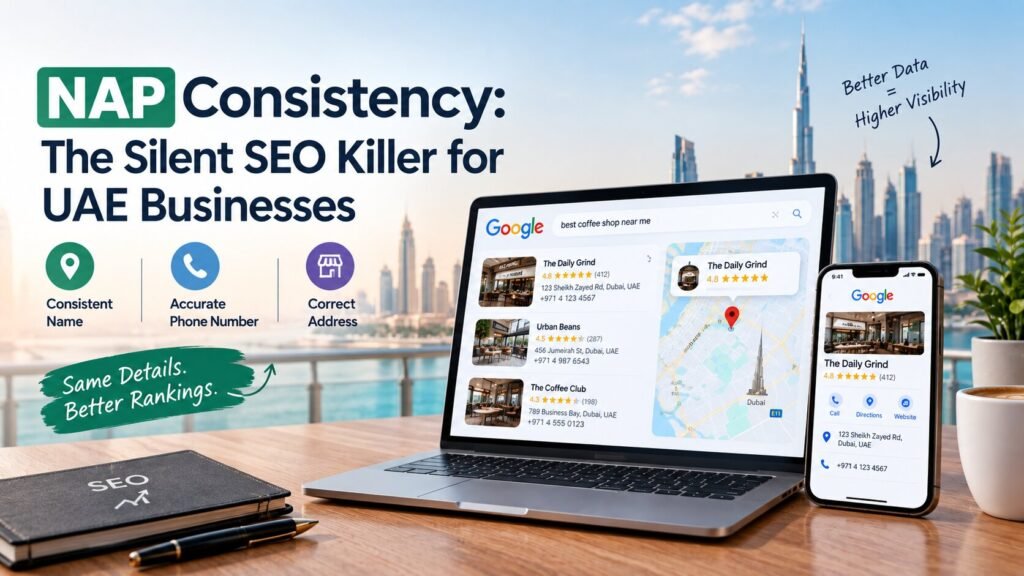
6. Keep NAP and Business Information Consistent
NAP stands for Name, Address, and Phone number — the three core identifiers of your business. Consistency across every platform where your business appears is a foundational local SEO signal.
Your NAP should match exactly across:
- Your website (especially the footer and contact page)
- Your Google Business Profile
- UAE business directories
- Social media profiles (Instagram, Facebook, LinkedIn)
- Industry-specific directories
Even small inconsistencies — “Al Quoz” vs. “Al Quoz Industrial Area,” or a landline listed on one platform and a mobile number on another — can create confusion for both users and Google’s algorithms, weakening the confidence signals that support your ranking.
7. Build Local Citations in Dubai
A citation is any online mention of your business name, address, and phone number, typically on directories, business listing sites, or industry platforms.
For Dubai businesses, relevant citation sources include general UAE business directories, chamber of commerce listings, and industry-specific platforms relevant to your field (legal directories for law firms, medical directories for clinics, hospitality platforms for hotels and restaurants, and so on).
Focus on quality over quantity. Ten accurate, relevant citations on reputable UAE or industry platforms will do far more for your rankings than 200 submissions to low-quality, generic directories that add no real trust signal and may even introduce NAP inconsistencies if not properly maintained.
8. Create Dubai-Focused Local Content
Location-based content helps reinforce relevance for the specific areas you serve. Useful formats include:
- “Best [service] in Dubai” — a genuinely useful comparison or guide, not just a keyword-stuffed page
- “[Service] in Business Bay” — content specific to that district’s context and customer needs
- “[Service] near Dubai Marina” — practical, useful information for that specific audience
- “[Service] in Jumeirah” — tailored to the area’s demographics and common needs
The key distinction: useful local content answers real questions and provides real value for that specific area. A “doorway page” — a thin page that just swaps out the district name with no unique, useful content — provides little value to users and can actively harm your SEO. If you serve multiple areas, only create dedicated location pages where you can write genuinely distinct, helpful content for each one.
9. Optimize the Website for Local SEO
Your Google Business Profile doesn’t operate in isolation — Google also evaluates your website as part of the prominence and relevance equation. Key elements to get right:
- Local keyword targeting: Naturally incorporate the services and Dubai locations you serve
- Title tags: Include your primary service and location where relevant (e.g., “AC Repair Services in Dubai | [Business Name]”)
- Meta descriptions: Write compelling, accurate summaries that encourage clicks
- H1/H2 structure: Clear, logical heading hierarchy that reflects your services and locations
- Service pages: Dedicated pages for each core service rather than one page trying to cover everything
- Location pages: Genuinely useful pages for each area you serve, where relevant
- Internal linking: Connect your service pages, location pages, and blog content logically
- Business information: NAP clearly visible, ideally in the footer of every page
- Contact page: Easy to find, with a form, phone number, email, and address
- Embedded Google Map: Include on your contact page where appropriate
- Mobile experience: The majority of local searches in Dubai happen on mobile — your site must work flawlessly there
- Page speed: Slow-loading pages hurt both rankings and conversions
- Clear conversion paths: Make it obvious how to call, message, or book you
10. Build High-Quality Local Backlinks
Backlinks remain one of the strongest prominence signals available. For Dubai businesses, relevant backlink sources include:
- UAE-based news and business publications
- Reputable UAE business directories
- Industry-specific websites relevant to your field
- Partnerships with complementary local businesses
- Sponsorships of local events, sports teams, or community initiatives
- Local business associations and chambers of commerce
- Digital PR — genuinely newsworthy stories about your business
- Useful, link-worthy resources (guides, data, tools) that other sites want to reference
The goal is relevance and editorial value, not volume. A single link from a respected UAE business publication is worth far more than dozens of links from unrelated, low-quality sites — and mass-purchased backlinks carry real risk of penalty.
11. Use Photos, Videos, and Google Business Profile Updates
An active, well-maintained profile signals to Google (and to users) that your business is real, current, and engaged. Regularly add:
- Authentic photos of your business exterior and interior
- Team photos that put a human face on your business
- Photos of products or completed work
- Location-specific photos, especially if you’re in a recognizable Dubai area
- Short videos showing your team or services in action
- Google Posts for offers, updates, or events
Avoid stock photography — authentic images consistently perform better and are more trusted by users deciding between you and a competitor.
12. Optimize for “Near Me” and Local Search Queries
Dubai users commonly search in patterns like:
- “[service] near me”
- “[service] in Dubai”
- “best [service] in Dubai”
- “[service] near Business Bay”
Rather than repeatedly stuffing “near me” into your content — which Google’s systems recognize and often reward less than natural language — focus on clearly communicating what you do and where you’re located. Google associates “near me” searches with proximity data automatically; your job is to make sure your relevance and prominence signals are strong enough to appear when that proximity match happens.
13. Use Schema Markup and Structured Data
Schema markup (structured data) is code added to your website that helps search engines understand information about your business more precisely — things like your address, hours, services, and reviews.
For local businesses, the most relevant schema types include LocalBusiness and industry-specific variants (e.g., Restaurant, Dentist, RealEstateAgent).
Important clarification: schema markup helps search engines understand your business more accurately, but it does not directly cause or guarantee a #1 Google Maps ranking. It’s a supporting technical element, not a ranking shortcut.
14. Track Your Google Maps Rankings
Ongoing monitoring lets you see what’s working and where to adjust. Key metrics to track:
- Local keyword rankings (using rank-tracking tools that account for geo-location)
- Google Business Profile Insights: views, searches, and actions
- Phone calls generated from your profile
- Website click-throughs from your profile
- Direction requests
- Overall search visibility for your target terms
- Review volume, rating trend, and response rate
- Competitor profile performance over time
Important: rankings aren’t fixed — they can vary significantly depending on exactly where the searcher is standing, even within the same city. Someone searching from Downtown Dubai and someone searching from Al Barsha may see completely different results for the same query. Track trends over time rather than obsessing over a single search result.
Common Google Maps SEO Mistakes in Dubai
Avoid these frequent and costly errors:
- Keyword stuffing the business name field (e.g., adding “Best SEO Agency Dubai” to your actual business name)
- Fake or purchased reviews
- Incorrect or overly broad category selection
- Duplicate Google Business Profile listings for the same location
- Inconsistent NAP information across platforms
- Submitting to low-quality, irrelevant citation sites
- Ignoring or never responding to reviews
- Creating thin, duplicate “doorway” location pages
- Buying spammy, irrelevant backlinks
- Using a fake or virtual address that doesn’t reflect an actual business presence
- Neglecting the website while over-focusing only on the Google Business Profile
How Long Does It Take to Rank #1 on Google Maps in Dubai?
There’s no fixed timeline, and any agency promising a specific number of days or weeks to reach #1 should be treated with caution. What genuinely affects timeline includes:
- Competition: A dentist in a saturated area like Jumeirah will face a longer road than a niche service provider with few local competitors
- Business location: Proximity to the searcher plays a direct role that’s outside your control
- Industry: Some industries are inherently more competitive online than others
- Existing authority: A business with years of reviews and citations already has a head start
- Reviews: Building volume and quality takes sustained effort over time
- Profile quality: How complete and optimized your current listing is
- Website strength: Existing domain authority and technical health
- Local citations: How established your citation footprint already is
- Backlinks: Existing link profile and ongoing acquisition
- Competitor strength: How well-optimized the businesses you’re competing against already are
For many Dubai businesses starting from a reasonably complete profile, meaningful improvement is often visible within a few months, with more competitive positions typically taking longer and requiring sustained, ongoing effort rather than a one-time fix.
Google Maps SEO Checklist for Dubai Businesses
Save this as a quick-reference action list:
- Claim and verify your Google Business Profile
- Choose the most accurate primary category
- Add all genuinely relevant secondary categories
- Write a clear, natural business description
- List all services and products accurately
- Ensure NAP consistency across your website, GBP, and all directories
- Upload authentic photos and videos regularly
- Set accurate business hours, including holiday hours
- Build a steady, ethical review generation process
- Respond to all reviews, positive and negative
- Build relevant, high-quality local citations
- Create genuinely useful location-specific content
- Optimize on-page SEO elements (titles, meta descriptions, headings)
- Ensure your website is mobile-friendly and fast
- Add relevant schema markup
- Earn quality local backlinks
- Post regular Google Business Profile updates
- Track rankings, insights, and competitor activity monthly
Frequently Asked Questions
How do I rank #1 on Google Maps in Dubai? Focus on strengthening relevance (accurate category and complete profile), prominence (reviews, citations, backlinks), and ensuring consistent, accurate business information everywhere online. No agency can guarantee a permanent #1 spot, since rankings vary by searcher location and competitor activity.
How long does Google Maps SEO take in Dubai? It varies based on competition, industry, and your starting point. Many businesses see measurable improvement within a few months, though highly competitive categories can take longer and require ongoing effort.
How much does Google Maps SEO cost in Dubai? Costs vary widely depending on your industry’s competitiveness, the scope of work, and whether you handle it in-house or hire an agency. It’s best evaluated based on the specific work required for your business rather than a fixed industry average.
What is Google Maps SEO? It’s the process of optimizing your Google Business Profile and website so your business ranks higher in Google Maps and the Local Pack when people search for relevant products or services near your location.
How do I improve my Google Business Profile ranking? Complete every profile field accurately, choose the correct category, build genuine reviews, keep information consistent everywhere, and post regular updates and photos.
Do Google reviews improve Maps rankings? Yes — review count, rating, and recency all contribute to prominence, one of Google’s three core local ranking factors, and reviews also strongly influence whether users click through to your business.
How important are backlinks for Google Maps SEO? Backlinks contribute to prominence and overall website authority, which factors into your Maps ranking. Quality and relevance matter far more than sheer volume.
Can a new business rank on Google Maps in Dubai? Yes, though it typically takes longer than for an established business. A complete, accurate profile combined with genuine early reviews and relevant citations can help new businesses build visibility over time.
How do I rank for “near me” searches in Dubai? Focus on strong relevance and prominence signals rather than literally repeating “near me” in your content — Google automatically matches these searches to nearby, well-optimized businesses based on proximity.
What is the difference between Google Maps SEO and local SEO? Google Maps SEO is generally considered a subset of local SEO. Local SEO covers your entire local visibility, including both the Google Maps/Local Pack results and standard organic rankings for location-based searches.
Do I need a physical office in Dubai to rank on Google Maps? For most business types, yes — Google requires an eligible physical or service-area location. Service-area businesses without a public-facing office can still qualify under Google’s service-area business guidelines.
Does having a website help my Google Maps ranking? Yes. Your website contributes to prominence and relevance signals, and a strong, well-optimized site generally supports a stronger Maps presence than having no website at all.
Final Thoughts
Ranking well on Google Maps in Dubai isn’t about finding a single trick — it’s about consistently strengthening relevance, distance-related eligibility, and prominence across your Google Business Profile, reviews, citations, website, and backlink profile. Businesses that treat this as an ongoing discipline — regularly updating their profile, earning genuine reviews, keeping information consistent, and building real local authority — put themselves in the strongest possible position, even though no one can promise a permanent #1 spot in a competitive market like Dubai.
Start with the checklist above, tackle one section at a time, and revisit your progress monthly using Google Business Profile Insights and rank tracking. Over time, these consistent, genuine improvements are what separate the businesses that dominate Dubai’s Local Pack from those that never appear in it at all.


What do you think?
[…] — often require larger budgets because competitors are also investing heavily in SEO, and ranking for valuable keywords takes more sustained content and authority-building work. This doesn’t mean every business in […]
[…] optimization, patient reviews, local keyword targeting, and website trust signals to help clinics rank higher in local search results and convert more of those searches into booked […]
Comments are closed.