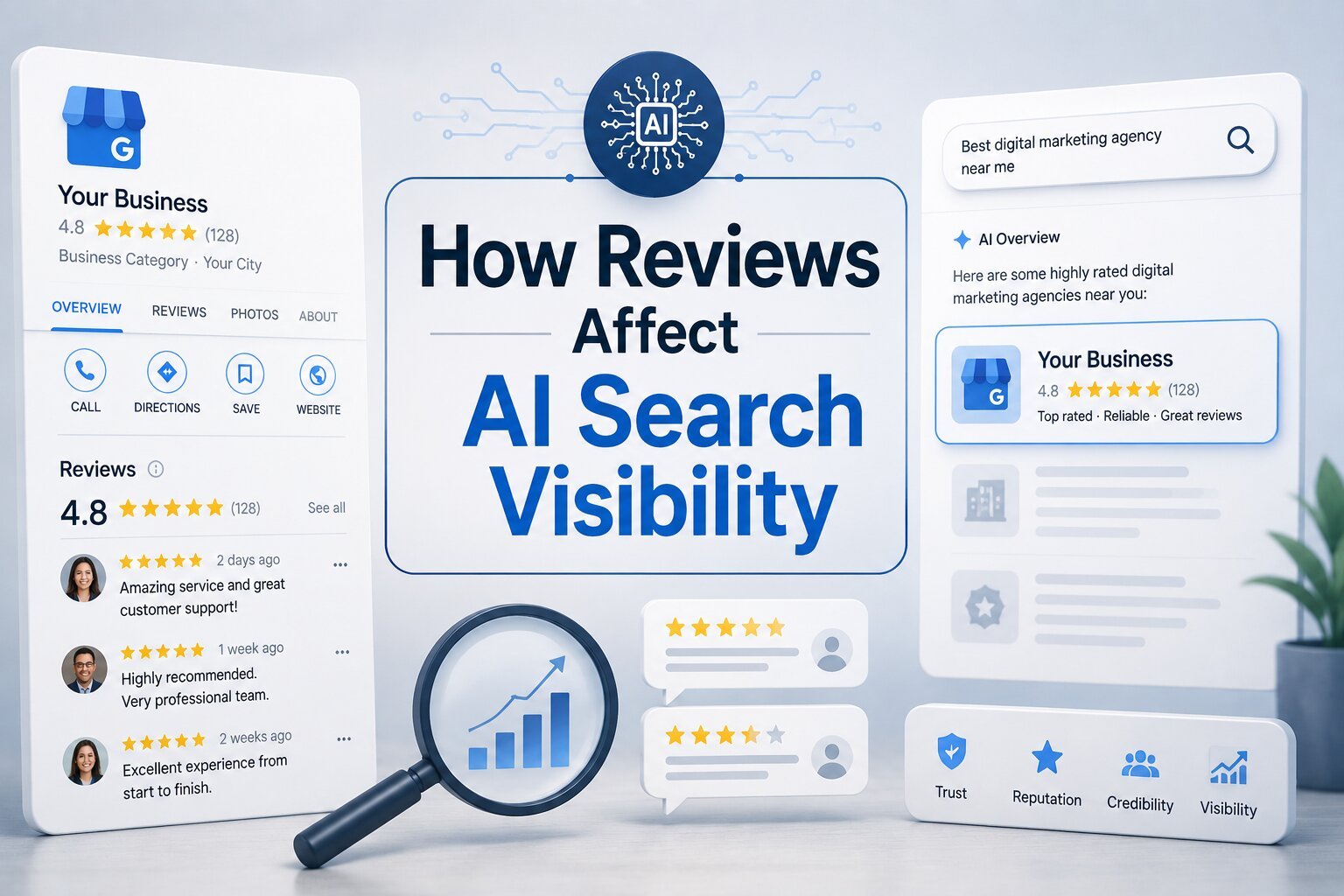
Reviews don’t work as a simple ranking factor the way backlinks or page titles do. But they do give AI search engines like Google AI Overviews, ChatGPT, Copilot, and Perplexity usable context about who you are, what you do, where you operate, and whether people trust you. That context can shape whether your business gets mentioned when someone asks an AI tool for a recommendation. Volume matters less than most business owners assume. Detail, freshness, and consistency across platforms matter more
A few years ago, the review strategy was simple: get more stars than the competitor down the street, and hope people notice before they scroll past.
That’s changed, and it’s changed faster than most business owners have caught up with. When someone types “best accountant for small business in Chicago” into ChatGPT or gets a Google AI Overview instead of ten blue links, there’s no scrolling involved. The AI tool has already picked a handful of businesses to mention, summarized what it “knows” about them, and moved on. If your business isn’t part of that summary, the searcher may never see you at all.
Reviews sit at the center of this shift, but not in the way most people assume. It’s not just about the star rating anymore. Reviews are one of the few places online where real customers describe, in their own words, what a business actually does, how it performs, and who it’s good for. That’s exactly the kind of raw material generative AI systems are built to read, synthesize, and repeat back to someone asking a question.
This article looks at what’s actually known about that relationship, what’s reasonably inferred, and what’s still unconfirmed — because a lot of advice in this space overstates certainty that doesn’t exist yet.
Table of Contents
ToggleWhat Is AI Search Visibility?
AI search visibility refers to whether and how often your business shows up inside AI-generated answers — an AI Overview summary, a ChatGPT recommendation, a Perplexity citation, a Copilot response — rather than as a standalone link in traditional search results.
Traditional SEO visibility is about rank position: are you in the top three results for a keyword. AI search visibility is different. It’s about whether an AI system has enough reliable information about your business to confidently include you when it generates an answer to someone’s question.
That’s a meaningful shift. Ranking systems work off crawlable, structured signals — links, on-page content, technical SEO. AI answer generation works more like synthesis: the model pulls from many sources (your website, your Google Business Profile, review platforms, directories, forum mentions) and tries to build a coherent picture of your business before deciding whether, and how, to mention you.
Reviews feed directly into that synthesis process, because they’re one of the richest sources of independently written, real-world description of what your business actually does.
Do Reviews Affect AI Search Visibility?
Yes — but indirectly, and not in a way that’s fully transparent or publicly confirmed by any single AI provider.
It’s important to be precise here, because there’s a real difference between:
- Direct ranking factors — confirmed inputs a system uses in a scoring formula
- Indirect reputation signals — information that shapes how trustworthy or relevant a business appears
- Contextual information — details AI systems can pull from public sources to describe a business accurately
- Entity understanding — how confidently a system can identify what your business is, does, and serves
No major AI search provider has published a confirmed formula stating “X number of reviews at Y star rating equals Z visibility boost.” That kind of specific claim should be treated skeptically wherever you see it.
What’s reasonably inferred, based on how these systems are built and how they behave, is that reviews contribute to entity understanding and reputation signals — they help an AI system build a clearer, more corroborated picture of your business, which can make it more likely to be referenced accurately and confidently.
How AI Search Engines Use Review Information
Generative AI systems are trained to synthesize information from many sources rather than trust a single claim at face value. Reviews contribute several kinds of contextual information to that process:
- Customer satisfaction — the general pattern of positive versus negative experiences
- Products and services — what people actually hired the business to do
- Business specialties — the specific niche a business is known for, drawn from repeated mentions
- Location — where a business operates, especially when reviewers mention neighborhoods or service areas
- Common customer experiences — recurring themes like response time, pricing honesty, or communication
- Strengths and weaknesses — what people consistently praise or complain about
- Brand reputation — the overall trust level built up across many independent voices
- Service quality — specific, descriptive accounts of how work was performed
The important nuance: AI systems appear to draw on multiple sources at once rather than relying exclusively on one review platform. A business’s Google reviews, industry-specific reviews, and mentions across the web likely all contribute to the same underlying picture, rather than any single platform acting as the sole source of truth.
7 Ways Reviews Can Influence AI Search Visibility
1. Reviews Build Trust and Reputation
Reviews are third-party validation. A landscaping company claiming “we do quality work” on its own homepage is a marketing statement. Forty customers independently describing clean, on-time, well-communicated jobs is a pattern — and patterns built from independent sources carry more weight than self-description, for AI systems just as much as for human readers.
2. Reviews Provide Context About Your Business
Reviews often describe specifics a service page might not: which neighborhoods a business actually serves, which problems it solves well, or which situations it handles best. A plumbing company’s reviews mentioning “fixed our tankless water heater on a Sunday” tells an AI system something concrete that a generic “emergency plumbing services” page doesn’t.
3. Review Sentiment Can Reinforce Brand Perception
Consistent sentiment across reviews — say, repeated mentions of “honest pricing” or “explained everything clearly” — reinforces a specific brand perception. When that sentiment shows up again and again across different reviewers, it starts to look less like a coincidence and more like an actual characteristic of the business.
4. Fresh Reviews Show Ongoing Customer Activity
A business with reviews trickling in every week looks active and currently operating. A business whose most recent review is from three years ago raises a natural question: is this business still running, and still performing the same way? Review freshness signals current relevance, not just historical reputation.
5. Detailed Reviews Help Clarify Services
Detailed reviews function almost like unintentional service descriptions. A reviewer who writes “they replumbed our entire second floor bathroom over two days and cleaned up thoroughly” is effectively documenting a specific service in a way that adds real, usable detail — far more than a five-word comment can.
6. Reviews Support Local Search Relevance
Reviews that mention specific neighborhoods, cities, or landmarks reinforce local relevance signals already present in your Google Business Profile and website content. This kind of naturally occurring local language can help connect your business to location-based queries.
7. Consistent Reputation Across Multiple Platforms Strengthens Online Presence
A business with aligned ratings and sentiment on Google, Yelp, Facebook, and an industry-specific platform presents a more coherent, corroborated identity than one whose reputation looks completely different depending on where you check. Consistency across sources appears to matter more than excelling on just one.
Does Google Review Count Matter for AI Search?
Review count matters, but not in isolation. Consider three realistic scenarios:
| Scenario | Review Count | Characteristics | Likely Contextual Value |
|---|---|---|---|
| Business A | 10 reviews | Highly detailed, specific, recent | Moderate volume but rich, specific detail |
| Business B | 100 reviews | Mostly generic, short, similar wording | High volume but limited descriptive value |
| Business C | 500 reviews | Mixed quality, inconsistent sentiment, spread over many years | Very high volume but inconsistent signal |
Business A, despite having the fewest reviews, may actually provide more usable contextual information than Business B or C, simply because the content is specific and descriptive. Volume without detail or consistency doesn’t necessarily translate into stronger AI visibility. Context, authenticity, and consistency appear to matter as much as — or more than — raw numbers.
Do Star Ratings Affect AI Recommendations?
Star ratings offer a quick, easily digestible reputation signal — for human searchers and, plausibly, for AI systems synthesizing quick context. A 5-star or 4.5+ average generally reads as a positive, low-risk signal. A rating that’s dropped suddenly, or one sitting well below competitors, may raise questions about recent service issues.
That said, there’s no confirmed threshold — no evidence that a business needs exactly 4.5 stars or higher to appear in AI-generated answers. Businesses with a 4.2 average and detailed, resolved negative reviews may present a more trustworthy overall picture than one with a 5.0 average built on five generic reviews. Treat star rating as one input into a larger picture, not a pass/fail gate.
Why Detailed Reviews May Be More Valuable Than Generic Reviews
Compare these two reviews:
“Great service!”
versus:
“I hired this local HVAC company to replace my AC unit in Long Island. The technician arrived on time, explained the options clearly, and completed the installation in one day.”
The first review confirms a positive experience and nothing else. The second confirms the service (AC unit replacement), the location (Long Island), the business type (HVAC), and specific behaviors (punctuality, clear communication, single-day completion). That second review is effectively doing double duty — it’s customer feedback and a mini service description at the same time, which is exactly the kind of rich, corroborated detail that’s useful for both human readers and AI synthesis.
Reviews and Local SEO + AI Search
Reviews and local SEO have always been connected through Google Business Profile, and that connection carries directly into AI search behavior. When reviews consistently mention your service area, your specific offerings, and your location, they reinforce the same signals your Business Profile and website are already sending.
This matters more as AI Overviews increasingly pull from local business data to answer location-based questions like “who does AC repair near me” or “best immigration consultant in Toronto.” A steady stream of geographically specific, service-specific reviews strengthens that local relevance picture rather than relying on your website content to carry the whole load.
How Negative Reviews Affect AI Search Visibility
Negative reviews aren’t automatically harmful, and trying to hide or suppress legitimate criticism is both against most platform policies and, practically speaking, unlikely to work in the long run.
What matters more is the overall pattern:
- Repeated complaints about the same issue (chronic lateness, poor communication) suggest a real, unresolved problem
- Isolated negative reviews with a thoughtful business response can actually strengthen trust by showing accountability
- A healthy mix of mostly positive with some negative reviews often reads as more authentic than an implausible run of five-star-only feedback
- Review diversity — different customers highlighting different strengths and occasional weaknesses — tends to look more genuine than a uniform wall of praise
The takeaway: address root causes of complaints and respond professionally, rather than trying to erase criticism.
How to Get Better Reviews Ethically
- Ask customers shortly after a successful job or delivery, while the experience is fresh
- Make leaving a review as simple as possible — a direct link, a QR code, a short text message
- Ask for honest feedback, not specifically for five stars
- Respond professionally and specifically to both positive and negative reviews
- Focus on actually improving the customer experience, since that’s what reviews will reflect
- Monitor for recurring complaints and treat them as operational feedback, not just reputation management
- Encourage detail (“what was most helpful?”) without scripting or dictating what customers should write
- Keep business name, address, phone number, and service details consistent everywhere you’re listed
Avoid:
- Buying reviews
- Offering incentives exclusively for positive reviews
- Writing or posting reviews for your own business
- Copy-pasting similar review text across multiple accounts
- Pressuring customers who had a negative experience to remove their review instead of resolving the issue
How to Respond to Reviews for Better Reputation
Positive review: “Thank you for taking the time to share this — we’re glad the installation went smoothly and that the timeline worked for your schedule.”
Neutral review: “Thanks for the honest feedback. We’d like to hear more about what would have made this a five-star experience — feel free to reach out directly.”
Negative review: “We’re sorry this didn’t go the way it should have. We’d like to make it right — please contact us directly so we can address this properly.”
Detailed service review: “Really appreciate the detailed rundown of your experience — glad the team could get the bathroom finished on schedule and keep things clean throughout.”
Keep responses genuine and specific to the situation. Generic, copy-pasted responses (“Thank you for your feedback!”) add little value to a human reader or to the contextual richness an AI system might draw from.
Reviews Across Multiple Platforms
Relevant platforms to monitor typically include:
- Google Business Profile
- Yelp
- TripAdvisor (for hospitality and travel-related businesses)
- Industry-specific platforms (Clutch and G2 for agencies and software, Avvo for legal, Healthgrades for medical)
- Reputable local directories relevant to your market
Prioritize platforms genuinely used by your customers and industry, rather than spreading effort thin across every review site that exists.
Case Study / Example
The following is a hypothetical example for illustration, not real data.
Business A: 4.9 stars, 180 reviews, detailed customer feedback describing specific services and outcomes, consistent name and address across every platform.
Business B: 4.8 stars, 600 reviews, mostly short and generic (“good service,” “recommend”), inconsistent business hours and address listed across different platforms.
Despite Business B having more than triple the review count, Business A likely provides stronger contextual signals for AI systems trying to understand what the business does, who it serves, and whether it’s currently active — because the underlying content is richer and the business information is consistent everywhere it appears.
How Businesses Can Improve AI Search Visibility Through Reviews
- Review generation: build a simple, repeatable process for requesting reviews after every job
- Review quality: encourage specific, descriptive feedback over generic one-liners
- Review freshness: aim for a steady trickle rather than sporadic bursts
- Review responses: reply to every review, positive or negative, within a few days
- Reputation management: monitor sentiment across platforms and address recurring issues
- Google Business Profile optimization: keep categories, services, hours, and photos current
- Consistent business information: match name, address, and phone number everywhere
- Website content: reflect the same services and locations your reviews describe
- Local SEO: reinforce service areas mentioned in reviews within your site content
- Brand mentions: encourage natural mentions across directories and industry sites
- Customer experience: ultimately, reviews reflect real service quality — that’s the foundation everything else builds on
Common Mistakes Businesses Make With Reviews
- Buying fake reviews or using review farms
- Asking every customer indiscriminately for a five-star review instead of honest feedback
- Ignoring negative reviews instead of responding and resolving them
- Using robotic, copy-pasted responses across every review
- Letting profiles go stale with outdated hours, services, or photos
- Focusing only on collecting more reviews rather than improving their quality
- Posting fabricated testimonials on the business website
- Attempting to manipulate or selectively filter which feedback gets published
Frequently Asked Questions
Do reviews affect AI search visibility? Reviews appear to influence AI search visibility indirectly, by contributing to reputation and context rather than acting as a confirmed direct ranking factor. They help AI systems build a clearer picture of a business, which can affect whether it gets mentioned in generated answers.
Do Google reviews influence AI search results? Google reviews likely play a role, especially in local and AI Overview results, since Google Business Profile data feeds into many of its AI-generated summaries. This isn’t a confirmed formula, but it’s a reasonable inference based on how Google’s local systems work.
Can reviews help a business appear in AI Overviews? Reviews can contribute to the reputation and contextual signals that make a business appear more credible and relevant, which may increase the chance of being mentioned. There’s no guarantee, since AI Overviews draw from many combined sources.
Does review quantity matter for AI search? Quantity matters to some degree, but detail, recency, and consistency appear to matter more. A smaller number of specific, descriptive reviews may provide more useful context than a large volume of generic ones.
Are 5-star reviews important for AI recommendations? A high average rating is a positive signal, but there’s no confirmed star-rating threshold required for AI visibility. A slightly lower rating with detailed, resolved reviews can still present a trustworthy picture.
Do negative reviews hurt AI visibility? Occasional negative reviews, especially with thoughtful business responses, aren’t necessarily harmful and can add authenticity. Repeated, unresolved complaints about the same issue are more likely to hurt overall reputation.
How often should businesses ask for reviews? Consistently, after each completed job or transaction, rather than in occasional large batches. A steady stream of recent reviews signals ongoing, active customer engagement.
Do detailed reviews help local SEO? Yes. Detailed reviews that mention specific services and locations reinforce the same relevance signals used in local search and Google Business Profile optimization.
Can fake reviews hurt AI search visibility? Fake or incentivized reviews risk removal or flagging by platforms, which undermines the reputation signal entirely. Unnatural review patterns may also be discounted by systems designed to detect them.
How can businesses improve their reputation for AI search? Focus on genuinely improving customer experience, requesting honest feedback consistently, responding to all reviews professionally, and keeping business information accurate and consistent across every platform.
Do reviews affect ChatGPT business recommendations? It’s reasonable to infer that publicly available review information could inform how ChatGPT and similar tools describe or recommend a business, since these systems draw on broad web data. This isn’t confirmed by OpenAI as a specific ranking mechanism.
What is the relationship between reviews, local SEO, and AI search? Reviews reinforce local SEO signals like service area and business category, which feed into the same data AI search tools use to generate local recommendations. Together, they build a more complete, trustworthy picture of a business.
Conclusion
Reviews shouldn’t be treated as a shortcut to better AI search rankings, because no such guaranteed formula exists — and any claim that promises one should be viewed skeptically. What reviews reliably do is build a richer, more corroborated picture of your business: what you do, where you do it, and whether people trust you.
That picture matters more, not less, as search shifts toward AI-generated answers. Businesses that treat reviews as part of a broader reputation and local visibility strategy — alongside accurate business information, solid website content, and genuinely good customer service — put themselves in a stronger position to be understood, and eventually mentioned, by the AI tools more people are starting to ask instead of Google.
Practical takeaway: Focus on earning honest, detailed, recent reviews across a few relevant platforms, respond to all of them, and keep your business information consistent everywhere it appears. That foundation serves both your customers and the AI systems increasingly standing between you and them.