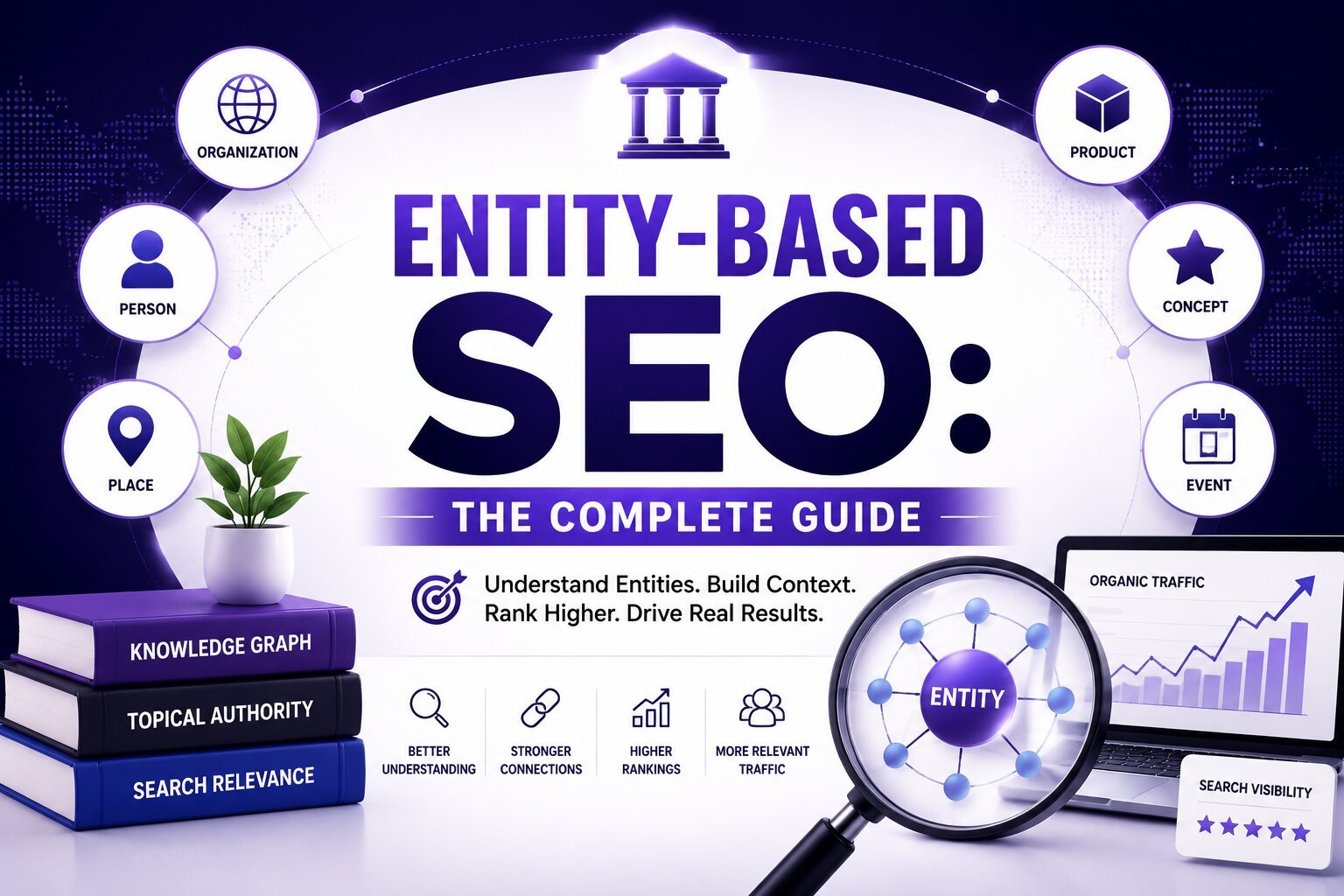
Google stopped being a keyword-matching engine over a decade ago. What replaced it is a system built around entities — real-world people, places, brands, and concepts — and how they relate to one another. That shift is now the single biggest reason some pages show up in Google’s Knowledge Panels, AI Overviews, and ChatGPT answers while nearly identical competitors don’t.
This guide covers what entity-based SEO actually is, how it works under the hood, and exactly how to build an entity strategy that holds up in both traditional search and AI-powered answer engines.
Table of Contents
ToggleWhat Is an Entity?
An entity is any distinct, well-defined thing that search engines can identify and store facts about — a person, place, organization, product, or concept. Unlike a keyword, which is just a string of text, an entity has an identity that stays consistent no matter how it’s phrased.
“Apple” the keyword is ambiguous. “Apple Inc.” the entity is not — search engines know it’s a technology company headquartered in Cupertino, distinct from the fruit, with a defined set of attributes: founders, products, executives, and relationships to other entities like Tim Cook or the iPhone.
Where You’ve Already Seen Entities
- Knowledge Panels — the info box that appears beside search results for a known person, place, or brand
- Google Business Profiles — local entities with attributes like address, hours, and reviews
- “People Also Ask” clusters — grouped around a shared underlying entity or concept
- Wikipedia infoboxes — structured facts about an entity, ready-made for machine reading
Entity vs. Keyword: A Quick Comparison
| Keyword | Entity |
|---|---|
| A string of text | A defined, unique thing |
| Ambiguous without context | Disambiguated — has one identity |
| Matched by text similarity | Matched by meaning and relationships |
| “seo agency karachi” | Vryse (the specific company) |
| “apple” | Apple Inc. or the fruit — resolved by context |
What Is Entity-Based SEO?
Entity-based SEO is the practice of structuring content, data, and site architecture so that search engines can clearly identify, understand, and connect the real-world entities your content is about. Instead of optimizing for a phrase, you’re optimizing for recognition — making sure Google (and increasingly, AI models) knows exactly who or what you are, what you do, and how you relate to other known entities.
This isn’t a replacement for keyword research. It’s a layer on top of it. Keywords still tell you what people are searching for; entities tell search engines what your content — and your brand — actually is.
How Entity-Based SEO Works
Google’s entity understanding is powered by its Knowledge Graph, a database that has grown from roughly 570 million entities in 2012 to well over 8 billion entities and hundreds of billions of facts today. When Google crawls a page, it doesn’t just index the words — it tries to map the content to entities it already knows about, and to identify new ones.
That process relies on a few core techniques:
- Named Entity Recognition (NER) — identifying which words in a text refer to real entities (people, places, organizations)
- Entity disambiguation — deciding which entity a mention refers to, based on surrounding context
- Entity linking — connecting a mention in your content to the corresponding entry in a knowledge base like Wikidata or Google’s own Knowledge Graph
- Relationship mapping — understanding how entities connect (a person “works for” a company, a product “is made by” a brand)
The practical upshot: the more clearly and consistently your content identifies its entities — and the more those entities are corroborated elsewhere on the web — the easier it is for Google to trust and rank you for a much wider range of related queries than the exact keywords on the page.
Expert tip: A useful mental model is that Google isn’t asking “does this page contain the word X?” anymore. It’s asking “does this page — and this website, and this author — meaningfully relate to the entity X, and can I verify that from other sources?”
A Brief History: From Keywords to Entities
- 2012 — Google acquires Freebase and launches the Knowledge Graph, publicly framing the shift as “things, not strings.”
- 2013 — The Hummingbird update moves Google’s core algorithm toward understanding full queries and intent, not just matching keyword strings.
- 2015 — RankBrain introduces machine learning to help Google interpret ambiguous or never-before-seen queries.
- 2018–2019 — BERT improves Google’s grasp of natural language context, including how words relate within a sentence.
- 2021 — MUM extends that understanding across languages and formats.
- 2023–present — Generative and AI-powered search (Google AI Overviews, ChatGPT, Gemini, Perplexity) fully shifts the unit of retrieval from “pages” to “answers assembled from entities and passages.”
Each step moved search further away from literal text matching and closer to genuine conceptual understanding — which is exactly the environment entity-based SEO is built for.
Entity SEO vs. Keyword SEO vs. Semantic SEO
These three terms get conflated constantly. Here’s how they actually differ.
| Approach | Core Focus | Optimizes For | Example Tactic |
|---|---|---|---|
| Keyword SEO | Specific search terms and phrases | Matching what users literally type | Targeting “best running shoes” in a title tag |
| Semantic SEO | Meaning, context, and intent behind a query | Covering a topic comprehensively, not just a phrase | Writing content that answers every related sub-question |
| Entity SEO | Real-world things and their relationships | Being clearly identified and trusted as the authority on a specific entity | Structured data, consistent branding, entity linking, authoritative mentions |
In practice, the three overlap heavily and reinforce each other. Entity SEO gives search engines confidence in who you are; semantic SEO gives them confidence in what you know; keyword SEO gives them the specific phrases to match you against. A mature SEO strategy needs all three — but entity SEO is the piece most sites still neglect.
Why Entity-Based SEO Matters for AI Search
This is the part that’s changed the stakes dramatically in the last two years.
AI-powered search platforms — Google AI Overviews, ChatGPT, Gemini, and Perplexity — don’t rank ten blue links. They synthesize an answer from multiple sources and decide, passage by passage, what to cite. That process leans even more heavily on entity recognition than traditional search does, because the model needs to know exactly what a claim is about before it can confidently include it in a generated answer.
The data backs this up in a genuinely surprising way. According to Semrush’s large-scale study of AI search citations, when ChatGPT cites a webpage, that page ranks in traditional organic search position 21 or lower almost 90% of the time (source). In other words, ranking #1 through #3 on Google is no longer a prerequisite for being cited by AI — but being a clearly identifiable, well-corroborated entity on a specific topic matters enormously.
What this means practically:
- Google AI Overviews pull heavily from pages with clear entity signals — structured data, consistent naming, and strong topical depth.
- ChatGPT favors specific, well-defined passages tied to recognizable entities over broad, ambiguous pages, even when those pages rank lower in traditional search.
- Gemini inherits Google’s underlying Knowledge Graph understanding, making entity clarity directly relevant to its outputs.
- Perplexity is built around sourcing and citation, which rewards content that clearly states facts about identifiable entities rather than vague generalizations.
Conversational, entity-rich content — the kind that explicitly names people, brands, places, and concepts rather than relying on pronouns and vague references — is simply easier for these systems to lift and cite correctly.
How to Build an Entity-Based SEO Strategy
Step 1: Identify Your Core Entities
Start by listing the entities central to your business: your brand name, your founder or key team members, your core products or services, and the specific topics you want to be known for. Every one of these needs a consistent, unambiguous identity across your site and the wider web.
Step 2: Build Topic Clusters Around Each Entity
Give each core entity a dedicated pillar page, supported by cluster content that covers related sub-topics, use cases, comparisons, and questions. This structure signals depth and helps search engines map the full scope of what you know about that entity.
Step 3: Add Structured Data (Schema Markup)
Schema markup is the most direct way to tell search engines explicitly which entities appear on a page and how they relate. At minimum, most sites should implement:
- Organization schema — defines your business as an entity, with a
sameAsproperty linking to your Wikipedia, LinkedIn, Crunchbase, and other authoritative profiles - Person schema — for authors and key team members, similarly linked via
sameAs - Article/BlogPosting schema — clarifies authorship, publish date, and subject matter
- FAQPage schema — structures question-and-answer content for direct extraction
- Product schema — for e-commerce entities, including reviews and pricing
Step 4: Get Corroborated Elsewhere on the Web
Search engines don’t just trust what you say about yourself — they look for confirmation elsewhere. This means:
- Getting listed in relevant, reputable directories
- Earning mentions (not just links) from credible publications
- Maintaining an active, consistent presence on platforms like LinkedIn, Crunchbase, and industry-specific databases
- Where relevant and genuinely notable, building a presence on Wikipedia or Wikidata
Step 5: Interlink Entities Consistently
Internal linking should reinforce entity relationships — link mentions of your product to its dedicated page, link team members to their author pages, and use consistent, descriptive anchor text every time. Avoid linking the same entity under multiple different names.
Step 6: Keep Naming and Descriptions Consistent
Inconsistent branding is one of the fastest ways to undermine entity clarity. If your business is sometimes called “Vryse,” sometimes “Vryse SEO,” and sometimes “Vryse.co” across different platforms, you’re fragmenting the trust signals search engines need to treat those mentions as the same entity.
Tools for Entity Research and Optimization
| Tool | What It’s Used For |
|---|---|
| Google Knowledge Graph Search API | Check whether an entity already exists in Google’s Knowledge Graph and view its associated data |
| Google Cloud Natural Language API | Test how Google’s NLP models parse and score the salience of entities in your content |
| Wikidata | Explore and contribute to the structured, open knowledge base many entity systems draw from |
| Schema Markup Validator / Rich Results Test | Confirm your structured data is implemented correctly |
| Ahrefs / Semrush | Research topical gaps, competitor entity coverage, and content cluster opportunities |
| InLinks / MarketMuse | Purpose-built entity and topical-relevance optimization platforms |
Common Entity SEO Mistakes to Avoid
- Inconsistent brand naming across your site, social profiles, and directory listings
- Treating schema markup as a checkbox rather than an accurate reflection of well-developed content — schema on thin pages doesn’t help
- Ignoring
sameAsproperties that link your entity to authoritative external profiles - Building entity pages with no internal linking connecting them to related content
- Confusing entity SEO with keyword stuffing — repeating an entity’s name unnaturally doesn’t strengthen recognition; context and relationships do
- Neglecting author entities — publishing content with no clear, consistent author identity undermines E-E-A-T signals AI and traditional search both weigh heavily
Real-World Entity SEO Examples by Industry
| Industry | Core Entity | Supporting Entity Signals |
|---|---|---|
| SaaS | The product itself | Product schema, comparison pages, integration partner mentions |
| Local Business | The business location | Google Business Profile, consistent NAP data, local directory listings |
| Publishing/Media | The author | Person schema, consistent bylines, sameAs links to LinkedIn/Twitter |
| E-commerce | Individual products | Product schema, review markup, manufacturer entity links |
| B2B Services | The company brand | Organization schema, Crunchbase/LinkedIn presence, case study entities |
| Healthcare | Practitioners and services | Person schema for providers, MedicalOrganization schema, credential citations |
Entity-Based SEO Checklist
- Core brand, product, and team entities identified and documented
- Organization and Person schema implemented with
sameAslinks - Consistent naming used across the site, social platforms, and directories
- Topic clusters built around each core entity with strong internal linking
- Author bios include clear credentials and consistent identity signals
- Business listed in relevant, reputable industry directories
- Wikipedia/Wikidata presence considered where genuinely notable
- FAQPage and Article schema implemented on relevant content
- Entity mentions verified using Google’s Knowledge Graph Search API
- Content reviewed for vague pronouns/references that could be replaced with explicit entity names
- Structured data validated with Google’s Rich Results Test
- Regular monitoring of brand mentions and citations across the web
Frequently Asked Questions About Entity-Based SEO
1. What is entity-based SEO?
Entity-based SEO is the practice of optimizing content and site structure so search engines can clearly identify, understand, and trust the real-world entities — people, brands, products, and concepts — that your content is about, rather than relying purely on keyword matching.
2. How is entity SEO different from keyword SEO?
Keyword SEO targets the specific words and phrases people search for. Entity SEO targets recognition of what your content and brand actually are, using structured data, consistent naming, and corroborating mentions elsewhere on the web.
3. Do I need schema markup for entity SEO?
It’s one of the most effective tools available, but not the only one. Schema markup gives search engines explicit, structured confirmation of your entities — but it works best paired with genuinely comprehensive content and external corroboration.
4. Does entity SEO help with AI search visibility?
Yes, significantly. AI platforms like ChatGPT, Gemini, and Google AI Overviews rely heavily on entity recognition to decide what to cite, and research shows AI citations often come from pages that wouldn’t rank in the traditional top 10 — meaning entity clarity can matter more than raw keyword rank.
5. What’s the difference between entity SEO and semantic SEO?
Semantic SEO focuses on covering the full meaning and context behind a topic. Entity SEO focuses specifically on identifying and clarifying real-world things and their relationships. They overlap heavily and work best together.
6. Do I need a Wikipedia page for entity SEO to work?
No — a Wikipedia page can help significantly for well-known entities, but it’s not required. Consistent structured data, directory listings, and corroborating mentions across credible sources can build strong entity recognition without one.
7. How long does entity SEO take to show results?
It varies, but because entity recognition depends partly on corroboration accumulating across the web over time, it’s typically a slower, more compounding process than ranking for a single keyword — often measured in months rather than weeks.
8. Can small businesses benefit from entity SEO? Yes, arguably more than large brands. Clear, consistent entity signals help smaller sites establish trust and topical authority without needing to out-compete larger sites purely on backlink volume.
9. What is sameAs in schema markup, and why does it matter?
sameAs is a schema property that links your entity to its profiles on other authoritative platforms (Wikipedia, LinkedIn, Crunchbase, etc.), helping search engines confirm it’s the same entity across the web.
10. Is entity SEO only relevant for Google?
No. Because entity recognition underpins how most modern AI search and answer engines work — including ChatGPT, Gemini, and Perplexity — entity SEO has become relevant well beyond Google’s own results pages.
11. How do I find out if my brand is already recognized as an entity by Google?
Search your brand name directly and see if a Knowledge Panel appears, or query Google’s Knowledge Graph Search API to check whether your entity exists in their database and what data is associated with it.
Conclusion: Why Entity-Based SEO Is No Longer Optional
Search stopped being about matching text a long time ago. It’s about whether a search engine — or an AI model synthesizing an answer — can confidently say “yes, I know exactly what this is, and I trust it enough to cite.” That confidence comes from clear, consistent, well-corroborated entities, not clever keyword placement.
Key takeaways:
- Entities are distinct, identifiable things; entity SEO is about making sure search engines recognize and trust yours.
- Structured data, consistent naming, and external corroboration are the three pillars of a strong entity strategy.
- AI search platforms lean on entity recognition even more heavily than traditional search — and don’t require a top-3 ranking to cite you.
- Entity SEO, semantic SEO, and keyword SEO aren’t competing strategies; they work together, with entity SEO as the foundation most sites still underinvest in.
Start with the entities that matter most to your business — your brand, your team, your core offerings — and build outward from there. In a search landscape increasingly run by AI systems trying to understand what things are, that clarity is quickly becoming the difference between being cited and being invisible.