
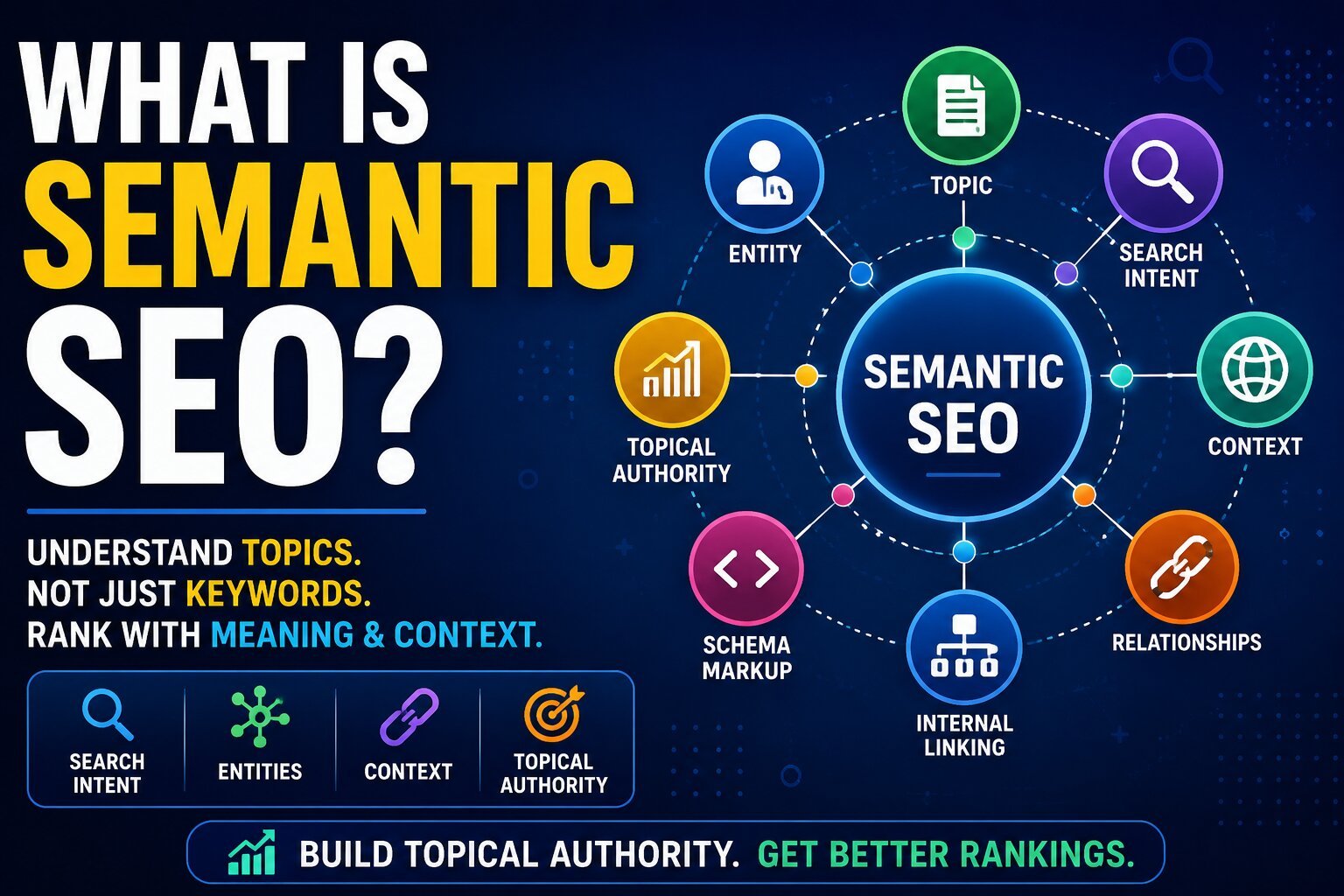
This shift has a name: Semantic SEO. It’s the practice of optimizing content around meaning, context, entities, and relationships between topics — not just individual keywords. And in 2026, with AI Overviews, ChatGPT, Gemini, and Perplexity all reshaping how people find information, semantic SEO isn’t optional anymore. It’s the foundation everything else is built on.
This guide answers three core questions right away, then goes deep into every part of semantic SEO you need to understand and apply:
- What is Semantic SEO? It’s an approach to content and site structure that helps search engines understand topics, entities, and intent — not just keywords.
- Why is Semantic SEO important in 2026? Because AI-powered search systems rank based on comprehensive topical understanding, not exact-match phrases.
- How does Google understand topics instead of keywords? Through entity recognition, the Knowledge Graph, natural language processing, and the relationships between pages on a site.
Let’s break all of this down in detail.
Table of Contents
ToggleWhat Is Semantic SEO?
Semantic SEO is the practice of structuring and optimizing content so that search engines understand its meaning, not just its wording. Instead of chasing exact-match keywords, semantic SEO focuses on the concepts, entities, and relationships behind a topic.
It rests on five pillars:
- Meaning-based optimization — writing content that thoroughly explains a concept, rather than repeating a phrase
- Contextual relevance — ensuring the words around your target topic reinforce what the page is actually about
- Entity-based SEO — optimizing for recognizable things (people, places, brands, products, concepts) rather than isolated words
- Search intent optimization — matching content to what the user actually wants to accomplish
- Topic relationships — connecting related subtopics so search engines see the full picture of your expertise
A simple example: A traditional SEO approach to “best running shoes” might repeat that exact phrase throughout a page. A semantic SEO approach would also naturally cover related concepts — cushioning, arch support, pronation, trail vs. road running, shoe brands, and foot injuries — because that’s what a real expert writing about running shoes would actually discuss. Google reads that depth as genuine topical understanding.
How Semantic SEO Works
Search Intent
Every search query falls into one (or more) of four intent categories:
- Informational — the user wants to learn something (“what is semantic SEO”)
- Commercial — the user is researching options before buying (“best SEO tools 2026”)
- Navigational — the user wants to reach a specific site or page (“Semrush login”)
- Transactional — the user is ready to take action (“buy Semrush subscription”)
Semantic SEO requires matching content format and depth to the correct intent. A commercial-intent page stuffed with only theoretical explanation — or an informational query answered with a hard sales pitch — will underperform, no matter how well-optimized the keywords are.
Entities
An entity is any distinct, identifiable “thing” — a person, place, brand, product, or concept — that search engines can recognize and connect to other entities. Examples include:
- People — e.g., an author, an expert, a public figure
- Places — e.g., a city, region, or country
- Brands — e.g., a company name
- Products — e.g., a specific software tool or physical item
- Concepts — e.g., “topical authority” or “link equity”
Google’s systems map entities and their relationships to each other, which is a large part of how it understands what a page — and a whole website — is really about.
Context
Context is how Google determines the specific meaning of a word or phrase based on everything around it. The word “python” means something completely different on a page about programming versus a page about reptiles. Google uses surrounding words, page structure, internal links, and even the rest of a website’s content to disambiguate meaning and confirm topical focus.
Relationships Between Topics
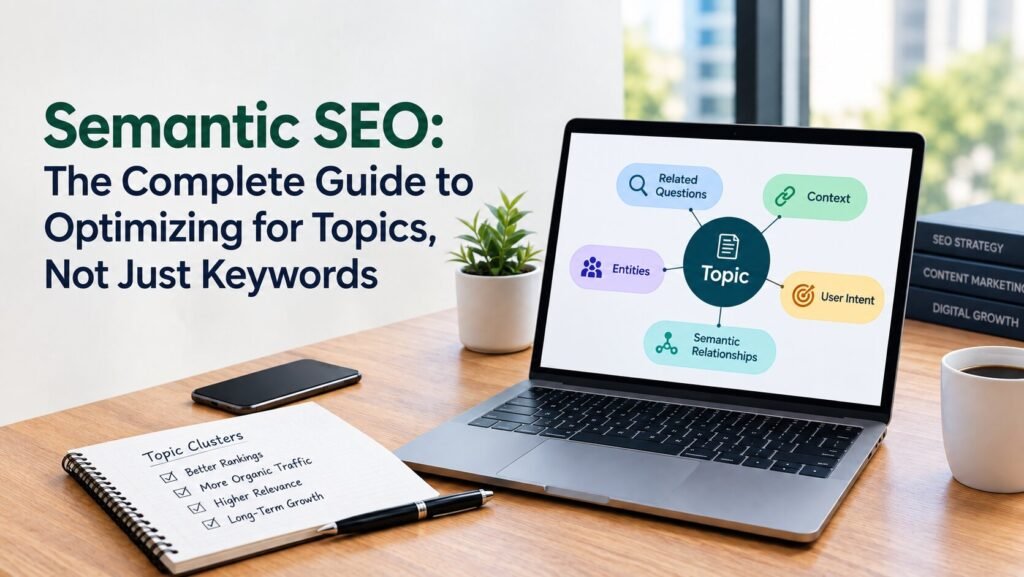
Semantic SEO isn’t about optimizing single pages in isolation — it’s about building networks of related content that reinforce each other. This is where topic clusters come in: a central topic (covered by a pillar page) surrounded by related subtopics (covered by cluster content), all interlinked.
When Google sees a dense, well-organized cluster of content around a subject, it interprets that as a strong semantic signal that the site has real depth and expertise on that topic — not just a single lucky page that happens to rank.
Semantic SEO vs. Traditional SEO
| Factor | Traditional SEO | Semantic SEO |
|---|---|---|
| Focus | Keywords | Topics & Entities |
| Ranking Method | Exact Match | Contextual Relevance |
| User Intent | Limited | High Priority |
| Content Strategy | Single Keywords | Topic Clusters |
| Internal Linking | Basic | Strategic |
| AI Search Compatibility | Lower | Higher |
Traditional SEO isn’t obsolete — keyword research still matters. But it’s now a starting point, not the whole strategy. Semantic SEO builds on top of keyword research by adding depth, structure, and relationships that traditional tactics alone can’t provide.
Why Semantic SEO Matters in 2026
Search has become AI-powered, and AI systems reward comprehensiveness and clarity over keyword density.
- Google’s AI-Powered Search — Google’s ranking systems use natural language understanding to evaluate topical depth, not just keyword frequency.
- AI Overviews — Google’s generated summaries pull from sources that clearly and comprehensively answer a query, often synthesizing multiple related subtopics.
- ChatGPT — when answering questions, ChatGPT (and similar assistants) favor content that’s well-organized and topically authoritative, since that structure makes it easier to extract accurate, citable information.
- Gemini — Google’s own AI assistant draws heavily on the same entity and topical understanding used in core Search.
- Perplexity — an answer engine that actively cites sources, favoring pages with clear, well-supported claims and strong topical relevance.
- Voice search — voice queries tend to be longer and more conversational, matching the natural-language, intent-driven approach semantic SEO already optimizes for.
In short, every one of these systems is trying to understand meaning — which means semantic SEO isn’t just a “nice to have” anymore. It’s the baseline requirement for visibility across both traditional and AI-driven search.
Core Components of Semantic SEO
Entity SEO
Entity SEO means clearly establishing who and what your content is about in a way search engines can recognize.
- Knowledge Graph — Google’s structured database of entities and their relationships; being recognized as an entity within it (a person, brand, or organization) strengthens trust and visibility.
- Named entities — clearly naming people, places, products, and organizations in your content, rather than relying on vague references.
- Brand entities — consistent brand mentions, structured data, and citations across the web help Google recognize your brand as a distinct, trustworthy entity.
Topical Authority
Topical authority is the degree to which a site is seen as a comprehensive, trustworthy source on a subject.
- Topic clusters — groups of related content covering a subject from multiple angles
- Pillar pages — broad overview pages that anchor a topic cluster
- Content hubs — organized collections of pillar and cluster content, often supported by clear navigation and internal linking
Internal Linking
Internal linking is the connective tissue of semantic SEO.
- Contextual relevance — links placed within body content, connecting genuinely related topics
- Authority distribution — spreading link equity to reinforce which pages matter most within a topic cluster
Structured Data
- Schema markup — code added to a page that explicitly tells search engines what type of content it is (an article, a product, an FAQ, a recipe, etc.)
- Rich results — enhanced search listings (star ratings, FAQ dropdowns, product prices) that schema markup can unlock, improving both visibility and click-through rate
Search Intent Optimization
Matching user expectations means making sure your content format, depth, and tone align with what someone searching that query actually wants — a quick definition, a detailed guide, a comparison, or a place to buy something.
Semantic SEO and Topical Authority
Topical authority matters because Google doesn’t just want the single best page on a topic — it wants to know that a site consistently produces trustworthy, comprehensive coverage of a subject over time. Semantic SEO builds this expertise by:
- Covering a topic from multiple angles (definitions, comparisons, how-tos, case studies)
- Connecting all of that coverage through internal links
- Reinforcing entity relationships across pages
Google identifies authoritative websites by looking at the density, consistency, and interconnection of topical content — not just isolated ranking signals on individual pages.
Here’s a simple visual of how it all fits together:
Semantic SEO
│
├── Pillar Page
│
├── Topic Cluster 1
├── Topic Cluster 2
├── Topic Cluster 3
│
└── Internal Linking
How to Build a Semantic SEO Strategy
Step 1: Identify Core Topics Start with the broad subjects most relevant to your business or audience — not individual keywords, but whole topics (e.g., “email marketing” rather than “best email marketing software 2026”).
Step 2: Research Entities Identify the people, brands, products, and concepts closely associated with your core topics, and make sure your content clearly references them.
Step 3: Create Topic Clusters Break each core topic into subtopics that a real expert would naturally cover.
Step 4: Build Pillar Pages Create a comprehensive overview page for each core topic that links out to every piece of cluster content.
Step 5: Implement Internal Linking Connect cluster pages back to the pillar, and to each other where relevant, using descriptive anchor text.
Step 6: Add Schema Markup Apply appropriate structured data (Article, FAQ, Product, Organization, etc.) to help search engines and AI systems parse your content accurately.
Step 7: Optimize for Search Intent Review each page to confirm its format and depth match what a searcher actually expects for that query.
Step 8: Measure Performance Track rankings, organic traffic, and — increasingly — appearances in AI Overviews and citations from AI assistants, then refine weak spots in the cluster.
Semantic SEO Examples
- SEO Industry — a pillar page on “Technical SEO” surrounded by cluster content on crawl budget, site speed, indexation, and structured data, all interlinked and referencing entities like Googlebot and Google Search Console.
- SaaS — a company selling project management software builds a hub around “Project Management,” with clusters on Agile, Kanban, remote team collaboration, and specific feature pages, linking educational content to product pages naturally.
- Healthcare — a clinic builds authority around “Diabetes Care,” with cluster pages on symptoms, diagnosis, treatment options, and diet — reinforcing medical entities and citing credible sources to support EEAT.
- Real Estate — an agency builds location-based topic clusters (“Buying a Home in Austin”), linking neighborhood guides, market trend pages, and mortgage information together.
- E-commerce — an outdoor gear retailer connects category pages, buying guides, and product pages into a single hiking-focused content hub, reinforcing entities like specific gear brands and outdoor activities.
In each case, entities, related subtopics, and internal linking work together to show search engines — and AI systems — that the site has real, structured expertise, not just a scattering of pages that happen to rank.
Best Semantic SEO Tools
| Tool | Purpose |
|---|---|
| Google Search Console | Tracks indexing, query performance, and identifies content gaps or underperforming pages |
| Ahrefs | Keyword and topic research, backlink analysis, and content gap analysis |
| Semrush | Topic research, competitor content mapping, and on-page SEO recommendations |
| Surfer SEO | Content optimization based on topical relevance and semantic keyword coverage |
| Frase | AI-assisted content briefs built around entities and related subtopics |
| Screaming Frog | Site crawling to audit internal linking structure and identify orphan pages |
Each of these tools supports a different part of the semantic SEO process — from identifying the entities and subtopics you should cover, to auditing whether your internal linking structure actually reflects that topical depth.
Semantic SEO for AI Search
- Google AI Overviews favor content that clearly and comprehensively answers a query, often pulling from sites with strong topical structure.
- ChatGPT Citations tend to favor sources that present information clearly, with well-organized headings and direct answers — the same structure semantic SEO encourages.
- Gemini draws on Google’s broader understanding of entities and topics, making semantic optimization directly relevant to visibility there as well.
- Perplexity actively cites sources and tends to favor content with clear factual claims, strong structure, and topical authority.
- Answer Engine Optimization (AEO) is the practice of structuring content — FAQs, clear definitions, concise answers — specifically to be extracted and cited by AI-generated answers.
Semantic SEO increases the chances of being cited by AI systems because these systems are fundamentally trying to do the same thing Google’s core algorithm does: understand meaning and identify the most trustworthy, comprehensive source on a topic.
Common Semantic SEO Mistakes
- Focusing only on keywords — writing to hit a phrase count instead of covering a topic thoroughly
- Ignoring entities — failing to clearly name and reference the people, brands, and concepts relevant to your content
- Weak internal linking — publishing related content without ever connecting it together
- Thin content — covering a topic too shallowly to demonstrate real expertise
- No topic clusters — treating every page as a standalone piece instead of part of a larger structure
- Poor content structure — skipping clear headings, making it harder for both readers and AI systems to parse the content
Semantic SEO Checklist
| Task | Completed |
|---|---|
| Topic Research | ☐ |
| Entity Optimization | ☐ |
| Internal Linking | ☐ |
| Schema Markup | ☐ |
| Topic Clusters | ☐ |
| Search Intent Alignment | ☐ |
Advanced Semantic SEO Techniques
- Entity Mapping — documenting every entity relevant to your niche and how they relate to each other, then systematically covering them across your content
- Knowledge Graph Optimization — building consistent, structured data and citations across the web to strengthen your brand’s presence as a recognized entity
- Content Relationships — deliberately designing how pieces of content reference and support one another, rather than letting relationships form randomly
- Reverse Siloing — allowing cluster content to link both up to the pillar and across to other relevant clusters, reinforcing the network rather than a strict hierarchy
- Semantic Internal Linking — linking based on conceptual relevance, not just exact keyword anchor text matches
- AI Search Optimization — structuring content with clear, extractable answers (concise definitions, FAQs, structured lists) to improve the odds of being cited by AI Overviews and AI assistants
Expert Recommendations
- Building topical authority: commit to covering a subject comprehensively before moving on to the next one — depth beats breadth in the early stages of a content strategy.
- Improving content quality: prioritize first-hand experience and expert review wherever possible, since EEAT signals (especially genuine Experience) increasingly influence both traditional rankings and AI-source selection.
- Ranking in AI search engines: structure key facts and definitions clearly near the top of relevant sections, making them easy for AI systems to extract accurately.
- Creating semantic content structures: use clear H1, H2, and H3 headings that map directly to the subtopics and questions your audience actually has.
FAQ Section
1. What is Semantic SEO?
Semantic SEO is the practice of optimizing content around meaning, entities, and topic relationships, rather than focusing only on exact-match keywords.
2. How is Semantic SEO different from traditional SEO?
Traditional SEO centers on individual keywords and exact-match phrasing, while Semantic SEO focuses on topics, entities, search intent, and the relationships between related pieces of content.
3. Does Google use Semantic SEO?
Yes. Google’s ranking systems use natural language understanding and the Knowledge Graph to interpret meaning, context, and entity relationships rather than relying solely on keyword matching.
4. What are entities in SEO?
Entities are distinct, identifiable things — such as people, places, brands, products, or concepts — that search engines recognize and connect to related entities.
5. How do topic clusters help Semantic SEO?
Topic clusters group related content around a central pillar page, showing search engines that a site comprehensively covers a subject rather than offering isolated, disconnected pages.
6. Is Semantic SEO important for AI search?
Yes. AI systems like Google AI Overviews, ChatGPT, Gemini, and Perplexity rely on understanding topics and entities to generate accurate answers, making semantic SEO directly relevant to AI search visibility.
7. Can Semantic SEO improve rankings?
Yes. By demonstrating topical depth, clear entity relationships, and strong content structure, Semantic SEO helps search engines recognize a page — and site — as a trustworthy, relevant source.
8. Do I need to abandon keyword research for Semantic SEO?
No. Keyword research is still a useful starting point for understanding what people search for; Semantic SEO builds on it by adding topical depth, entity coverage, and content relationships.
9. What’s the role of schema markup in Semantic SEO?
Schema markup explicitly labels content types for search engines, making it easier for them to understand and accurately represent your content, which can also unlock rich results.
10. How long does it take to see results from Semantic SEO?
Results vary, but most sites see meaningful improvements in topical rankings and AI search visibility within a few months of consistently building out topic clusters and internal linking.
Conclusion
Semantic SEO represents the shift from optimizing for keywords to optimizing for meaning. By focusing on topics, entities, search intent, and the relationships between pieces of content, it helps search engines — and increasingly, AI systems — understand not just what a single page says, but what an entire website genuinely knows.
This matters more in 2026 than ever before. As Google AI Overviews, ChatGPT, Gemini, and Perplexity reshape how people find information, the sites that win won’t be the ones with the most keyword-stuffed pages — they’ll be the ones with clear, well-organized, deeply interconnected topical authority. Semantic SEO is how you build that. Start with one core topic, map its entities and subtopics, connect it all with strategic internal linking, and you’ll have laid the foundation for rankings that hold up across both traditional and AI-powered search for years to come.


What do you think?
[…] The linking is what makes this work. Every cluster page links back to the pillar. The pillar links out to every cluster page. That two-way linking tells search engines these pages are all part of one coherent topic — which builds what’s often called topical authority. […]
Comments are closed.