
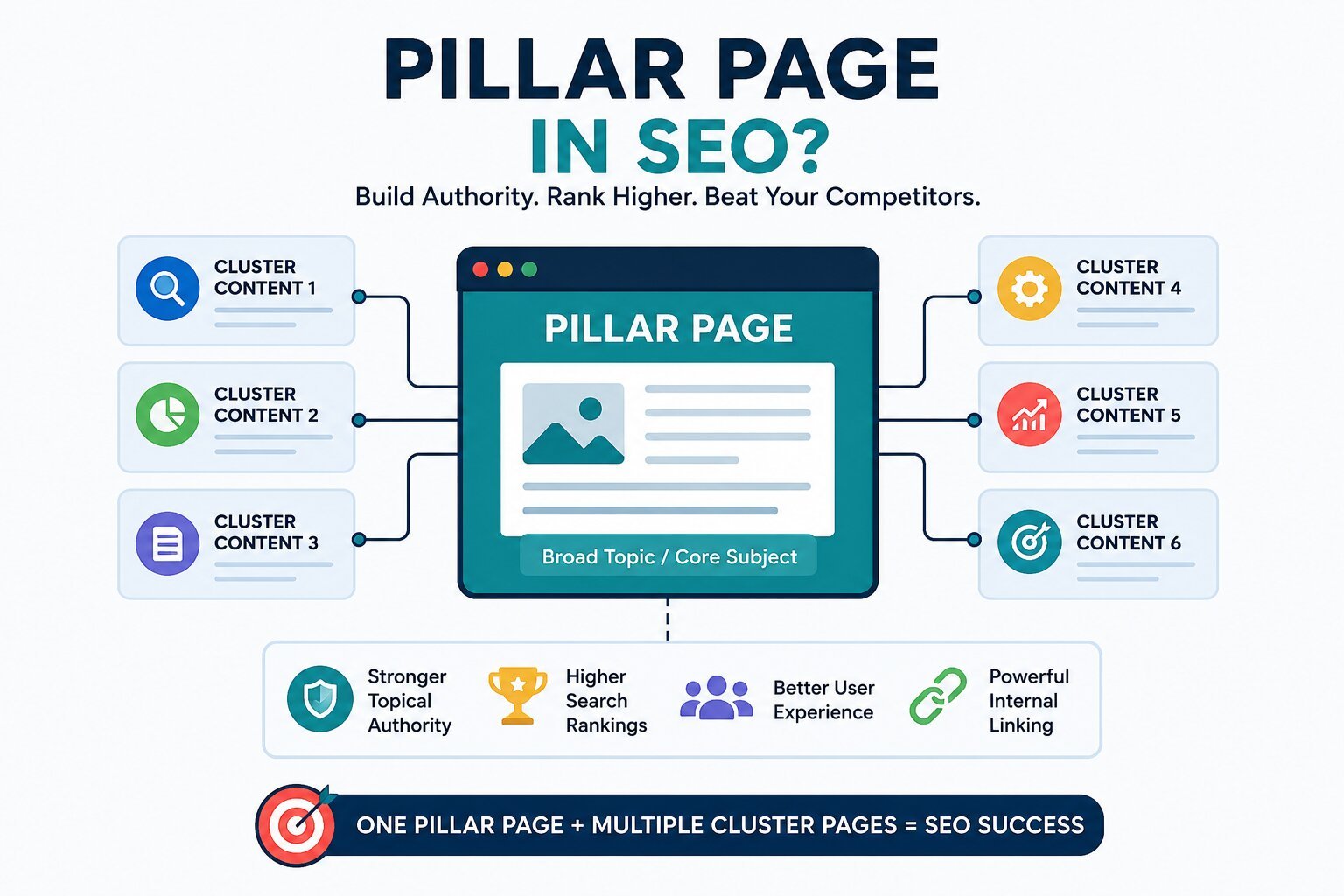
This shift is exactly why pillar pages have become one of the most important tools in modern SEO. If you want your website to be seen as a genuine authority — by Google and by AI search engines — you need more than isolated posts. You need structure, depth, and connection between your content. That’s what a pillar page delivers.
In this guide, you’ll learn exactly what a pillar page is, why it matters more than ever in 2026, and how to build one step by step — with real examples from SEO, SaaS, healthcare, real estate, and e-commerce.
Table of Contents
ToggleWhy Traditional SEO Strategies Are No Longer Enough in 2026
For years, the standard SEO playbook was simple: pick a keyword, write a post, optimize it, publish, repeat. That approach worked when search engines mostly matched keywords to pages. But Google’s algorithms — and now AI-driven search tools — have evolved to understand topics, not just keywords.
Here’s the problem with the old approach:
- Isolated blog posts create a scattered site structure. Search engines struggle to see how your content connects, so they don’t fully trust your site’s depth on any one subject.
- Keyword-only optimization ignores search intent. Ranking for a phrase doesn’t matter if the page doesn’t actually satisfy what the searcher needs.
- AI search engines reward comprehensiveness. Tools like ChatGPT, Gemini, and Perplexity pull from content that thoroughly answers a topic, not from thin, fragmented articles.
- Google’s Helpful Content System prioritizes topical depth. Sites that demonstrate real expertise across a subject outperform those with scattered, shallow coverage.
This is where pillar pages come in. They solve the structural, intent, and authority problems that isolated content can’t fix on its own.
What Is a Pillar Page in SEO?
A pillar page is a comprehensive, authoritative piece of content that covers a broad topic in depth and links out to related, more specific articles — known as cluster content. Think of it as the central hub of a wheel, with individual spokes (cluster pages) branching out to cover subtopics in detail.
For example, a pillar page titled “Content Marketing Strategy” might link to cluster articles like:
- “How to Create a Content Calendar”
- “Content Marketing Metrics That Matter”
- “How to Repurpose Blog Content”
Together, the pillar page and its cluster content form a content hub — a structured, interlinked network that tells search engines, “This site truly understands this subject.”
Unlike a typical blog post that targets one keyword, a pillar page targets an entire topic and its many related searches, making it a foundational piece of any solid SEO content strategy.
Why Pillar Pages Matter for SEO
Pillar pages aren’t just a content format trend — they directly influence how search engines and AI tools evaluate your site. Here’s why they matter:
- They establish topical authority. Covering a subject comprehensively signals expertise to Google’s ranking systems.
- They improve internal linking SEO. A well-built content hub distributes link equity across related pages, helping your entire cluster rank better.
- They target multiple keywords and intents at once. Instead of one post per keyword, a pillar page captures a whole family of related searches.
- They increase dwell time and reduce bounce rate. Comprehensive content keeps users engaged longer, which is a positive user-experience signal.
- They’re built for AI search visibility. Structured, well-organized pillar content is easier for AI models to extract, summarize, and cite.
How Google Uses Topic Clusters
Google’s algorithm doesn’t evaluate pages in isolation — it evaluates sites and topics. The topic cluster model (pillar page + supporting cluster content, all interlinked) helps Google understand:
- How pages on your site relate to one another
- Which page is the primary, authoritative resource for a topic
- How deep and broad your expertise actually is
When cluster pages link back to the pillar page, and the pillar links out to each cluster page, Google’s crawlers can map your site’s topical structure with far more confidence. This internal linking pattern reinforces relevance and helps distribute ranking power (often called “link equity”) throughout the cluster — boosting visibility for both the pillar page and its supporting articles.
In short: topic clusters help Google see your website the way a human expert would — organized, connected, and thorough.
Pillar Page vs. Regular Blog Post: What’s the Difference?
People often confuse pillar pages with long blog posts, but they serve very different purposes.
| Pillar Page | Regular Blog Post |
|---|---|
| Covers a broad topic comprehensively | Covers one specific subtopic or question |
| Typically 2,500–5,000+ words | Usually 800–2,000 words |
| Targets multiple related keywords and intents | Targets one primary keyword |
| Links out to many cluster articles | Links to a few related posts, if any |
| Serves as a permanent, evergreen resource | Often timely or narrowly focused |
| Central hub in a content cluster | A “spoke” that supports a pillar page |
| Updated regularly to stay comprehensive | May be updated less frequently |
| Built for topical authority | Built to answer a specific query |
Essentially, a blog post answers a question. A pillar page organizes and connects the answers to all the related questions on a topic.
Pillar Page vs. Landing Page: What’s the Difference?
Another common mix-up is between pillar pages and landing pages. While both can be long-form and well-designed, their goals are completely different.
- A landing page is built for conversion. Its job is to get a visitor to take one specific action — sign up, buy, request a demo — and it’s often used for paid campaigns.
- A pillar page is built for education and authority. Its job is to inform, guide, and link readers to deeper resources, with conversion as a secondary (not primary) goal.
A landing page typically has minimal navigation and a single call-to-action to avoid distraction. A pillar page, by contrast, is meant to be explored — it invites clicks to related cluster content and keeps users engaged with your brand’s expertise over a longer journey.
How Pillar Pages Improve Topical Authority
Topical authority is the degree to which search engines trust your site as a reliable source on a given subject. It’s built through breadth (covering many related subtopics), depth (thoroughly answering each one), and structure (connecting it all logically).
Pillar pages improve topical authority in several ways:
- They demonstrate comprehensive coverage of a subject, not just isolated facts.
- They create a clear content hierarchy, showing search engines which page is the primary resource.
- They generate consistent internal linking, reinforcing topical relationships between pages.
- They encourage content freshness, since pillar pages are usually updated as new cluster content is added.
- They naturally attract backlinks, since comprehensive resources are more link-worthy than narrow posts.
Over time, a well-maintained pillar page and its cluster can make your site the go-to authority for an entire subject area — not just a single keyword.
How Pillar Pages Help You Rank in AI Search Engines
AI-powered search — including Google’s AI Overviews, ChatGPT, Gemini, and Perplexity — doesn’t just index pages; it synthesizes answers from content it deems trustworthy and well-structured. This is where Answer Engine Optimization (AEO) and Generative Engine Optimization (GEO) come in.
Pillar pages are naturally well-suited for AI search because they:
- Provide comprehensive context, which AI models need to generate accurate, complete answers.
- Use clear headings and structure, making it easy for AI to extract specific sections.
- Answer multiple related questions in one place, increasing the chances of being cited across various AI-generated queries.
- Demonstrate EEAT (Experience, Expertise, Authoritativeness, Trustworthiness), which AI systems increasingly weigh when selecting sources to summarize or cite.
- Include structured data, helping both traditional and AI crawlers understand page content precisely.
If you want your content to show up in an AI Overview snippet or get cited by ChatGPT, a scattered blog isn’t enough — you need the depth and structure that only a pillar page provides.
Step-by-Step Guide: How to Build a Pillar Page
Step 1: Choose a Core Topic
Start broad, but not too broad. Your topic should be big enough to support 8–15 subtopics, yet specific enough to stay focused. For example, “Email Marketing” is a strong pillar topic, while “Marketing” is too broad and “Email Subject Line Length” is too narrow (that’s cluster content).
Tip: Choose a topic that aligns with your core business offering — this is the subject you want to be known for.
Step 2: Perform Keyword Research
Use tools like Ahrefs, SEMrush, or Google Keyword Planner to identify:
- The primary keyword (e.g., “pillar page SEO”)
- Secondary and semantic keywords (e.g., “topic clusters,” “content hub,” “topical authority”)
- Question-based queries (great for FAQ sections and voice search)
- Search volume and competition for each related term
Group these keywords by intent — informational, navigational, or transactional — so you know which belong on the pillar page versus the cluster pages.
Step 3: Identify Cluster Topics
Break your core topic into logical subtopics. Each one becomes a standalone cluster article that links back to the pillar page. For a “Pillar Page SEO” pillar, clusters might include:
- “What Is Topical Authority and Why It Matters”
- “How to Do Internal Linking for SEO”
- “Content Cluster Strategy: A Beginner’s Guide”
- “SEO Pillar Page Examples by Industry”
Step 4: Create Supporting Content
Write each cluster article with genuine depth and originality — not just filler. Each piece should fully answer its specific question while naturally referencing the broader pillar topic. This is where real experience and expertise should shine through: use data, examples, and practical insights, not generic summaries.
Step 5: Build Internal Links
This is the backbone of the entire strategy. Every cluster page should link back to the pillar page using relevant anchor text, and the pillar page should link out to every cluster page. This creates a tightly connected content hub that search engines can easily crawl and understand.
Best practice: Use descriptive, keyword-relevant anchor text (e.g., “learn more about internal linking SEO”) rather than generic phrases like “click here.”
Step 6: Optimize for Search Intent
Make sure your pillar page actually satisfies what searchers want. Structure it with:
- Clear H2/H3 headings that mirror common questions
- Concise, direct answers near the top of each section (great for featured snippets)
- Bullet points and tables for scannability
- A logical flow from broad concepts to specific details
Step 7: Add Schema Markup
Structured data helps both traditional search engines and AI tools understand your content. For pillar pages, consider adding:
- Article schema for authorship and publish date
- FAQ schema for your frequently asked questions section
- BreadcrumbList schema to reinforce site structure
- HowTo schema if your pillar includes step-by-step instructions
Schema markup increases your chances of appearing in rich results, featured snippets, and AI-generated answers.
Step 8: Measure Performance
After publishing, track:
- Organic traffic to the pillar page and its cluster articles
- Keyword rankings across the full topic (not just one term)
- Internal link click-through rates
- Backlinks earned by the pillar page
- Appearances in featured snippets or AI Overviews (using tools like Google Search Console and AI visibility trackers)
Update the pillar page regularly as new cluster content is added or as the topic evolves — this keeps it fresh and authoritative.
SEO Pillar Page Examples by Industry
Here’s how pillar pages might look across different industries:
- SEO: A pillar page on “Technical SEO” linking to clusters like “Site Speed Optimization,” “XML Sitemaps Explained,” and “Crawl Budget Best Practices.”
- SaaS: A pillar page on “Project Management Software” linking to clusters like “Agile vs. Waterfall,” “Best Kanban Tools,” and “How to Choose PM Software for Remote Teams.”
- Healthcare: A pillar page on “Managing Type 2 Diabetes” linking to clusters like “Diabetes-Friendly Meal Plans,” “Understanding Blood Sugar Levels,” and “Exercise Tips for Diabetics.”
- Real Estate: A pillar page on “First-Time Home Buying Guide” linking to clusters like “How to Get Pre-Approved for a Mortgage,” “Understanding Closing Costs,” and “Home Inspection Checklist.”
- E-commerce: A pillar page on “Sustainable Fashion” linking to clusters like “How to Read Clothing Labels,” “Best Eco-Friendly Fabrics,” and “Caring for Sustainable Garments.”
Each example follows the same structure: one broad, authoritative hub supported by focused, interlinked articles.
Benefits of Pillar Pages and Their Impact on SEO
| Benefit | Impact on SEO |
|---|---|
| Comprehensive topic coverage | Builds topical authority and trust with search engines |
| Strong internal linking structure | Distributes link equity and improves crawlability |
| Targets multiple keywords/intents | Increases organic visibility across many search queries |
| Improved user engagement | Boosts dwell time and reduces bounce rate |
| Structured, well-organized content | Increases chances of featured snippets and AI citations |
| Evergreen, updatable format | Maintains long-term rankings with minimal rebuilding |
| Attracts backlinks naturally | Strengthens domain authority over time |
| Clear content hierarchy | Helps search engines identify your primary resource on a topic |
Common Mistakes Businesses Make When Creating Pillar Pages
Even well-intentioned pillar page strategies can fall short. Watch out for these common mistakes:
- Choosing a topic that’s too broad or too narrow. This makes it hard to structure a logical cluster around it.
- Skipping the internal linking step. A pillar page without links to cluster content isn’t really a pillar page — it’s just a long article.
- Writing for keywords instead of people. Stuffing keywords without addressing real search intent hurts both rankings and readability.
- Neglecting to update content. Pillar pages need regular refreshes to stay comprehensive and accurate.
- Ignoring page structure and scannability. Walls of text without headings, bullet points, or tables perform poorly with both readers and AI tools.
- Forgetting schema markup. Without structured data, you miss opportunities for rich results and AI visibility.
- Treating it as a one-time project. Pillar pages are living resources that should grow alongside your content cluster.
How Pillar Pages Help You Outrank Competitors in 2026
In 2026, ranking well isn’t just about having a good page — it’s about having the best organized body of knowledge on a topic. Here’s how pillar pages give you a competitive edge:
- They out-structure thin competitor content. Many competitors still publish isolated blog posts. A well-built content hub simply covers more ground, more credibly.
- They capture more search real estate. Instead of ranking for one keyword, your pillar and its clusters can rank for dozens of related terms simultaneously.
- They compound in authority over time. Every new cluster article you add strengthens the entire hub, making it harder for competitors to catch up.
- They align with how modern algorithms evaluate expertise. Google and AI search tools increasingly reward sites that demonstrate full-topic mastery, not just keyword matching.
- They create more linkable assets. A comprehensive pillar page is far more likely to earn backlinks than a narrow post, further boosting your domain’s authority.
Pillar Pages and AI Search Optimization (AEO & GEO)
As AI Overviews, ChatGPT, Gemini, and Perplexity become primary discovery channels, optimizing for Answer Engine Optimization (AEO) and Generative Engine Optimization (GEO) is no longer optional.
To make your pillar page AI-search-ready:
- Answer questions directly and early in each section — AI models favor clear, extractable answers over vague introductions.
- Use structured headings that mirror natural-language questions people actually ask.
- Include an FAQ section with schema markup, since AI tools frequently pull from FAQ-formatted content.
- Cite data, statistics, and credible sources to strengthen trustworthiness — a key EEAT signal AI systems consider.
- Keep content updated, since AI search tools tend to favor fresh, accurate information over outdated pages.
- Write conversationally, matching how people phrase voice and AI search queries (e.g., “What is a pillar page in SEO?” rather than just “pillar page SEO”).
A pillar page’s natural depth and structure make it one of the most AI-search-friendly content formats available today.
Expert Tips for Building High-Performing Pillar Pages
- Start with your most commercially important topic — the one most tied to your business goals.
- Aim for genuine originality; don’t just summarize what’s already ranking.
- Use real examples, data, and firsthand insights to strengthen EEAT.
- Revisit and expand your cluster every few months as new subtopics emerge.
- Make sure your pillar page is mobile-friendly and fast-loading — technical performance still matters.
- Don’t force every keyword into the pillar page itself; let cluster pages carry the long-tail terms.
Frequently Asked Questions
1. What is a pillar page in SEO?
A pillar page is a comprehensive piece of content that covers a broad topic in depth and links to related, more specific cluster articles, forming an organized content hub.
2. How long should a pillar page be?
Most effective pillar pages range from 2,500 to 5,000+ words, though length should be driven by comprehensiveness, not a fixed word count.
3. How many cluster articles should a pillar page have?
There’s no fixed number, but most effective content hubs include 8–20 cluster articles, depending on the topic’s breadth.
4. Is a pillar page the same as a landing page?
No. A pillar page is built for education and topical authority, while a landing page is built for a specific conversion action.
5. How often should I update a pillar page?
Review and update your pillar page every 3–6 months, or whenever new cluster content is added or the topic changes significantly.
6. Do pillar pages help with featured snippets?
Yes. Their structured headings and direct answers make them strong candidates for featured snippets and People Also Ask results.
7. Can pillar pages improve rankings in AI search engines like ChatGPT or Gemini?
Yes. Their depth, structure, and clarity make them well-suited for AI Overviews and generative search tools that prioritize comprehensive, trustworthy content.
8. What’s the difference between a pillar page and a content cluster?
The pillar page is the central hub; the content cluster refers to the full group of supporting articles linked to and from that pillar page.
9. Do I need schema markup on a pillar page?
It’s highly recommended. Article, FAQ, and HowTo schema all improve your chances of rich results and AI citations.
10. How do pillar pages improve internal linking SEO?
They create a structured network of links between the pillar and its cluster pages, distributing authority and helping search engines understand your site’s topical relationships.
Conclusion: Build Your Pillar Page and Own Your Topic in 2026
Pillar pages aren’t just another SEO tactic — they’re a fundamental shift in how you organize and present expertise online. In a search landscape shaped by AI Overviews, ChatGPT, Gemini, and Perplexity, the sites that win are the ones that demonstrate real, structured, comprehensive knowledge — not scattered, keyword-chasing posts.
By choosing a strong core topic, building out a thoughtful content cluster, optimizing for both search intent and AI discoverability, and maintaining strong internal linking, you can turn your website into the go-to authority in your industry.
Ready to build your first pillar page? Start by mapping out your core topic and its supporting cluster today — and watch your topical authority, search visibility, and AI citations grow throughout 2026 and beyond.



What do you think?
[…] related content that reinforce each other. This is where topic clusters come in: a central topic (covered by a pillar page) surrounded by related subtopics (covered by cluster content), all […]
Comments are closed.