
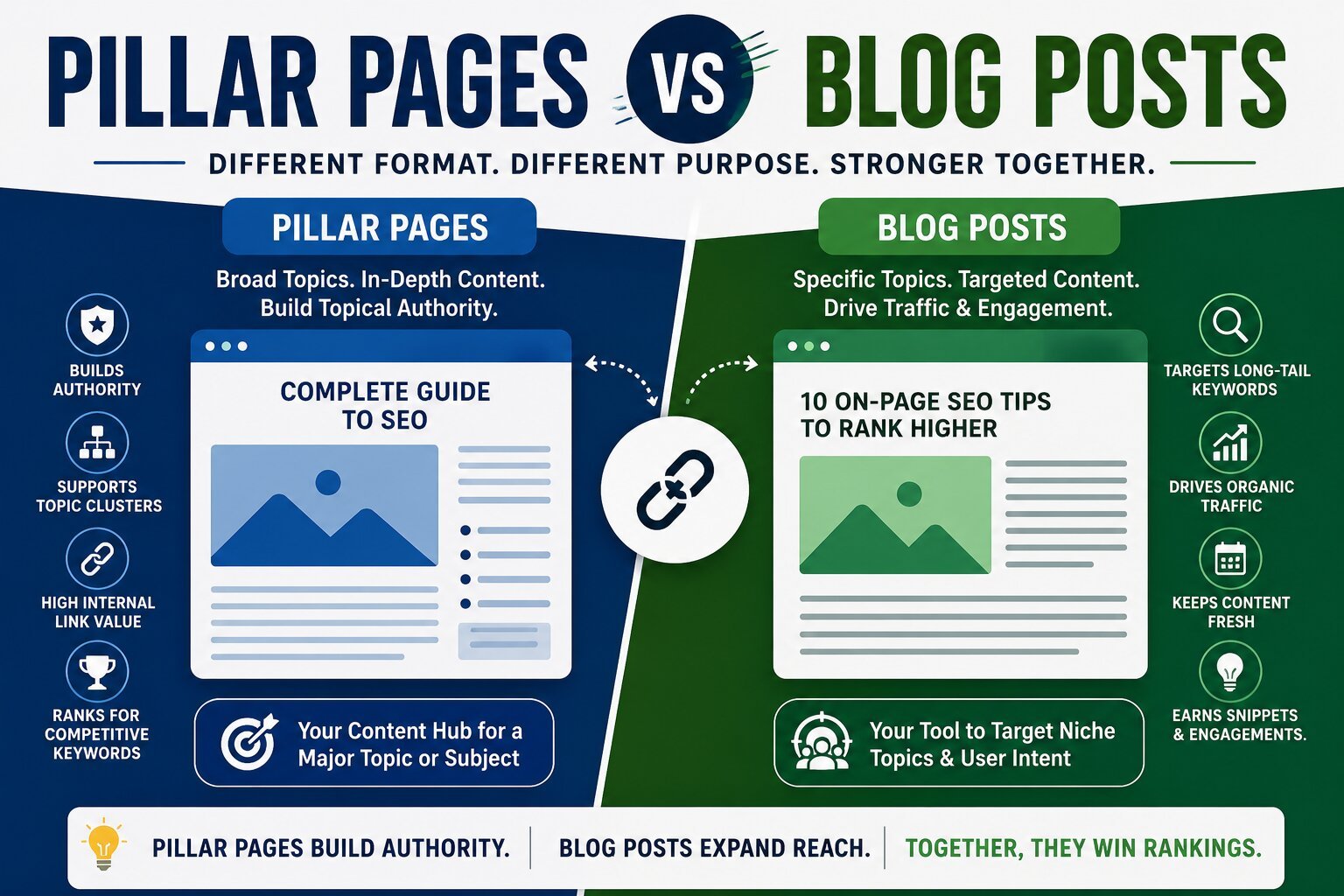
So what’s the real difference? A pillar page is a comprehensive, evergreen resource that covers an entire topic and organizes a network of related content beneath it. A blog post is a focused, often timely piece that answers one specific question or covers one narrow subtopic.
Why does this distinction matter in 2026? Because search engines — and the AI tools now sitting on top of them, like Google AI Overviews, ChatGPT, Gemini, and Perplexity — no longer just reward individual pages. They reward sites that demonstrate structured, comprehensive expertise. Knowing when to build a pillar page versus when to publish a blog post is the difference between a content strategy that compounds over time and one that just produces scattered, disconnected traffic spikes.
This guide breaks down exactly how these two content types differ, when to use each, and how combining them strategically is the real key to SEO success in 2026.
Table of Contents
ToggleWhat Is a Pillar Page?
Definition
A pillar page is a comprehensive, long-form page that thoroughly covers a broad topic and links out to a network of supporting blog posts, often called cluster content. It’s designed to be the definitive, central resource on a subject.
Purpose
The purpose of a pillar page is to establish topical authority — proving to both readers and search engines that your site has deep, well-organized expertise across an entire subject area, not just isolated facts.
Characteristics
- Long-form — typically 2,500 to 5,000+ words
- Broad in scope — covers a full topic rather than one narrow question
- Highly structured — organized with clear H2/H3 sections mapping to major subtopics
- Evergreen — built to be updated and expanded over time, not tied to a single moment
- Hub-like — links out to and receives links from a whole cluster of supporting content
Content Depth
Pillar pages go deep and wide at the same time. Rather than answering one question exhaustively, they touch on every major subtopic within a broader theme, giving readers a full picture while pointing them to dedicated articles for more detail.
Internal Linking Structure
A pillar page links to every relevant supporting blog post in its cluster, and those posts link back to the pillar page. This creates a content hub that search engines can crawl efficiently, reinforcing topical relevance across the entire group of pages.
Examples of Pillar Pages
- “The Complete Guide to Content Marketing Strategy” (marketing agency)
- “Everything You Need to Know About HR Software” (SaaS company)
- “A Complete Guide to Managing High Blood Pressure” (healthcare provider)
What Is a Blog Post?
Definition
A blog post is a focused piece of content that addresses one specific topic, question, or update. It’s typically shorter, more targeted, and often tied to a specific keyword or moment in time.
Purpose
Blog posts exist to answer specific questions, share timely updates, and capture long-tail search traffic. They’re the building blocks of a content strategy — individually narrow, but collectively powerful when organized well.
Content Format
Blog posts are usually more conversational and narrower in scope than pillar pages. They often follow common formats: how-to guides, listicles, comparisons, opinion pieces, tutorials, or news updates.
Search Intent Targeting
Because blog posts focus on one specific query, they’re excellent at matching precise search intent — whether that’s informational (“how to reset a router”), comparative (“Product A vs Product B”), or transactional (“best budget laptops under $800”).
Examples of Blog Posts
- “5 Email Subject Line Formulas That Boost Open Rates”
- “How to Set Up Two-Factor Authentication in Gmail”
- “iPhone 17 vs Galaxy S26: Which Should You Buy?”
Pillar Pages vs Blog Posts: Key Differences
| Feature | Pillar Page | Blog Post |
|---|---|---|
| Main Purpose | Build topical authority and organize a content hub | Answer a specific question or capture a niche keyword |
| Content Length | 2,500–5,000+ words | 800–2,000 words |
| Keyword Targeting | Broad, high-volume head terms | Specific, long-tail keywords |
| Search Intent | Broad informational intent | Narrow informational, comparative, or transactional intent |
| Internal Linking | Links out to many supporting blog posts | Links back to the pillar page and a few related posts |
| User Experience | Comprehensive overview, encourages exploration | Quick, direct answer to one question |
| SEO Impact | Strengthens the entire topic cluster’s authority | Expands keyword coverage and captures niche traffic |
| Ranking Potential | Strong for competitive, broad terms | Strong for low-competition, specific terms |
| Topical Authority | Central driver of topical authority | Supports and reinforces the pillar’s authority |
| Content Updates | Reviewed and updated regularly as a living resource | Updated occasionally, sometimes left as-is after publishing |
How Pillar Pages Help SEO
Pillar pages contribute to SEO in ways that go beyond simply ranking for one keyword:
- Topical authority — Comprehensive, well-organized coverage of a subject signals genuine expertise to search engines.
- Semantic SEO — By naturally including related terms, concepts, and entities, pillar pages align with how modern algorithms interpret meaning rather than exact-match phrases.
- Topic clusters — Acting as the hub of a cluster, a pillar page ties together dozens of related articles into one coherent structure.
- Internal linking — A strong internal link network distributes ranking authority across the cluster and improves overall site crawlability.
- Crawl efficiency — Clear, hub-and-spoke linking helps search engine bots discover and index related content faster.
- AI search visibility — The depth, structure, and clarity of pillar pages make them prime candidates for citation in AI Overviews, ChatGPT, Gemini, and Perplexity.
How Blog Posts Help SEO
Blog posts play an equally important, but different, role:
- Long-tail keyword targeting — Individual posts can rank for specific, lower-competition search terms that a pillar page can’t realistically target on its own.
- Fresh content signals — Regularly publishing new blog posts signals to search engines that your site is active and continuously expanding its expertise.
- Featured snippets — Focused, well-structured blog posts are often better positioned to win featured snippets for specific questions.
- Topical expansion — Each new blog post is an opportunity to cover another subtopic, expanding your site’s overall topical footprint.
- Traffic generation — Because they target very specific queries, blog posts often capture consistent, incremental organic traffic over time.
When Should You Create a Pillar Page?
Pillar pages make the most sense when you want to establish a definitive resource on a subject central to your business. Common scenarios include:
- SEO Guide — “The Complete Guide to On-Page SEO“
- Local SEO Hub — “Local SEO for Small Businesses: The Full Guide”
- SaaS Resource Center — “The Ultimate Guide to Marketing Automation Software”
- Healthcare Knowledge Base — “Understanding and Managing Type 1 Diabetes”
- E-commerce Buying Guide — “How to Choose the Right Mattress: A Complete Buying Guide”
When Should You Publish a Blog Post?
Blog posts are the right choice for narrower, more specific, or time-sensitive content. Common scenarios include:
- Industry news — “Google’s Latest Algorithm Update: What You Need to Know”
- How-to guides — “How to Set Up Google Search Console in 10 Minutes”
- Product comparisons — “Ahrefs vs SEMrush: Which SEO Tool Is Right for You?”
- Tutorials — “How to Create a Content Calendar in Notion”
- Case studies — “How We Increased Organic Traffic by 150% in 6 Months”
How Pillar Pages and Blog Posts Work Together
Rather than competing, pillar pages and blog posts form a system — the pillar page provides structure and authority, while blog posts provide depth and breadth. Here’s a simple visual representation:
Pillar Page
│
├── Blog Post 1
├── Blog Post 2
├── Blog Post 3
├── Blog Post 4
└── Blog Post 5
Every blog post links back to the pillar page, and the pillar page links out to every supporting article. This hub-and-spoke structure does three important things:
- It tells search engines exactly which page is the primary, authoritative resource on the topic.
- It distributes link equity across the cluster, helping every page — not just the pillar — rank better.
- It creates a smooth navigation path for readers, letting them move from a broad overview to specific answers (and back again) without hitting a dead end.
Over time, as you add more blog posts to the cluster, the pillar page’s authority compounds — making the entire topic harder for competitors with scattered, unlinked content to outrank.
Which One Ranks Better in Google?
The honest answer: it depends on the keyword.
- Broad keywords — Pillar pages tend to perform better for competitive, high-volume terms because of their comprehensive coverage and strong internal link support.
- Long-tail keywords — Blog posts typically outperform pillar pages for specific, lower-competition search terms since they can focus entirely on answering one question.
- Search intent — Google matches content to intent; broad informational intent favors pillar pages, while narrow or comparative intent favors blog posts.
- User engagement — Comprehensive pillar pages often see longer dwell times, while blog posts tend to see faster, more direct visits tied to a specific need.
- AI Overviews — AI-generated summaries often pull from comprehensive sources, giving pillar pages an edge for broad queries, while blog posts may be cited for very specific sub-questions.
- Entity-based SEO — Pillar pages, with their broad topical coverage, tend to reinforce more entity relationships, strengthening your site’s overall semantic footprint.
In short: pillar pages win on breadth and authority; blog posts win on precision and long-tail volume.
Which One Is Better for AI Search?
AI-powered search tools evaluate content differently than traditional search engines, but the same principle applies: comprehensiveness and structure win.
- ChatGPT citations — ChatGPT tends to favor well-structured, topically complete sources when generating and citing answers, giving pillar pages a natural advantage.
- Google AI Overviews — These summaries often synthesize information from multiple sources on a site, and a strong pillar page can serve as the anchor reference.
- Gemini — Google’s AI model leans heavily on entity relationships and topical depth, both of which pillar pages are specifically built to reinforce.
- Perplexity — This answer engine favors clear, fact-based, well-organized content — a strength shared by both well-written pillar pages and focused blog posts.
- Answer Engine Optimization (AEO) — Blog posts that directly and concisely answer specific questions are often better suited to appear in narrow, question-based AI responses.
In practice, pillar pages tend to become the authoritative source AI tools cite for broad topics, while blog posts support topical depth and get cited for specific, narrow questions. Together, they maximize your visibility across the full range of AI-generated search results.
Common Mistakes to Avoid
- Publishing isolated blog posts — Writing blog content with no connection to a broader pillar page wastes an opportunity to build topical authority.
- Creating thin pillar pages — A pillar page that doesn’t genuinely cover the topic in depth won’t earn the authority it’s meant to establish.
- Poor internal linking — Failing to consistently link blog posts back to their pillar page weakens the entire cluster’s SEO potential.
- Keyword cannibalization — Writing multiple blog posts targeting the same keyword confuses search engines about which page should rank.
- Ignoring search intent — Publishing content that doesn’t match what searchers are actually looking for hurts both rankings and user experience.
Real-World Examples
- SEO agencies — A pillar page on “Technical SEO” supported by blog posts on crawl budget, canonical tags, and Core Web Vitals.
- SaaS companies — A pillar page on “Sales Enablement Software” supported by blog posts on onboarding tools, sales scripts, and CRM integrations.
- E-commerce brands — A pillar page on “Sustainable Fashion Shopping” supported by blog posts on fabric guides, care instructions, and brand spotlights.
- Healthcare websites — A pillar page on “Managing Anxiety and Stress” supported by blog posts on breathing techniques, therapy options, and sleep hygiene.
- Real estate businesses — A pillar page on “Home Buying 101” supported by blog posts on mortgage pre-approval, home inspections, and closing costs.
Step-by-Step Strategy: How to Build a Pillar Page
- Choose a broad topic — Select a subject central to your business that’s broad enough to support multiple subtopics.
- Conduct keyword research — Identify the primary keyword plus related semantic and long-tail terms to inform both the pillar page and future blog posts.
- Create topic clusters — Map out the specific subtopics that will become individual blog posts within the cluster.
- Build internal links — Connect every blog post back to the pillar page, and link the pillar page out to each post.
- Update regularly — Revisit the pillar page every few months to add new cluster content and keep information current.
Step-by-Step Strategy: How to Write SEO Blog Posts
- Target long-tail keywords — Focus each post on one specific, well-researched keyword or question.
- Match search intent — Structure the post to directly satisfy what the searcher is looking for, whether that’s a how-to, comparison, or list.
- Optimize headings — Use clear, descriptive H2/H3 headings that mirror natural search queries.
- Add internal links — Link back to the relevant pillar page and to other related blog posts to reinforce topical relationships.
- Include FAQs — Add a concise FAQ section to improve chances of ranking in featured snippets and voice search results.
Expert Recommendations
- Building topical authority — Start with a strong pillar page, then consistently add blog posts that expand its cluster over time rather than publishing unrelated, one-off content.
- Content planning — Map out your pillar topics first, then reverse-engineer a blog content calendar from the subtopics each pillar needs.
- Internal linking strategy — Use descriptive, keyword-relevant anchor text and ensure every blog post is no more than one click from its pillar page.
- Combining pillar pages and blog posts — Treat blog posts as the ongoing engine that keeps your pillar pages fresh, relevant, and continuously expanding in authority.
- Optimizing for AI search — Structure both pillar pages and blog posts with clear, direct answers near the top of each section, since AI tools favor easily extractable content.
Frequently Asked Questions
1. Are pillar pages better than blog posts?
Not necessarily better — they serve different purposes. Pillar pages build broad topical authority, while blog posts capture specific, long-tail search traffic.
2. Do pillar pages rank faster?
Not always. Pillar pages often take longer to rank due to their competitive, broad-term focus, while well-optimized blog posts can rank faster for specific, lower-competition keywords.
3. How many blog posts should support a pillar page?
Most effective clusters include 8–20 supporting blog posts, though the right number depends on how many meaningful subtopics the core topic naturally includes.
4. Can a blog post become a pillar page?
Yes. If a blog post covers a broad enough topic, it can be expanded with additional sections, internal links, and supporting content to become a full pillar page.
5. Which content type generates more traffic?
Blog posts often generate more cumulative traffic over time due to their volume and long-tail keyword coverage, while pillar pages tend to drive higher-value traffic for broad, competitive terms.
6. Are pillar pages important for topical authority?
Yes. Pillar pages are the central organizing structure that ties supporting content together, making them essential for demonstrating comprehensive topical authority.
7. Should every blog post link to a pillar page?
Ideally yes, if the blog post’s topic fits within an existing pillar’s cluster — this strengthens both the blog post’s and the pillar page’s SEO performance.
8. How often should a pillar page be updated?
Every 3–6 months, or whenever significant new cluster content is added or the topic evolves.
9. Can blog posts alone build topical authority without a pillar page?
It’s possible but far less effective — without a central hub organizing them, related blog posts miss the structural benefits that drive stronger topical authority.
10. Do AI search tools prefer pillar pages or blog posts?
It depends on the query. AI tools tend to cite pillar pages for broad topic overviews and blog posts for specific, narrow questions.
Conclusion
Pillar pages and blog posts aren’t competing strategies — they’re two halves of the same content engine. Pillar pages provide the structure, depth, and authority needed to establish your site as a trusted resource on a broad topic. Blog posts provide the ongoing, specific content that expands your reach, captures long-tail traffic, and keeps your site active and relevant.
In 2026, with Google, AI Overviews, ChatGPT, Gemini, and Perplexity all placing growing emphasis on topical authority and comprehensive, well-structured content, businesses that rely on only one of these formats are leaving significant ranking potential on the table. The strategy that wins is simple: build strong pillar pages as your foundation, and continuously support them with well-linked, focused blog posts.
Do this consistently, and you won’t just publish content — you’ll build a genuine, compounding source of authority that ranks across traditional search, featured snippets, and AI-generated answers well into 2026 and beyond.




What do you think?
[…] “Blog Post About Running […]
Comments are closed.