An SEO title, also called a title tag, is the clickable headline that appears in search engine results and browser tabs for a webpage. It’s defined by the HTML <title> tag and directly influences both search rankings and click-through rate. A well-optimized SEO title includes the primary keyword, matches search intent, stays within Google’s display limits, and gives searchers a clear, compelling reason to click.
Table of Contents
ToggleIntroduction
Every page that ranks in Google has one thing in common: a title tag. It’s one of the oldest, most fundamental SEO elements, and it still matters as much today as it did fifteen years ago.
Title tags do two jobs at once. They tell search engines what a page is about, and they tell searchers whether it’s worth clicking.
Get it wrong, and a well-ranked page can still get skipped over in favor of a competitor’s more compelling result. Get it right, and even a slightly lower-ranked page can out-click a competitor sitting above it.
What Is an SEO Title?
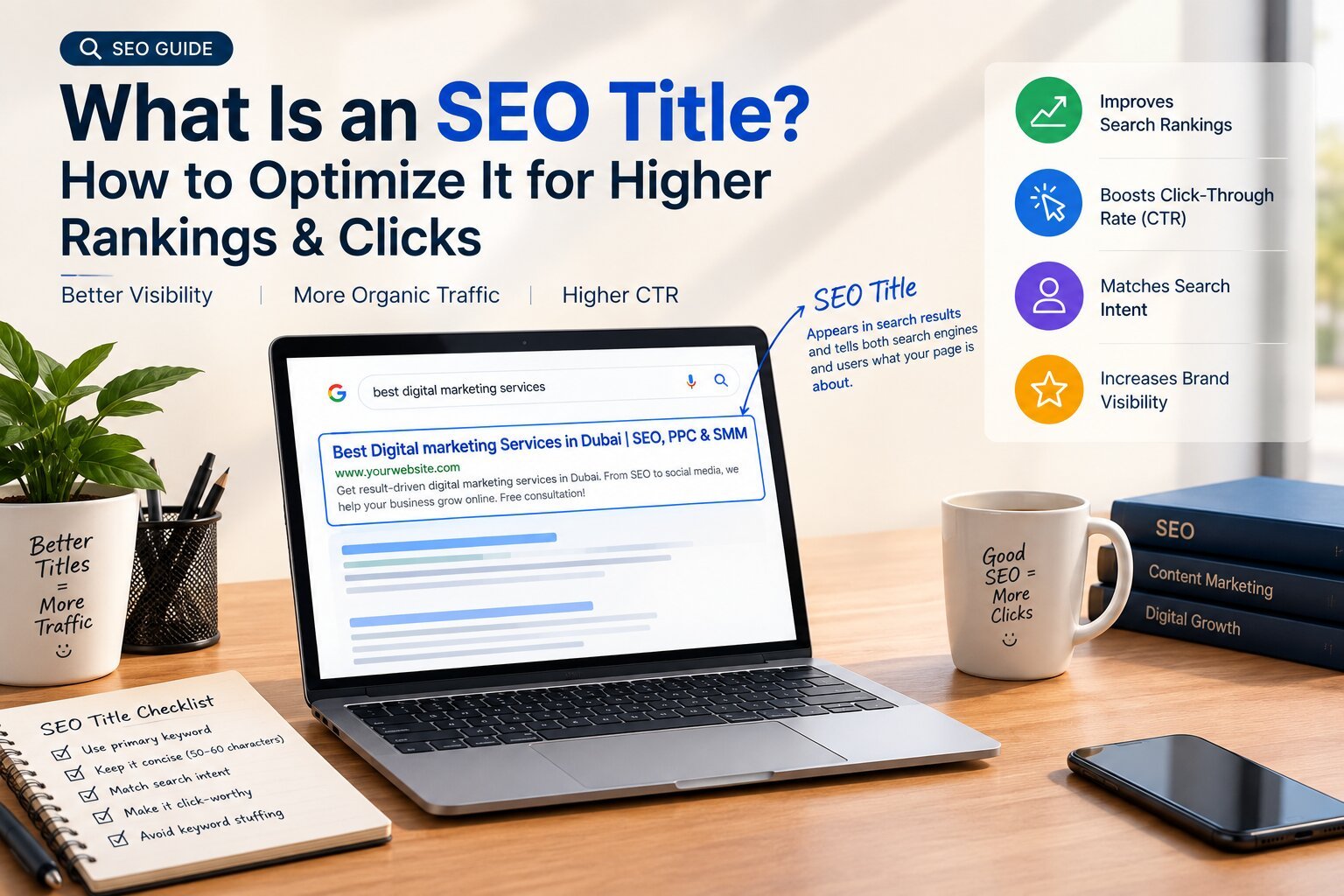
An SEO title is the text defined in a webpage’s HTML <title> tag. It’s what search engines display as the clickable blue link in search results, and what shows in a browser tab when the page is open.
It’s easy to confuse with the H1 — the main visible headline on the page itself. They’re related, but not the same thing.
SEO title (title tag): Appears in search results and browser tabs. Defined in the page’s HTML <head> section. Optimized primarily for search engines and click-through rate.
H1 (page headline): Appears visibly on the page itself, at the top of the content. Optimized primarily for the reader actually on the page.
They can be identical, but they don’t have to be — and often shouldn’t be, since they’re solving slightly different problems.
Example from a Google search result:
Best Running Shoes for Flat Feet in 2026 | RunGear rungear.com/running-shoes-flat-feet Find the best running shoes for flat feet, tested and reviewed by podiatrists and runners…
The bolded text is the SEO title. The line below it is the meta description — a separate, related element that doesn’t directly affect rankings but does influence clicks.
Why SEO Titles Matter
Search rankings. Title tags remain one of the clearest on-page relevance signals search engines use to understand what a page is about.
Click-through rate (CTR). Even at the same ranking position, a compelling title can significantly outperform a bland one in actual clicks earned.
User experience. A clear, accurate title sets the right expectation before a visitor even clicks, reducing the chance they bounce immediately upon arrival.
Search intent matching. A title that clearly reflects what the searcher is looking for signals relevance instantly, both to the algorithm and to the human scanning results.
Brand visibility. Consistent, strategic use of a brand name in titles builds recognition over repeated searches and impressions, even when a click doesn’t happen.
How Search Engines Use SEO Titles
Crawling and indexing. Search engines read the title tag as one of the first signals when processing a page, helping categorize what it’s about.
Relevance signals. Keyword presence and placement in the title help search engines match a page to relevant queries.
Keyword understanding. Titles help search engines understand not just individual keywords, but the broader topic and intent a page addresses.
User engagement signals. How often a title earns a click, and whether searchers stick around afterward, feeds back into how search engines evaluate that page over time.
How to Optimize an SEO Title
Place the Primary Keyword Near the Beginning
Search engines and searchers both tend to weight the beginning of a title more heavily. Front-loading your primary keyword captures attention faster and reinforces relevance early.
Good: “Running Shoes for Flat Feet: 2026 Buyer’s Guide”
Poor: “2026 Buyer’s Guide to Footwear: Running Shoes for Flat Feet”
Match Search Intent
A title should clearly reflect what the searcher actually wants — informational, comparison, or transactional — not just contain the right keyword.
Good: “How to Choose Running Shoes for Flat Feet (2026 Guide)” for an informational search.
Poor: “Running Shoes for Flat Feet” for a searcher clearly looking for a detailed guide, with no indication the page actually provides one.
Keep It Within Recommended Length
Titles that run too long get truncated in search results, often cutting off exactly the part meant to earn the click.
Good: “Best Running Shoes for Flat Feet in 2026” (under 60 characters, fully visible)
Poor: “The Complete and Comprehensive Ultimate Guide to the Best Running Shoes for People with Flat Feet in the Year 2026” (far too long, guaranteed truncation)
Add Power Words Naturally
Words that convey clear value — “proven,” “essential,” “complete” — can improve CTR when used honestly and sparingly.
Good: “The Complete Guide to Running Shoes for Flat Feet”
Poor: “The INSANE Secret to Running Shoes NOBODY Tells You About” — overpromises and reads as clickbait, damaging trust.
Include Numbers When Relevant
Numbers add specificity and often improve CTR, particularly for list-based or comparison content.
Good: “7 Best Running Shoes for Flat Feet (Tested in 2026)”
Poor: “Running Shoes for Flat Feet” — vague, no indication of what the content actually offers.
Make It Click-Worthy
Beyond keywords, a title should give a genuine, specific reason to click over a competing result.
Good: “Running Shoes for Flat Feet: Podiatrist-Reviewed Picks for 2026”
Poor: “Running Shoes” — technically relevant, but generic enough to lose to almost any more specific competing title.
Add Brand Name Strategically
Including a brand name can build recognition, but it shouldn’t crowd out the keyword or push it too far back in the title.
Good: “Running Shoes for Flat Feet: 2026 Guide | RunGear”
Poor: “RunGear | Running Shoes for Flat Feet” — pushes the keyword-relevant part back, weakening both relevance and readability.
Avoid Keyword Stuffing
Repeating a keyword or cramming variations into a title reads poorly to humans and can be treated as a spam signal by search engines.
Good: “Running Shoes for Flat Feet: Best Picks for 2026”
Poor: “Running Shoes Flat Feet | Best Running Shoes for Flat Feet | Flat Feet Running Shoes 2026” — repetitive, unreadable, and unlikely to convert a click even if it somehow ranks.
SEO Title Length Best Practices
| Title Length | Recommendation | Impact |
|---|---|---|
| Under 30 characters | Often too short | May lack sufficient context or keyword coverage |
| 50–60 characters | Ideal range | Typically displays fully without truncation |
| 60–70 characters | Use with caution | Risk of partial truncation depending on character width |
| 70+ characters | Too long | Very likely to be truncated, losing the end of the title |
Google doesn’t truncate based on a strict character count — it’s based on pixel width, since letters vary in width. A title full of narrow letters (like “i” or “l”) can run longer than one full of wide letters (like “W” or “M”) before truncating. Staying within roughly 50–60 characters is a safe, reliable guideline regardless of letter width.
Google also sometimes rewrites title tags automatically, particularly when a title is too long, contains excessive branding, or doesn’t clearly match the query — another reason to keep titles clear, concise, and genuinely relevant rather than stuffed or overly promotional.
SEO Title Examples
Blog Post
- Poor: “Blog Post About Running Shoes
- Improved: “Running Shoes for Flat Feet: A Complete Guide”
- Optimized: “Best Running Shoes for Flat Feet in 2026 (Podiatrist-Reviewed)”
Local SEO Page
- Poor: “Our Services”
- Improved: “Dentist in Dubai Marina”
- Optimized: “Dentist in Dubai Marina | Same-Day Appointments Available”
Ecommerce Product Page
- Poor: “Product 4521”
- Improved: “Men’s Running Shoes – Blue”
- Optimized: “Nike Air Zoom Pegasus 41 – Men’s Running Shoes | Free UAE Shipping”
Service Page
- Poor: “Legal Services”
- Improved: “Corporate Lawyer Dubai”
- Optimized: “Corporate Lawyer in Dubai | Business Setup & Contract Law Experts”
Category Page
- Poor: “Shoes”
- Improved: “Running Shoes”
- Optimized: “Running Shoes for Men & Women | Shop 200+ Styles Online”
Common SEO Title Mistakes
Duplicate titles. The same title used across multiple pages confuses search engines about which page is actually relevant for a given query, and it’s one of the most common technical SEO issues on larger sites.
Missing keywords. A title with no relevant keyword misses an easy, high-impact relevance signal.
Titles that are too long. Get truncated, often cutting off exactly the part meant to drive the click.
Titles that are too short. Miss the opportunity to include relevant context, keywords, or a compelling reason to click.
Clickbait titles. Overpromise relative to the actual content, which damages trust and increases bounce rate, ultimately hurting rankings over time.
Keyword stuffing. Reads poorly, risks being flagged as a spam signal, and rarely improves rankings the way it once might have years ago.
SEO Title Optimization Checklist
- ☐ Primary keyword included, ideally near the beginning
- ☐ Title clearly matches the page’s actual search intent
- ☐ Length kept within roughly 50–60 characters
- ☐ No duplicate title used elsewhere on the site
- ☐ No keyword stuffing or unnatural repetition
- ☐ Genuinely compelling, not just technically accurate
- ☐ Brand name included where it adds value, without crowding the keyword
- ☐ Reads naturally as a sentence or phrase, not a list of keywords
Tools to Analyze SEO Titles
Google Search Console shows which titles are earning impressions and clicks, and flags pages where Google has rewritten your title automatically.
Ahrefs offers site audit tools that flag duplicate, missing, or overly long titles across an entire site.
Semrush provides similar site audit capability, along with SERP position tracking tied to specific title variations.
Screaming Frog crawls a website directly and exports a full list of title tags, lengths, and duplicates for manual review.
Yoast SEO (WordPress) provides real-time title length and keyword feedback directly in the content editor before publishing.
Rank Math (WordPress) offers similar real-time optimization feedback, including a visual SERP preview as you write.
FAQ: SEO Titles
What is an SEO title? An SEO title is the text in a webpage’s HTML title tag, displayed as the clickable headline in search engine results and browser tabs.
What is the ideal SEO title length? Roughly 50–60 characters is the safest range to avoid truncation in most search results, though the actual limit is based on pixel width rather than a strict character count.
Does the SEO title affect rankings? Yes. It’s one of the clearest on-page relevance signals search engines use, though it works alongside many other ranking factors, not in isolation.
Can the H1 and SEO title be different? Yes, and often they should be. The SEO title is optimized for search results and click-through rate; the H1 is optimized for the reader on the page itself.
How many keywords should be in a title? Generally one primary keyword, naturally placed, is enough. Cramming multiple keyword variations into one title usually hurts readability and can look like keyword stuffing.
Why does Google rewrite title tags? Google sometimes rewrites titles it judges to be too long, overly promotional, or not clearly matching the searcher’s query, replacing them with text it considers more relevant or readable.
Does the meta description affect rankings the same way? No. Meta descriptions don’t directly influence rankings, but they do influence click-through rate, working alongside the title to earn the click.
Should every page have a unique title? Yes. Duplicate titles across multiple pages create confusion for search engines about which page is actually the relevant result for a given query.
Is it bad to use the same title as a competitor? It’s not against any rule, but it does nothing to differentiate your result, making it easier for searchers to default to whichever result they recognize or find more compelling.
Do power words actually improve click-through rate? Often yes, when used honestly — words that convey genuine value or specificity tend to outperform vague, generic phrasing, but overused or exaggerated power words can backfire by reading as clickbait.
Should I include my brand name in every title? Not necessarily every page — it’s often more valuable on homepage and top-level pages, while deeper content pages may benefit more from prioritizing keyword relevance first.
How often should I review and update my title tags? Periodically, especially for pages with declining click-through rate despite stable rankings — this often signals a title that no longer resonates with searchers, even if it’s still technically ranking well.
Conclusion
An SEO title is a small piece of HTML that does an outsized amount of work. It tells search engines what a page is about, and it tells real people whether it’s worth their click.
The framework is simple: lead with your primary keyword, match genuine search intent, stay within a safe length, and give searchers a real, honest reason to choose your result over the one next to it.
Get those fundamentals right consistently across a site, and the compounding effect on both rankings and click-through rate tends to outperform almost any other single on-page SEO change available.