
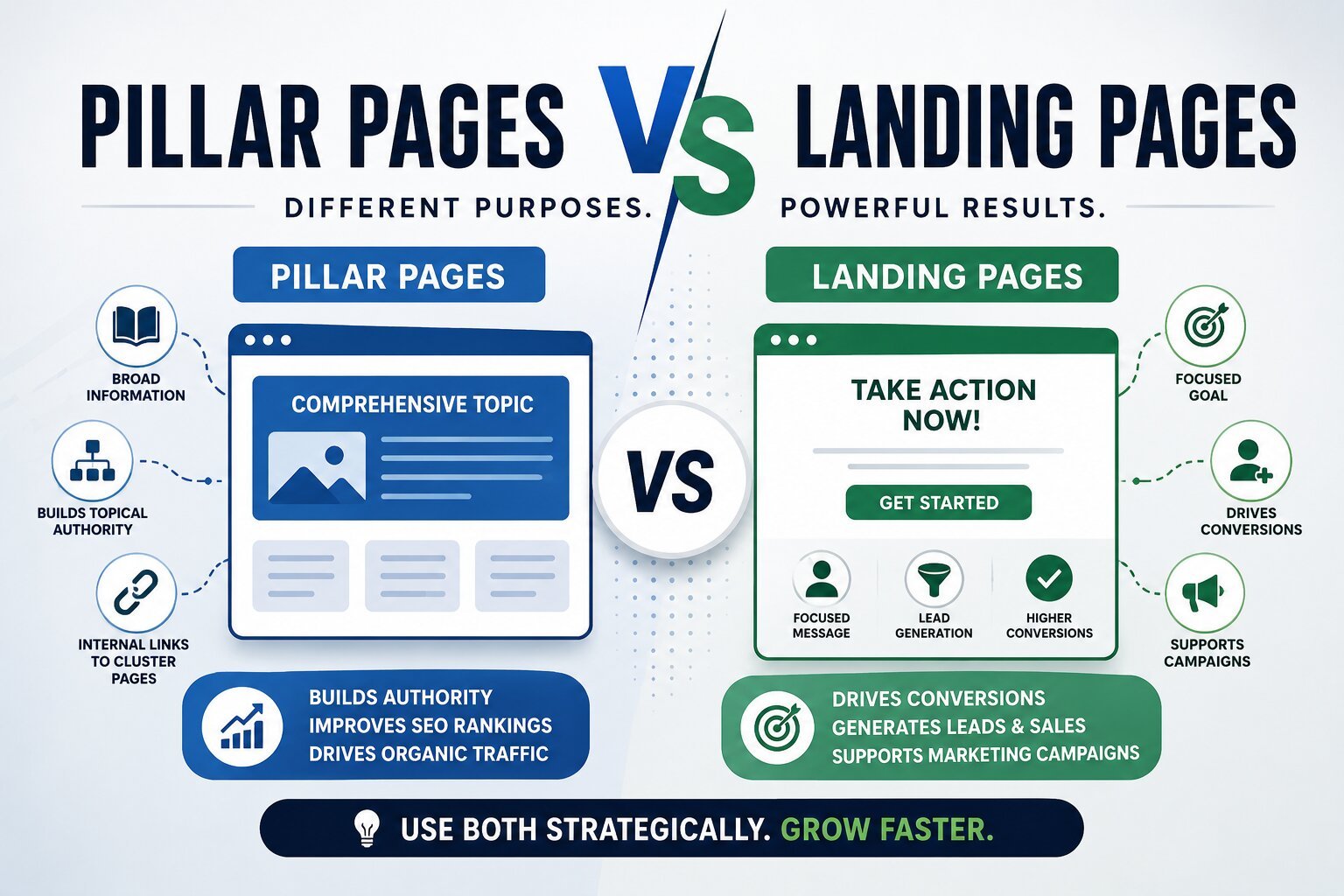
So let’s clear it up. A pillar page is a comprehensive, educational resource designed to build topical authority and rank for broad, informational search terms. A landing page is a focused, conversion-driven page designed to turn visitors into leads or customers, usually tied to a specific offer or campaign.
Understanding this difference matters more than ever in 2026. Search engines and AI tools like Google AI Overviews, ChatGPT, Gemini, and Perplexity now evaluate content based on intent, structure, and purpose — not just keywords. Using the wrong page type for the wrong goal doesn’t just hurt conversions; it can actively work against your SEO. This guide breaks down exactly what separates these two page types, when to use each, and how to make them work together for maximum impact.
Table of Contents
ToggleWhat Is a Pillar Page?
Definition
A pillar page is a comprehensive, long-form page that thoroughly covers a broad topic and links out to related, more specific “cluster” articles. It acts as the central hub of a content cluster, organizing your site’s expertise on a subject into one authoritative resource.
Purpose
The purpose of a pillar page is to educate, inform, and establish topical authority. It’s not built to sell — it’s built to demonstrate deep expertise on a subject, answer a wide range of related questions, and guide readers toward more detailed resources.
Characteristics
Pillar pages typically share these traits:
- Long-form content — usually 2,500 to 5,000+ words
- Broad topic coverage — addressing an entire subject, not just one narrow question
- Multiple internal links — connecting to supporting cluster articles and relevant service pages
- Educational tone — focused on informing rather than persuading
- Evergreen structure — designed to be updated and expanded over time
How Pillar Pages Support Topical Authority
Because pillar pages cover a subject comprehensively and link to in-depth supporting content, they signal to search engines that your site has genuine expertise on that topic. This is the foundation of topical authority — a critical ranking factor in a search landscape increasingly driven by semantic SEO and entity recognition.
Internal Linking Structure
A well-built pillar page links out to every relevant cluster article on its topic, and those cluster articles link back to the pillar page. This creates a tightly connected content hub that search engines can crawl efficiently, distributing ranking authority across the entire cluster rather than concentrating it on a single page.
Examples of Successful Pillar Pages
- A cybersecurity company’s pillar page on “Data Privacy Compliance,” linking to clusters on GDPR, CCPA, and data breach response plans
- A fitness brand’s pillar page on “Strength Training for Beginners,” linking to clusters on form technique, program design, and recovery
- A financial services pillar page on “Retirement Planning,” linking to clusters on 401(k) strategies, IRA comparisons, and Social Security timing
What Is a Landing Page?
Definition
A landing page is a standalone page designed with one specific goal: converting a visitor into a lead or customer. Unlike a pillar page, it’s not meant to educate broadly — it’s meant to persuade quickly and drive a single action.
Purpose
Landing pages exist to capture attention, communicate value fast, and remove friction between a visitor and a conversion action — whether that’s filling out a form, booking a call, or making a purchase.
Lead Generation Role
Landing pages are the backbone of most lead generation efforts. They’re built to capture contact information in exchange for something of value — a quote, a free trial, a consultation, or a downloadable resource.
Conversion-Focused Design
Effective landing pages typically minimize distractions:
- A single, clear headline addressing the visitor’s need
- One primary call-to-action (CTA), repeated strategically
- Minimal navigation to avoid distracting from the goal
- Trust signals like testimonials, reviews, or case studies
- A short, benefit-focused layout that gets to the point quickly
PPC and Marketing Campaign Usage
Landing pages are the standard destination for PPC (pay-per-click) campaigns, email marketing links, and social ads. Because they’re built around one offer and one action, they typically convert far better than a general homepage or blog post for paid traffic.
Examples of High-Converting Landing Pages
- A “Free SEO Audit” landing page with a short form and a clear CTA button
- A local plumbing company’s “Emergency Plumbing Services” page with a click-to-call button
- A SaaS company’s “Start Your Free Trial” page with minimal copy and a single signup form
Pillar Pages vs Landing Pages: Major Differences
| Feature | Pillar Page | Landing Page |
|---|---|---|
| Main Goal | Educate and build topical authority | Convert visitors into leads or customers |
| SEO Purpose | Rank for broad, informational keywords | Rank for commercial or local intent keywords |
| Content Length | Long-form (2,500–5,000+ words) | Short to medium (300–1,000 words) |
| Internal Links | Many links to cluster content and related pages | Minimal links to avoid distraction |
| External Traffic Sources | Organic search, referrals, backlinks | PPC ads, email campaigns, social ads |
| Conversion Focus | Secondary goal, often soft CTAs | Primary goal, single strong CTA |
| User Intent | Informational | Commercial or transactional |
| Ranking Potential | Strong for broad, competitive topics | Strong for specific, high-intent keywords |
| Lead Generation | Indirect, through internal links or lead magnets | Direct, through forms and CTAs |
| AI Search Visibility | High, due to depth and structure | Lower, due to narrow, promotional focus |
How Pillar Pages Improve SEO
Pillar pages strengthen your SEO in several interconnected ways:
- Topical authority — Comprehensive coverage of a subject signals genuine expertise to search engines.
- Semantic SEO — By naturally incorporating related terms, entities, and concepts, pillar pages align with how modern search engines interpret meaning rather than just keywords.
- Internal linking — A strong network of links between the pillar page and cluster content improves crawlability and distributes ranking power.
- Content clusters — Organizing content into clusters helps you rank for a wide range of related keywords instead of competing with yourself for one term.
- Search rankings — Comprehensive, well-structured pillar pages are more likely to earn featured snippets and rank for competitive head terms.
- AI search optimization — The depth and clarity of pillar pages make them ideal sources for AI Overviews, ChatGPT, Gemini, and Perplexity to reference and cite.
How Landing Pages Improve Conversions
Landing pages drive business results in ways pillar pages simply aren’t designed for:
- Lead generation — Focused forms and CTAs make it easy to capture contact information from interested visitors.
- PPC campaigns — A dedicated landing page increases ad relevance and Quality Score, improving both conversions and cost-efficiency.
- Local SEO services — Location-specific landing pages help service businesses rank and convert for “near me” and city-specific searches.
- Service-based businesses — Clear, benefit-driven landing pages help convert visitors who are already close to making a decision.
- E-commerce promotions — Dedicated landing pages for sales, product launches, or seasonal campaigns drive urgency and focused conversions.
When Should You Use a Pillar Page?
Pillar pages make sense when your goal is education, authority-building, and long-term organic visibility. Common use cases include:
- SEO guides — Comprehensive resources like “The Complete Guide to Technical SEO“
- SaaS knowledge hubs — In-depth resources like “The Ultimate Guide to Customer Relationship Management”
- Healthcare resource centers — Educational hubs like “Understanding Heart Disease: Symptoms, Causes, and Treatment”
- E-commerce buying guides — Resources like “How to Choose the Right Running Shoes”
- Real estate information hubs — Guides like “The Complete First-Time Home Buyer’s Resource”
When Should You Use a Landing Page?
Landing pages are the right choice when the goal is a specific, measurable conversion. Common use cases include:
- SEO services — A page promoting your agency’s SEO packages with a “Get a Free Proposal” CTA
- Local SEO services — A city-specific page like “SEO Services in Austin, TX” with a contact form
- PPC services — A dedicated page for paid ad campaigns promoting a specific offer
- Lead generation campaigns — Gated content offers like an ebook or whitepaper download
- Product launches — A page introducing a new product with a “Buy Now” or “Pre-Order” CTA
- Webinar registrations — A focused signup page with a countdown timer and registration form
Can a Landing Page Rank in Google?
Yes — but only under the right conditions. While landing pages aren’t built for broad informational rankings, they can absolutely rank for commercial intent keywords when optimized correctly.
SEO Landing Pages
An SEO landing page blends conversion-focused design with just enough on-page optimization — keyword-relevant headers, clear service descriptions, and structured content — to rank for high-intent search terms.
Commercial Intent Keywords
Keywords like “SEO services near me,” “buy running shoes online,” or “book a consultation” reflect strong commercial intent, and landing pages are often exactly what searchers want to find for these queries.
Service Pages and Local Landing Pages
Service-based businesses often see strong results from local landing pages — city- or region-specific pages optimized for “[service] in [location]” searches. These pages combine local SEO signals (like location keywords and business information) with a clear conversion path.
Best Practices
- Include enough unique, relevant content to avoid being flagged as thin
- Use clear headings that reflect the searcher’s intent
- Add trust signals like reviews, certifications, or case studies
- Optimize page speed and mobile experience, since these pages often drive paid traffic too
Can a Pillar Page Generate Leads?
Yes — indirectly, and often quite effectively, when designed thoughtfully.
Strategic CTAs
While a pillar page’s primary goal isn’t conversion, well-placed, low-pressure CTAs (like “Download our free checklist” or “See how we can help”) can capture interest without disrupting the educational experience.
Lead Magnets
Offering a related lead magnet — a template, checklist, or guide — within a pillar page gives readers a natural next step and a reason to share their contact information.
Internal Links to Service Pages
A pillar page can link to relevant service or landing pages within its cluster content, guiding readers who are ready to take action toward a more conversion-focused destination.
Email Capture Opportunities
Adding a newsletter signup or gated bonus content section allows you to capture leads from readers who aren’t ready to convert immediately but want to stay engaged with your brand.
Which Is Better for SEO in 2026?
This isn’t really an either/or question — it depends entirely on your goal. But understanding how search engines have evolved helps clarify when each page type matters most.
Google AI Overviews and Semantic Search
Google’s AI Overviews synthesize answers from comprehensive, trustworthy sources — which strongly favors pillar pages over narrow, promotional landing pages. Semantic search and entity SEO reward content that thoroughly covers a topic and its related concepts, not just a single commercial phrase.
Topical Authority and User Intent
Pillar pages build the kind of topical authority that strengthens your entire domain’s credibility, which can indirectly help related landing pages rank better too. Meanwhile, landing pages remain essential for capturing user intent at the commercial and transactional stages of the buyer journey.
Search Experience Optimization
In 2026, ranking well means optimizing the entire search experience — from the informational stage (where pillar pages excel) to the decision stage (where landing pages excel). Businesses that only build one type of page are leaving visibility and conversions on the table.
The balanced answer: Use pillar pages to build authority and capture informational search traffic. Use landing pages to convert visitors who are ready to act. The two aren’t competing strategies — they serve different stages of the same customer journey.
How Pillar Pages and Landing Pages Work Together
Here’s a simple way to visualize how these two page types fit into a cohesive content and conversion strategy:
Pillar Page
│
├── Topic Cluster 1 (educational article)
├── Topic Cluster 2 (educational article)
├── Topic Cluster 3 (educational article)
│
└── Link to Service Landing Page
Landing Page
│
├── Lead Form
├── CTA
├── Testimonials
└── Conversion Goal
In this model, the pillar page and its cluster attract and educate visitors through organic search, gradually building trust. At the right moment — usually near the end of the page or within a relevant section — the pillar page links to a landing page designed to convert that now-informed visitor into a lead or customer.
Common Mistakes Businesses Make
- Using a landing page as a pillar page — Trying to rank a short, sales-focused page for broad informational keywords rarely works.
- Creating thin pillar content — A pillar page that doesn’t genuinely cover the topic in depth won’t build real topical authority.
- Poor internal linking — Failing to connect pillar pages to cluster content (or to relevant landing pages) wastes their SEO potential.
- Too many CTAs on pillar pages — Overloading educational content with sales pitches undermines trust and hurts readability.
- No conversion path from informational content — Pillar pages that never guide readers toward a next step miss valuable lead generation opportunities.
Real-World Examples
- SEO agencies — A pillar page on “Local SEO Strategy” builds authority and links to a “Local SEO Services” landing page for businesses ready to hire help.
- SaaS companies — A pillar page on “Team Productivity Software” educates readers, linking to a “Start Your Free Trial” landing page.
- E-commerce stores — A pillar page on “How to Choose Skincare for Your Skin Type” links to product category landing pages for targeted purchases.
- Healthcare businesses — A pillar page on “Managing Chronic Back Pain” links to a “Book a Consultation” landing page for a physical therapy clinic.
- Real estate websites — A pillar page on “Selling Your Home: A Complete Guide” links to a “Get a Free Home Valuation” landing page.
Expert Recommendations
- Building topical authority — Focus pillar pages on genuinely comprehensive coverage, not keyword stuffing; depth and originality matter more than length alone.
- Increasing conversions — Keep landing pages focused on one offer and one CTA; resist the urge to add multiple competing actions.
- Combining SEO and lead generation — Use pillar pages to attract and educate, then strategically link to landing pages to convert once trust is established.
- Internal linking best practices — Link contextually within body content using descriptive anchor text, and ensure every landing page tied to a topic is reachable from its related pillar page.
- Optimizing for AI search — Structure pillar pages with clear headings, direct answers, and FAQ sections to increase your chances of being cited by AI Overviews, ChatGPT, Gemini, and Perplexity.
Frequently Asked Questions
1. Is a pillar page the same as a landing page?
No. A pillar page is a long-form, educational resource built for topical authority, while a landing page is a short, conversion-focused page built for a specific action.
2. Which page type ranks better?
Pillar pages generally rank better for broad, informational keywords, while landing pages can rank well for specific commercial or local intent keywords when properly optimized.
3. Can a landing page have internal links?
Yes, but sparingly. Too many internal links can distract from the page’s single conversion goal, so links should be limited and purposeful.
4. Do pillar pages generate leads?
Yes, indirectly — through strategic CTAs, lead magnets, and internal links to relevant landing pages or service pages.
5. Which is better for local SEO?
Landing pages, particularly location-specific service pages, tend to perform better for local SEO due to their direct alignment with local commercial search intent.
6. Can I convert a blog post into a pillar page?
Yes, if the blog post covers a broad topic. Expand it with additional subtopics, internal links to supporting content, and a more comprehensive structure.
7. Do pillar pages need a call-to-action?
They can include soft, low-pressure CTAs, but the primary focus should remain on providing valuable, comprehensive information.
8. Are landing pages good for AI search visibility?
Not typically. Their narrow, promotional focus makes them less useful for AI Overviews and generative search tools compared to comprehensive pillar pages.
9. How long should a landing page be?
Most effective landing pages range from 300 to 1,000 words — just enough to build trust and communicate value without diluting the primary CTA.
10. Should every pillar page link to a landing page?
Not necessarily, but if there’s a relevant product or service tied to the topic, a well-placed link to a landing page can help convert engaged readers.
Conclusion
Pillar pages and landing pages aren’t rivals — they’re two essential tools that serve different stages of the customer journey. Pillar pages build topical authority, attract organic traffic, and establish trust through comprehensive, educational content. Landing pages convert that trust into measurable action through focused, persuasive design.
In 2026, as Google AI Overviews, ChatGPT, Gemini, and Perplexity increasingly shape how people discover and evaluate information, businesses that understand this distinction — and use both page types strategically — will build stronger search visibility, deeper authority, and more consistent lead generation than those relying on just one.
The smartest approach isn’t choosing between a pillar page and a landing page. It’s building both, connecting them thoughtfully, and letting each do what it does best.