
If you’ve typed “how do I do SEO for my website” into Google, you’re probably not looking for a definition of SEO. You already know it means getting found in search. What you actually want is a sequence: what to do first, what to do next, and how to know whether any of it worked.
This guide gives you that sequence. It covers the full 2026 workflow — technical setup, keyword and topic research, content, internal linking, backlinks, AI search visibility (AEO/GEO), Core Web Vitals, structured data, and measurement — in the order an experienced SEO consultant would actually work through it on a real website. Every section is built to be actioned, not just read.
Table of Contents
ToggleQuick Answer: How Do I Do SEO for My Website in 2026?
Set up Google Search Console and analytics before changing anything, then crawl and audit your site to fix indexing and technical issues. Research keywords by search intent, build topic and entity clusters, and optimize existing pages before publishing new ones. Create genuinely useful content, strengthen internal linking, and earn relevant backlinks and brand mentions. Optimize for local, video, and image search where relevant, improve page experience, and monitor rankings, clicks, conversions, and AI-search visibility — then keep updating pages based on what the data shows.
What Does SEO Actually Do for a Website?
SEO is the process of making a website easier for search engines to crawl, understand, and trust enough to show to the right people — and easier for those people to actually use once they arrive. It works through a chain: Google has to crawl your pages, index the ones worth keeping, judge their relevance to a query, weigh the site’s authority on that topic, and factor in how good the user experience is before ranking anything. None of these steps operates alone — a beautifully written page that Google can’t crawl will never rank, and a fast, crawlable page with thin content won’t either.
Illustrative example: A Karachi-based dentist wants to rank for “dentist in DHA Karachi.” SEO here isn’t one action — it’s a stack: a technically sound website that Google can crawl and index, a Google Business Profile with accurate hours and address, a service page specifically about dental care in DHA (not a generic “our services” page), local reviews, NAP consistency across directories, and internal links connecting the local page to the homepage and other service pages. Skip any one layer and the others carry more weight than they should.
SEO in 2026 — What Has Changed?
Traditional SEO — crawling, indexing, on-page relevance, backlinks — still forms the base layer of everything else. Semantic search means Google increasingly understands topics and entities rather than matching exact strings of words. AI Overviews and AI Mode now surface synthesized answers above or instead of traditional blue links for many queries, and Google has confirmed these features are generated using retrieval-augmented generation (RAG) and query fan-out, both grounded in the same core Search index and ranking systems used for standard results.
AEO (answer engine optimization) and GEO (generative engine optimization) are the newer terms for making content easier for AI systems to extract and cite. Google published official guidance on this in May 2026, titled “Optimizing your website for generative AI features on Google Search”. Its central position: from Google’s perspective, optimizing for generative AI search is simply optimizing for the search experience — it remains SEO, not a separate discipline requiring its own toolkit.
Entity-based search means Google connects your brand, your people, and your content to real-world concepts — not just keywords. First-hand experience and brand authority matter more as AI systems try to identify which sources are trustworthy enough to cite.
Google is also explicit about what doesn’t help. The guidance pushes back on manufactured tactics — special AI-only files, artificially engineered “mentions,” or rewriting content to capture every possible long-tail keyword variation. Google notes that its systems already understand synonyms and general meaning, so there’s no need to write differently for AI than you would for a human reader. Don’t chase artificial “AI hacks” — chase the fundamentals that already work, and let AI visibility follow.
Step 1 — Set Up Your SEO Tracking Before Changing Anything
Before you touch a single page, install the tools that let you measure whether your changes actually work.
- Google Search Console — connect and verify your property (domain-level verification is preferred over URL-prefix).
- Google Analytics (GA4) — set up conversion events (form submissions, calls, purchases), not just pageviews.
- Bing Webmaster Tools — worth setting up if any meaningful share of your audience uses Bing or Copilot.
- XML sitemap — submitted inside Search Console.
- Robots.txt monitoring — check it isn’t accidentally blocking important sections.
- Rank tracking — even a simple spreadsheet of 20–30 target keywords checked monthly is enough to start.
- Page-speed monitoring — PageSpeed Insights or the Search Console Core Web Vitals report.
Illustrative example: If your website receives 2,000 organic clicks a month before you start optimizing, that number is your baseline. Without it, you have no way to prove — to yourself or a client — that the SEO work you did in the following months actually produced a measurable lift.
Step 2 — Crawl and Audit Your Website
A technical audit finds the structural problems that block everything else from working. Run a crawler (Screaming Frog, Sitebulb, or Search Console’s own reports) and check:
- Indexability and crawlability of key pages
- HTTP status codes (404s, 500s, unexpected redirects)
- Broken internal and external links
- Redirect chains and loops
- Canonical tag accuracy
- Duplicate or near-duplicate pages
- Thin pages with little unique value
- Orphan pages with no internal links pointing to them
- Sitemap accuracy and robots.txt rules
- HTTPS coverage across the whole site
- Mobile usability issues
- JavaScript-rendered content Google may not see
- Internal linking depth
- Page speed and Core Web Vitals
| SEO Problem | What It Means | What To Do |
|---|---|---|
| 404 pages | Broken URL, no matching content | Redirect to the closest relevant page or restore it |
| Noindex page | Page excluded from Google’s index | Confirm it’s intentional; remove the tag if not |
| Duplicate content | Multiple URLs serving near-identical content | Consolidate into one page or add a canonical tag |
| Orphan page | No internal links point to it | Add contextual internal links from related pages |
| Slow page | Poor loading experience | Compress images, reduce scripts, improve hosting |
| Broken internal link | Link points to a dead or wrong page | Replace with the correct URL or remove the link |
Step 3 — Check Which Pages Google Has Indexed
Use Search Console’s Page Indexing report, the URL Inspection tool, and your sitemap reports to see what Google has actually crawled and kept in its index.
It helps to separate four stages that people often treat as one: Crawled → Indexed → Ranking → Receiving clicks. A page can pass through the first three stages and still get zero clicks.
Illustrative example: A blog post might be indexed and ranking at position 14 for its target keyword — but if that keyword only gets a handful of monthly searches, or the title tag doesn’t match what searchers expect to see, the page can sit there indefinitely without a single click. Indexed and ranking is not the same as valuable.
Step 4 — Find the Right Keywords
Search volume alone is a weak filter. A keyword research process should weigh:
- Search intent — what the searcher actually wants to do next
- Relevance — how directly the topic connects to what you offer
- Business value — whether ranking for it would actually drive revenue or leads
- Competition — realistic difficulty given your current authority
- Topical relationships — how the keyword connects to other pages on your site
- Long-tail queries — lower-volume, higher-intent phrases that convert well
- Commercial vs. informational vs. local intent
Illustrative example — Pakistan-based SEO agency:
| Page | Primary Keyword | Search Intent |
|---|---|---|
| Homepage | SEO agency Pakistan | Commercial |
| Service page | SEO services Pakistan | Commercial |
| Blog | What is SEO? | Informational |
| Pricing page | SEO pricing Pakistan | Commercial |
| Local page | SEO company Karachi | Local/commercial |
Mapping keywords to pages this way, before writing anything, prevents two pages from competing for the same query later.
Step 5 — Build a Semantic Keyword and Topic Map
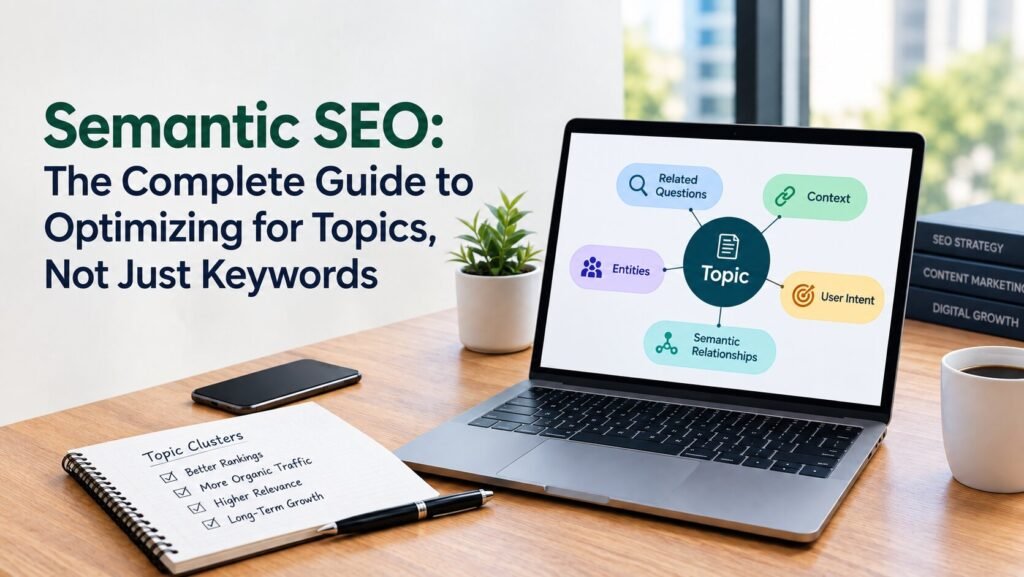
Semantic SEO isn’t about sprinkling synonyms into a page. It’s about mapping the relationships between your main topic, its subtopics, the entities involved, their attributes, and the questions real users ask around them — so a page reads as a complete, connected explanation rather than a keyword grab.
Illustrative example — Coffee Shop SEO:
Main topic: Coffee Shop SEO
Related entities and concepts: Local SEO, Google Business Profile, Reviews, Google Maps, Local citations, Coffee shop, Restaurant, Menu, Location, Opening hours, Directions.
A page built around this map naturally covers how a coffee shop’s Google Business Profile, reviews, and location data connect — which gives search engines (and AI systems) far more topical context than a page that just repeats “coffee shop SEO” a dozen times.
Step 6 — Match Search Intent Before Creating Content
There are five broad intent types, and mismatching a page to the wrong one is one of the most common reasons content underperforms even when the keyword is right:
- Informational — “how does SEO work” → a guide or explainer
- Commercial investigation — “best CRM software” → a comparison
- Transactional — “buy CRM software” → a product or pricing page
- Navigational — “HubSpot login” → the brand’s own page
- Local — “SEO agency near me” → a local landing page
Illustrative example: For “best CRM software,” a straight product sales page will usually struggle, because most searchers at that stage want to compare options, not commit to one. A well-structured comparison article — covering several tools, pricing tiers, and use cases — matches the intent far better and tends to hold its ranking longer.
Step 7 — Build Topic Clusters Instead of Random Blog Posts
A pillar page covers a broad topic comprehensively; supporting pages go deep on specific subtopics and link back to the pillar. This structure signals topical authority far more clearly than a scatter of unconnected blog posts.
Illustrative example:
Pillar: Complete Guide to Local SEO
Supporting articles: Google Business Profile SEO, Local keyword research, Local citations, Local link building, Local SEO pricing, Local SEO for dentists, Local SEO for restaurants.
Each supporting article links back to the pillar with descriptive anchor text, and the pillar links out to each supporting article in the section where that subtopic is introduced. This is what turns a random collection of posts into a cluster Google can recognize as a coherent body of expertise.
Step 8 — Optimize Existing Pages Before Publishing Hundreds of New Ones
More content isn’t automatically more traffic. Before writing anything new, audit what you already have for:
- High impressions but low click-through rate
- Rankings stuck between positions 5–20 (the “page one and a half” zone)
- Declining clicks over the last 3–6 months
- Outdated facts, prices, or screenshots
- Weak alignment with the query’s actual intent
- Poor or missing internal links
- Explanations that are technically correct but too thin to be genuinely useful
Illustrative example: A page ranking at position 11 with 30,000 monthly impressions is often a far better use of your time than a brand-new page targeting a keyword with almost no search demand. Moving that page from position 11 to position 6 could realistically multiply its clicks, while a new page starting from zero authority might take months to earn any visibility at all.
Step 9 — Write Content That Actually Deserves to Rank
Instead of the vague instruction to “create high-quality content,” the actual process looks like this: choose one search intent, identify the specific questions users ask around it, answer the primary question immediately, then cover the related subtopics that genuinely help the reader finish the task they came to do.
What that looks like in practice:
- A direct answer near the top, before background explanation
- Original insight or a perspective the reader can’t get from five other pages
- First-hand experience — something you actually did, tested, or observed
- Concrete examples and real numbers rather than generalities
- Evidence and expert commentary where relevant
- Information that’s current, not copied from a page written two years ago
- Clear structure: short paragraphs, useful headings, tables where they help
- Visuals that clarify rather than decorate
Google’s own Search Essentials documentation is unambiguous about the goal: create helpful, reliable, people-first content, and use the words people actually search with in prominent places — the title, the main heading, and other descriptive spots like alt text and link text.
Step 10 — Optimize Titles and Meta Descriptions
Before:
SEO Services | Company | Best SEO Services
Better:
SEO Services in Pakistan: Packages, Pricing & What’s Included
The second version states the primary keyword, matches commercial search intent, and tells the searcher specifically what they’ll find. A title needs to balance keyword relevance, specificity, and honest framing — a title that overpromises hurts click-through rate once people see the actual page. Meta descriptions can shape how your result is presented in the SERP snippet, but they are not a direct ranking factor — treat them as ad copy for your own page, not a technical lever.
Step 11 — Optimize Headings and Content Structure
Keep a clean hierarchy: one H1, logical H2s for major sections, H3s for subsections within them. Question-based headings tend to perform well for both readability and AI extraction.
Instead of:
SEO Information
Use:
How Much Does SEO Cost in Pakistan?
The second heading tells the reader (and the search engine) exactly what they’ll get from that section, which improves both usability and the odds of the section being pulled into a featured snippet or AI answer.
Step 12 — Improve Internal Linking
Internal links help Google discover pages, understand their relationships, and pass relevance between them — and they help orphan pages (identified in Step 2) get found.
Weak anchor text:
Click here
Better anchor text:
local SEO services in Pakistan
The second example describes the destination page accurately, which helps both users scanning the page and search engines trying to understand what that linked page is about. Prioritize links from high-traffic pages toward important pages that are underperforming.
Step 13 — Fix Technical SEO
A practical checklist to work through:
- HTTPS across the entire site, with no mixed-content warnings
- XML sitemap kept current and submitted in Search Console
- Robots.txt reviewed for accidental blocks
- Canonical URLs set correctly on every indexable page
- Redirects implemented as 301s, not chains
- 404 errors monitored and resolved
- Duplicate content consolidated or canonicalized
- Indexability confirmed for every page you want ranked
- Mobile-first indexing verified — Google largely uses the mobile version of your site
- JavaScript-rendered content tested to confirm Google can actually see it
- Site architecture kept shallow — important pages within 2–3 clicks of the homepage
- Pagination and faceted navigation controlled so they don’t create infinite duplicate URLs
- International SEO (hreflang) implemented if you serve multiple countries or languages
Step 14 — Improve Core Web Vitals and Page Experience
Core Web Vitals measure real-world experience across three dimensions — loading, interactivity, and visual stability. Google’s official targets are:
- LCP (Largest Contentful Paint) — loading speed. Aim for the largest visible element to load within 2.5 seconds.
- INP (Interaction to Next Paint) — responsiveness. Aim for under 200 milliseconds.
- CLS (Cumulative Layout Shift) — visual stability. Aim for a score under 0.1.
Practical fixes: compress images and serve modern formats (WebP/AVIF), reduce unnecessary JavaScript, lazy-load below-the-fold resources, improve server response time, remove unneeded third-party scripts, and reserve space for images and ads so content doesn’t jump around as it loads.
Important: a perfect Core Web Vitals score does not guarantee top rankings. Good scores are one input among many — content quality and relevance still carry far more weight. Treat Core Web Vitals as a tiebreaker between otherwise similar pages, not a silver bullet.
Step 15 — Add Structured Data Where It Actually Makes Sense
Structured data (schema markup) helps search engines understand what a page represents, and it can make a page eligible for certain search features. Common, appropriate uses include:
- Organization — company details on the homepage
- LocalBusiness — for physical or service-area businesses
- Product — for e-commerce listings
- Article — for blog and news content
- Breadcrumb — to reflect site hierarchy
- Event — for time-bound listings
- Recipe or Review — only where genuinely applicable
Don’t add schema simply because “more markup means better rankings” — it doesn’t. Structured data is about eligibility and clarity, not a ranking multiplier, and Google’s own structured data guidelines make clear that markup must accurately reflect the visible content on the page or it risks being treated as spam.
Step 16 — Optimize Images for SEO
- Use descriptive filenames, not camera-generated strings
- Write alt text that describes the image, not a keyword list
- Compress files and use modern formats
- Set explicit width/height to prevent layout shift
- Lazy-load images below the fold
- Add captions where they add genuine context
Before:
IMG12345.jpg
Better:
local-seo-services-karachi.jpg
Alt text should read like a sentence a person would say to describe the image to someone who can’t see it — not a string of stuffed keywords.
Step 17 — Build Quality Backlinks and Brand Authority
Link building in 2026 isn’t a numbers game. A single relevant, editorially earned link from a trusted industry publication typically outperforms hundreds of low-quality directory links — and the wrong kind of link building can actively trigger Google’s spam systems.
Approaches worth investing time in:
- Digital PR around genuinely newsworthy angles
- Contributing expert commentary to relevant publications
- Publishing original research or data studies other sites want to cite
- Partnerships with complementary (non-competing) businesses
- Resource-page outreach where your content is a legitimate fit
- Local organization sponsorships or memberships for location-based businesses
- Earning genuine brand mentions through real visibility, not manufactured ones
Illustrative example: A single link from a well-known regional business publication, earned because you contributed useful commentary on an industry trend, will usually do more for both rankings and trust than a batch of paid directory submissions ever could.
Step 18 — Optimize for Local SEO
For any business serving a specific location:
- Fully complete and regularly update your Google Business Profile
- Build location-specific landing pages rather than one generic “services” page
- Actively collect and respond to reviews
- Keep NAP (name, address, phone) consistent across your site and every directory
- Build local citations on relevant, reputable local directories
- Earn local backlinks from area organizations, press, and partners
- Include service-area information clearly if you don’t have a storefront
Illustrative example: For “best dentist in DHA Karachi,” a strong local landing page includes the practice’s name and exact DHA location, hours, a map embed, specific services offered at that location, patient reviews, and internal links to related service pages — not a paragraph of generic dental copy repeated across every branch page.
Step 19 — Optimize for AEO
Answer engine optimization means structuring content so both people and AI systems can extract a clear, standalone answer quickly.
Use:
- Question-based headings that mirror how people actually search
- A direct answer immediately after the heading
- FAQ sections for common follow-up questions
- Clear definitions for any technical term
- Lists, tables, and step-by-step instructions where they genuinely clarify
- Concise explanations that make sense without the surrounding paragraph
How long does SEO take?
Most websites need several months to see meaningful SEO growth, but the timeline varies based on competition, website authority, technical condition, content quality, and the specific changes being implemented.
That two-sentence answer works as a standalone extract. Everything after it — the “Step 20” and later sections on realistic timelines — is where you expand with supporting detail, not repeat the same claim.
Step 20 — Optimize for GEO and AI Search
GEO, done properly, is about making your brand and content easy for generative systems to understand and trust enough to cite — not about tricking them. Focus on:
- Entity clarity — is it obvious who you are and what you do?
- Demonstrated brand authority across multiple credible sources
- First-party information — data, results, and claims that originate with you
- Genuinely expert-written content, not generic filler
- Original research others can cite
- Consistent business information across the web
- Clear, factual statements that are easy to extract accurately
- Strong, connected topical coverage (see Step 5 and Step 7)
What to avoid — Google is explicit about this:
- Fake AI mentions or manufactured “citations”
- Mass-produced, low-value AI pages
- Keyword stuffing aimed at AI parsers
- Fake reviews or fabricated expertise
- Unnecessary AI-specific files created purely to try to game visibility
Google’s position, summarized plainly: site owners don’t need special AI text files or markup to appear in generative AI Search. The recommended focus stays on crawlability, useful content, and standard SEO fundamentals — not on the growing list of unsupported “GEO hacks” that third-party services have been promoting.
Step 21 — Use AI to Speed Up SEO Without Publishing Garbage
AI tools are genuinely useful for parts of the SEO workflow: keyword clustering, first-draft content outlines, SERP and competitor analysis, content briefs, metadata ideas, internal-link discovery, content gap analysis, draft schema markup, data analysis, and refreshing old content.
What AI shouldn’t replace: your actual expertise, fact-checking, original examples drawn from real experience, editorial judgment, accuracy, and final quality control before anything publishes.
Google has been consistent on this for years, and its position hasn’t softened: using automation, including AI, to generate content primarily to manipulate rankings violates its spam policies. At the same time, Google is clear that not all AI-assisted content counts as spam. The test is whether the content is genuinely useful to a reader, not how it was produced.
Step 22 — Create an SEO Content Brief Before Writing
Use this reusable template for every new page or major update:
- Primary keyword:
- Search intent:
- Target audience:
- Primary question:
- Secondary questions:
- Entities to cover:
- Competitor gaps:
- Internal links to include:
- External sources to reference:
- Examples to include:
- Original insight:
- CTA:
- Schema to apply:
Fill this out before writing a word. It forces intent-matching (Step 6) and semantic coverage (Step 5) to happen at the planning stage instead of getting bolted on afterward.
Step 23 — Measure SEO Performance
Track these on a recurring basis:
- Organic clicks and impressions
- Click-through rate (CTR)
- Average position
- Number of indexed pages
- Conversions attributed to organic traffic
- Organic revenue or qualified leads
- Keyword rankings for your priority terms
- Backlink growth and quality
- Engagement metrics (time on page, scroll depth)
- Core Web Vitals status
- AI-search visibility, where measurable through Search Console’s generative AI report
Separate traffic metrics from business metrics. A page pulling in 10,000 visitors but generating zero leads is often less valuable to the business than a page bringing in 500 visitors that converts 30 of them into qualified leads.
Google Search Console — What Should I Check Every Month?
- Performance — clicks, impressions, CTR, and average position trends
- Indexing — new pages indexed, pages excluded, and why
- Sitemaps — submission status and errors
- Core Web Vitals — URLs flagged as “Needs Improvement” or “Poor”
- Manual actions / security issues — confirm there are none
- Pages gaining impressions — early signals of rising relevance
- Queries with high impressions but low CTR — title/meta opportunities
- Pages losing clicks — candidates for the optimization work in Step 8
Google has also added a dedicated way to track AI visibility directly: the Generative AI performance report inside Search Console, which shows how your content performs specifically within generative AI features. Check it alongside your standard Performance report rather than treating it as a separate workflow.
SEO Statistics You Should Know in 2026
Global Search Market Share
According to StatCounter data (reported via Statista, worldwide, all devices, July 2026), Google held approximately 91.32% of global search engine referrals, with Bing a distant second at roughly 4.46%.
Pakistan Search Market
Per StatCounter Global Stats, Google held 97.14% of the search engine market share in Pakistan in July 2026, with Bing at 1.89%, Yahoo! at 0.52%, and Yandex and DuckDuckGo splitting the remainder (StatCounter, Pakistan, all devices, July 2026).
For a business targeting Pakistani users, this matters directly: optimization effort aimed at any search engine other than Google is very unlikely to be a good use of limited time or budget in this market. Google Search Console and Google’s ranking systems should be the near-total focus of measurement and optimization work here.
Real SEO Example — Optimizing a Local Business Website
Hypothetical example — cleaning company in Karachi.
Before SEO:
- Homepage targets generic “cleaning services” with no location signal
- No dedicated service pages
- Weak, non-specific title tag
- Poor internal linking between pages
- No local optimization at all
After SEO:
Homepage title becomes:
Cleaning Services in Karachi | Residential & Commercial Cleaning
Dedicated service pages are created for: house cleaning, office cleaning, deep cleaning, sofa cleaning, carpet cleaning, and commercial cleaning — each targeting its own specific keyword and intent rather than competing with the homepage.
From there: each service page links internally to related services and to a local landing page; a Google Business Profile is fully completed and kept current; LocalBusiness schema is added to the homepage and location page; a review-collection process is set up; and Search Console tracking confirms whether impressions and clicks actually improve over the following months. This is illustrative of the process, not a claim about results any specific business achieved.
SEO Example — E-Commerce Website
Hypothetical example — online shoe store.
Key optimization areas:
- Category pages — clear, keyword-relevant titles and unique intro copy, not just a product grid
- Product pages — unique titles and descriptions, not manufacturer boilerplate copied across every retailer
- Images — compressed, descriptively named, with real alt text for each angle
- Product schema — price, availability, and review data marked up accurately
- Reviews — genuine customer reviews, both for trust and potential rich results
- Internal links — cross-links between related products and categories
- Filters and faceted navigation — controlled so they don’t generate thousands of near-duplicate crawlable URLs
- Commercial keywords — mapped separately from informational ones (see Step 4)
Before:
Men’s Running Shoe – Black
After:
Men’s Black Running Shoes – Lightweight, Breathable, Size 7–12
The improved title is specific enough to match how a real shopper searches, while still reading naturally.
Common SEO Mistakes to Avoid in 2026
- Keyword stuffing in titles, headings, or body copy
- Buying spammy or irrelevant backlinks
- Publishing AI-generated content at scale without human review
- Creating a separate page for every minor keyword variation instead of consolidating
- Ignoring search intent in favor of chasing volume
- Neglecting technical SEO while focusing only on content
- Copying competitor content structure instead of adding something new
- Publishing pages with no internal links pointing in or out
- Constantly publishing new content while ignoring existing underperforming pages
- Chasing rankings as the goal instead of conversions
- Ignoring local SEO for a location-based business
- Over-optimizing anchor text to the point it looks manipulative
- Fake reviews or fabricated expertise claims
- Leaving outdated information live on high-traffic pages
Many of these fall directly under Google’s spam policies, which Google has clarified now apply across all of Google Search, including generative AI responses — meaning manipulative tactics can hurt visibility in AI Overviews and AI Mode, not just traditional rankings.
How Long Does SEO Take?
Results depend on competition, domain history, existing authority, technical condition, content quality, search intent, industry, location, link profile, and how fast changes actually get implemented. There is no fixed timeline that applies to every site.
As general planning windows — not guarantees:
- 30 days — technical fixes may resolve indexing issues; expect little to no ranking movement yet
- 60–90 days — early signals: impressions may rise, some long-tail rankings may improve
- 3–6 months — clearer ranking movement on moderately competitive terms, assuming consistent execution
- 6–12 months — meaningful traffic and conversion growth on competitive terms, particularly for newer or lower-authority sites
Never promise a client or a boss that rankings will land in 30 days — that promise isn’t realistic and sets up a conversation you don’t want to have later.
How Much Does It Cost to Do SEO for a Website?
Costs vary by approach:
- DIY SEO — time investment instead of cash, viable for small sites with a patient owner
- Freelance SEO — flexible, often narrower in scope than an agency
- SEO agency — broader coverage across technical, content, and link work
- Enterprise SEO — larger teams, larger sites, more complex stakeholder coordination
- One-time audit — a fixed-scope diagnostic, good for identifying priorities
- Monthly retainer — ongoing execution and monitoring
- Technical SEO project — scoped fix for a specific structural problem
- Content-led SEO — ongoing content production and optimization
What actually drives cost: website size, competitiveness of the industry, number of pages needing work, content production needs, technical complexity, target location(s), and how aggressive the growth goals are. There’s no honest fixed price to quote without knowing these variables.
My 90-Day SEO Plan for a New Website
Days 1–30
- Install tracking (Search Console, GA4, rank tracker)
- Complete a full technical audit
- Fix indexing and crawlability issues
- Complete keyword research and intent mapping
- Review and adjust site architecture
- Identify and strengthen core pages
- Build the initial topic/entity map
Days 31–60
- Produce priority content based on the keyword map
- Apply on-page optimization to new and existing pages
- Strengthen internal linking across the site
- Set up and optimize local SEO assets (if applicable)
- Resolve remaining technical issues
- Add appropriate structured data
- Begin outreach for digital PR and link opportunities
Days 61–90
- Update and improve underperforming existing pages
- Optimize titles for pages with high impressions but low CTR
- Analyze ranking movement against the original baseline
- Review and improve on-page conversion elements
- Continue link acquisition
- Expand content into gaps identified during research
- Full performance review against Day 1 baseline
SEO Checklist for 2026
Technical SEO
- HTTPS across the site
- All key pages crawlable
- All key pages indexable
- XML sitemap submitted and current
- Robots.txt reviewed
- Canonical tags correct
- Mobile usability confirmed
- Core Web Vitals in “Good” range
On-Page SEO
- Search intent matched
- Title tag optimized
- Single, clear H1
- Logical H2/H3 structure
- Genuinely helpful content
- Internal links added
- Images optimized
- Schema applied where appropriate
Authority
- Relevant backlinks in progress
- Digital PR opportunities identified
- Brand mentions tracked
- Expert-authored content
AEO/GEO
- Direct answers included
- Clear definitions for technical terms
- Entity relationships mapped
- Original insight present
- First-hand experience reflected
- Claims backed by reliable sources
Measurement
- Search Console reviewed monthly
- Analytics conversions tracked
- Rankings monitored
- Organic conversions measured
- CTR reviewed by query
- AI-search visibility checked where available
Frequently Asked Questions
How do I do SEO for my website myself? Start by installing Search Console and analytics, then run a technical audit to fix indexing issues. Research keywords by intent, optimize your existing pages before writing new ones, build internal links, and track performance monthly. It’s realistic for a small site with consistent effort, though it takes longer without dedicated expertise.
How can I rank my website on Google? Ranking comes from a combination of technical accessibility, content that genuinely answers the searcher’s question, relevant internal and external links, and a good page experience. There’s no single fix — it’s the accumulation of these factors over time that moves rankings.
What are the latest SEO techniques in 2026? The core techniques remain technical SEO, intent-matched content, and internal linking — layered with newer practices like structuring content for AI extraction (AEO), building entity clarity for generative search (GEO), and tracking visibility inside AI Overviews through Search Console’s generative AI report.
Is SEO still important in 2026? Yes. Google’s own guidance confirms that generative AI search features are built on the same core ranking and quality systems as traditional Search, meaning the fundamentals that earn strong traditional rankings are the same ones that support AI-search visibility.
How long does SEO take? Most sites need several months to see meaningful growth, with early technical wins possible within 30–60 days. The exact timeline depends on competition, site authority, technical condition, and how quickly changes are implemented.
How much does SEO cost? Cost varies widely based on website size, competitiveness, content needs, and technical complexity. There’s no single fixed number — a small local business audit costs far less than ongoing enterprise SEO for a large e-commerce site.
What is the first step in SEO? Install measurement tools — Search Console and analytics — before making any changes. Without a baseline, you can’t tell whether later work actually improved anything.
How do I find keywords for my website? Look beyond search volume to intent, relevance, business value, and competition. Map each priority keyword to a specific page so you’re not creating multiple pages competing for the same query.
How many keywords should a page target? One primary keyword per page, supported by closely related secondary terms and questions that share the same search intent. Targeting unrelated keywords on the same page usually dilutes relevance for all of them.
Does AI-generated content hurt SEO? Not automatically. Google’s guidance states that using automation to generate content primarily to manipulate rankings violates its spam policies, but AI-assisted content that is genuinely useful, accurate, and edited by a human isn’t penalized simply for how it was produced.
What is AEO? Answer Engine Optimization — structuring content so it can be extracted as a direct, standalone answer by AI systems and featured snippets. It relies on clear headings, direct answers, and well-organized supporting detail.
What is GEO? Generative Engine Optimization — making a brand and its content easy for generative AI systems to understand, trust, and cite. Google treats it as an extension of standard SEO rather than a separate discipline.
How do I optimize my website for AI search? Focus on the same fundamentals that support traditional rankings — crawlable pages, genuinely useful content, clear structure — while adding direct answers, strong entity clarity, and consistent factual information across the web. Avoid manufactured AI-specific tactics that Google’s own guidance advises against.
How do backlinks help SEO? Relevant backlinks signal to Google that other credible sites vouch for your content, which supports both authority and trust. A small number of genuinely relevant links typically outperforms a large number of low-quality ones.
How important are Core Web Vitals? They matter for user experience and can act as a tiebreaker between otherwise similar pages, but strong Core Web Vitals scores alone do not guarantee top rankings. Content relevance and quality carry more weight.
How often should I update my content? Revisit high-traffic and declining pages every few months to refresh outdated facts, numbers, and examples. There’s no universal schedule — prioritize pages showing declining clicks or outdated information first.
How do I check if Google has indexed my website? Use the URL Inspection tool in Search Console for individual pages, or the Page Indexing report for a site-wide view of what’s indexed versus excluded, and why.
Can a small business do SEO without an agency? Yes, particularly for a smaller site with manageable competition. It requires consistent time investment in technical maintenance, content, and measurement, but the fundamentals in this guide are achievable without outside help.
What SEO tools should beginners use? Google Search Console and Google Analytics are essential and free. Beyond that, a crawler like Screaming Frog and a basic rank tracker cover most of what a beginner needs before investing in paid all-in-one platforms.
What are the biggest SEO mistakes to avoid? Ignoring search intent, neglecting technical SEO in favor of content alone, publishing without internal links, and constantly creating new pages while ignoring underperforming existing ones are among the most common and costly mistakes.
Final Answer: How Should I Do SEO for My Website in 2026?
Follow the sequence: Audit → Research → Structure → Optimize → Publish → Link → Measure → Improve. Start by installing tracking and auditing your site’s technical health. Research keywords by intent and map them into topic clusters. Optimize your existing pages before publishing new ones, structure content around direct answers and genuine expertise, and support it with clean internal linking and relevant backlinks. Apply structured data and local optimization where they genuinely fit, and keep Core Web Vitals healthy without treating them as a silver bullet. Because Google’s generative AI features run on the same core ranking systems as traditional Search, none of this changes for AI visibility — it reinforces it. Measure everything in Search Console every month, and treat every page as a living asset that gets revisited, not a one-time publish.