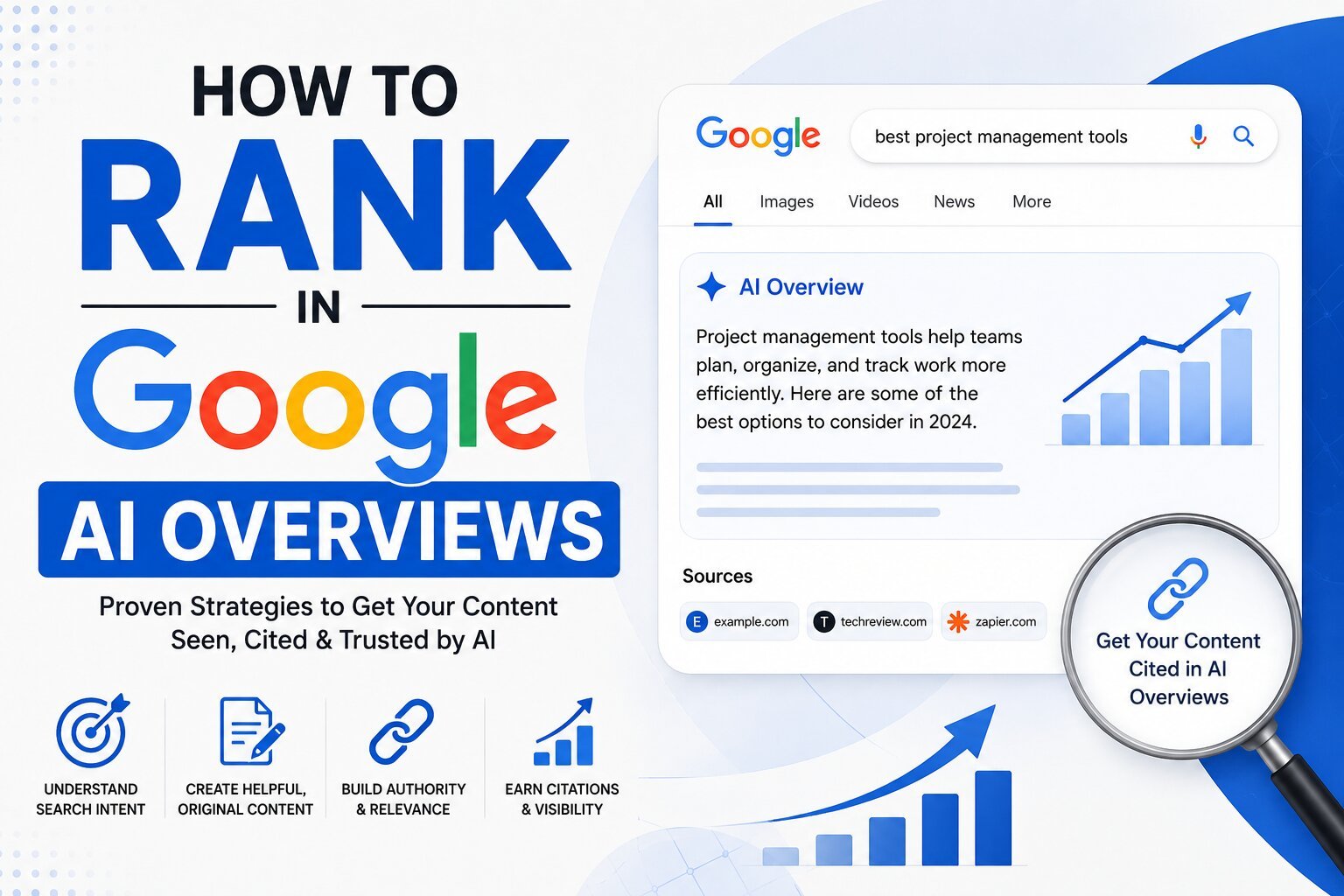
Search no longer starts and ends with a list of blue links. Increasingly, a Google search returns an AI-generated summary above traditional results — synthesizing information from multiple sources into a direct answer, with links back to where it drew from. This is Google AI Overviews, and it’s changing how people discover information and decide which websites to visit.
For business owners, marketers, and content creators, the question is: how does a website actually get referenced inside one of these AI-generated answers? There’s no secret schema, no magic word count, and no guaranteed formula. What exists instead is a set of principles — many rooted in long-standing SEO fundamentals, others specific to how generative search retrieves and synthesizes information — that meaningfully improve a site’s chances of being discovered, understood, and cited.
This article explains what AI Overviews are, how they conceptually work, and what you can realistically do to improve visibility, without pretending to know Google’s proprietary systems.
Quick Answer: How Do You Rank in Google AI Overviews?
There’s no guaranteed formula. Websites improve their odds by strengthening the same foundations that support strong organic performance: full crawlability and indexability, content that genuinely satisfies search intent, clear topical authority, logical site structure with strong internal linking, demonstrated first-hand expertise, trustworthy well-sourced information, and structured data that accurately reflects the page. AI Overviews draw from Google’s broader index, so a page must be eligible to rank well in traditional search before it can realistically become a supporting source for an AI-generated answer.
What Are Google AI Overviews?
Google AI Overviews are AI-generated summaries appearing at the top of search results for certain queries, synthesizing information from multiple sources into one answer with links to those sources. Google launched AI Overviews in the U.S. in May 2024 and has since expanded to more than 100 countries. Updates rolling out through 2026 added inline links within the AI text itself, hover previews of source sites, and “suggested angles” pointing users to related in-depth articles — reflecting Google’s stated goal of helping users find relevant websites and original content, not just stay inside the summary.
AI Overviews differ from traditional results in a key way: instead of ranking a list of independent pages, Google blends information from several sources into one answer. A page can influence that answer without being the single top result — and ranking first doesn’t guarantee citation.
Example: Searching “best time to plant tomatoes” might trigger a summary of planting windows and soil temperature guidance, citing a few gardening and agricultural extension sites. This shift affects click behavior: some queries now resolve entirely within the overview, while others — especially ones inviting deeper exploration — still send meaningful traffic to cited sources.
How Do Google AI Overviews Work?
Conceptually, the process involves:
- Query interpretation — understanding intent, including context from prior queries in a session.
- Information retrieval — pulling relevant content from Google’s index.
- Multi-step reasoning — complex questions may be broken into related sub-searches.
- Synthesis — retrieved information is combined into a coherent summary.
- Source attribution — links to contributing sources are surfaced.
Google’s exact retrieval and ranking systems are proprietary, and no outside party has full visibility into the precise signals involved. What follows is grounded in established SEO principles and publicly available information about how AI Overviews function at a conceptual level — not claims about a known algorithm.
Does Traditional SEO Still Matter?
Yes. AI Overviews are built on Google’s existing index, so the same factors that support organic rankings affect eligibility for citation: crawlability, indexability, search-intent alignment, content quality, internal linking, technical SEO, site architecture, authority, relevance, and user experience.
Two nuances matter specifically for AI Overviews. First, ranking #1 doesn’t guarantee citation — synthesis may draw from several sources offering the clearest collective answer, not necessarily the single top page. Second, not ranking #1 doesn’t exclude a page — a well-structured page ranking fifth or eighth can still be cited if it offers something the top result doesn’t.
What Does a Website Need to Be Eligible?
Baseline technical requirements mirror traditional search eligibility: Googlebot accessibility, crawlability and indexability (via correct robots.txt and no unintended noindex tags), an accurate XML sitemap, proper canonical URLs, valid HTTP status codes, fully renderable JavaScript content, and compliance with search spam policies (no cloaking, doorway pages, or scaled low-value content).
Being technically eligible to appear in Search is not the same as being selected as a source in an AI Overview. Eligibility is the baseline; a page failing these checks has essentially no chance of citation, but passing them only opens the door — what happens next depends on content quality and the competitive landscape for that query.
15 Ways to Improve Your Chances
1. Build a strong technical foundation. Ensure crawlability, clean indexing, no canonicalization conflicts, an accurate sitemap, a non-blocking robots.txt, and properly rendered JavaScript. A technically broken site reliably prevents visibility.
2. Publish original, useful content. Reworded content that restates what’s already ranking rarely adds enough value. Original research, first-hand experience, case studies, real examples, and original data stand out.
3. Match search intent. Informational queries need clear explanation; commercial-investigation queries need comparisons; transactional queries need a clear path to purchase; navigational queries need a direct destination; local queries need location-specific detail. Mismatched intent is one of the most common reasons content underperforms.
4. Answer questions clearly. Use the structure Question → Direct Answer → Explanation → Example → Evidence. State the direct answer in the first sentence, then expand — serving scanning readers and giving AI systems a clean, extractable passage without manipulative formatting.
5. Build topical authority. Use a pillar page covering a broad topic, supported by cluster articles on subtopics, all interlinked. Example: an “SEO” pillar page linking to dedicated articles on technical SEO, link building, local SEO, and AI search optimization — each linking back to the pillar and to each other.
6. Strengthen internal linking. Contextual links with descriptive anchor text, placed naturally within body content, help search engines discover pages and understand topic relationships far more effectively than navigation-only links.
7. Demonstrate first-hand experience. Original experiments, documented case studies, screenshots, expert commentary, and original testing results are difficult to replicate and carry more credibility than generic explanation.
8. Support claims with reliable evidence. Cite primary sources — official documentation, research, industry data, properly attributed expert commentary. Never cite statistics you can’t verify.
9. Keep content accurate and updated. Freshness matters most where facts change: pricing, software features, regulations, technology. Changing a “last updated” date without substantive changes isn’t a genuine refresh — and it’s often detectable.
10. Make your brand and entities clear. Search engines increasingly evaluate content in terms of entities — organizations, people, products — not just keywords. Consistent business name, description, author credentials, and contact information across the site and structured data build a coherent entity profile.
11. Use structured data correctly. Relevant types include Organization, Article, Person, Product, LocalBusiness, Service, and BreadcrumbList. No schema type guarantees AI Overview placement — its role is to help engines understand content that already exists, not describe content that isn’t visible on the page.
12. Use helpful visuals. Original diagrams, charts, screenshots, and videos improve usefulness when they clarify the surrounding content. Visuals added purely for perceived “richness” add little.
13. Earn relevant authority and mentions. Quality backlinks from relevant, reputable sites and genuine industry mentions matter far more than link volume.
14. Address complex, multi-part queries. A query like “what’s the best CRM for a small business with a limited budget?” requires covering pricing, features, integrations, ease of use, support, scalability, and security together — not just one dimension.
15. Monitor AI search visibility. Track Search Console impressions, clicks, CTR, and queries. Periodically check manually whether AI Overviews appear for priority queries and which sources are cited, building a simple ongoing tracking habit.
Google AI Overviews vs Google AI Mode
Google AI Mode is a related but distinct, more conversational search experience supporting multi-turn follow-up questions and broader exploratory research within a session. AI Mode expanded internationally in October 2025 and by mid-2026 incorporated more advanced underlying models and a more conversational search interface across desktop and mobile.
| Feature | What It Is | Primary Behavior |
|---|---|---|
| Traditional Search | Ranked list of organic results | User clicks through ranked links |
| Featured Snippets | A single extracted answer from one source | Directly answers simple queries |
| AI Overviews | AI-generated summary synthesizing multiple sources | Summarizes an answer with citations |
| AI Mode | Conversational, chat-style search | Ongoing dialogue with multi-turn retrieval |
Visibility now spans multiple experiences rather than a single results page. The same content quality, technical soundness, and topical authority that support traditional rankings underpin visibility across all of them.
SEO vs AEO vs GEO vs AI SEO
| Strategy | Primary Focus | Example |
|---|---|---|
| SEO | Traditional search visibility | Ranking in standard organic results |
| AEO | Answer visibility | Structuring content to directly answer questions |
| GEO | Generative search visibility | Increasing the odds of AI-generated citation |
| AI SEO | Broader AI-search optimization | Improving visibility across AI-powered search overall |
These overlap significantly. Strong technical SEO supports AEO; clear answers serving AEO also support GEO; all depend on the same underlying qualities — crawlable, well-organized, genuinely useful content. Treating them as separate content strategies is usually unnecessary.
Does Schema Help With AI Overviews?
Structured data labels page content in a format search engines can parse programmatically — a price, an author, a business address. Relevant types include Organization, Article, Person, Product, LocalBusiness, Service, and FAQPage. No schema guarantees inclusion in an AI Overview; its role is to aid understanding, not manipulate selection. Marking up schema that doesn’t match visible content — FAQ schema for content that isn’t genuinely Q&A, for instance — can be counterproductive.
Does FAQ Content Help?
Genuine FAQs, addressing real questions your audience actually asks, are useful to both readers and AI systems parsing clear Q&A structures. Artificially padding a page with loosely related questions to trigger schema or insert keywords adds little value and often reads as disconnected. FAQ schema itself doesn’t guarantee citation. A short, genuinely useful FAQ section addressing a few real questions typically outperforms a padded list of a dozen superficial ones.
Does Word Count Matter?
There’s no magic word count. Content usefulness and completeness matter more than length. Eight hundred words of genuinely useful, specific information — direct answers, concrete examples, clear structure — is often more useful, and more easily extractable, than 3,000 words padded with repetitive restatement and filler. Length should be a byproduct of thoroughly covering a topic, not a target pursued for its own sake.
Can AI-Generated Content Appear in AI Overviews?
AI-assisted content isn’t automatically disqualified, but it must meet the same quality bar as anything else: genuine usefulness, accuracy, and reader value. The distinction that matters is whether content has been properly reviewed and enhanced with real expertise, or simply generated and published without oversight.
A poor workflow: prompt an AI tool, publish with minimal review, repeat at scale, include unverified claims. This creates real quality and trust risk. A responsible workflow: use AI to help draft or structure content, then have a knowledgeable editor verify facts, add first-hand insight the AI couldn’t generate, and ensure the final piece reflects genuine expertise rather than generic synthesis.
Example: Optimizing a Page for AI Overviews
Consider a fictional local SEO agency targeting: “How much does local SEO cost for a small business?”
Rather than a short, generic estimate, the agency could build a resource including: a direct answer up front acknowledging cost variability and typical ranges; the factors driving cost differences (competition, locations, website condition, scope); a breakdown of what’s included at different price points; concrete examples contrasting a single-location business with a multi-location chain; original insight from actual pricing and delivery experience; verifiable supporting evidence rather than invented statistics; a genuine FAQ addressing real follow-up questions; internal links to related service pages; clear author information; accurate Article and Organization schema; and periodic updates as market conditions genuinely shift.
This improves the page’s quality, completeness, and search readiness — but doesn’t guarantee it will be cited in an AI Overview for that query, since that outcome still depends on the competitive landscape and Google’s own selection process.
Why Your Website May Not Appear
Common causes: the page isn’t indexed; technical SEO problems (crawl errors, slow load times, mobile issues); weak or generic content mirroring what’s already available; poor search-intent alignment; weak topical coverage; low trust signals (missing author info, unclear business identity); poor internal linking; outdated information; stronger competing sources; the query simply doesn’t trigger an AI Overview; AI Overview behavior shifts over time; and search personalization or context affecting what’s shown to a given user.
Not appearing doesn’t necessarily indicate a penalty. Many high-quality pages simply aren’t selected for a given query at a given moment, often due to competitive dynamics rather than any deficiency in the page.
Common AI Overview SEO Mistakes
- Keyword stuffing — write naturally instead.
- Writing solely for AI systems — write for humans first; that also serves AI parsing.
- Publishing unreviewed AI content — use AI as a drafting aid, not a replacement for editorial oversight.
- Scaling large numbers of thin pages — invest in fewer, genuinely comprehensive pages.
- Ignoring technical SEO — maintain it as a prerequisite, not an afterthought.
- Accidentally blocking pages from crawling — audit
robots.txtandnoindextags regularly. - Weak internal linking — connect related content contextually.
- Using unverifiable statistics — rely only on sources you’ve actually checked.
- Building spammy backlinks — prioritize relevance over volume.
- Adding mismatched schema — only mark up what’s genuinely visible on the page.
- Creating artificial FAQ sections — answer real questions your audience asks.
- Repeating the same information across pages — consolidate into distinct, well-organized content.
- Chasing citations instead of user value — genuine usefulness is what drives citation potential.
- Expecting immediate results — treat this as an ongoing, iterative process.
- Assuming a simple ranking formula exists — build broad-based quality and monitor results over time.
30-Day Optimization Plan
This is an implementation framework, not a guarantee of visibility within 30 days.
Week 1 — Technical Foundation: Crawl the site; check indexation in Search Console; review robots.txt; verify the XML sitemap; fix canonical conflicts; review internal linking; document technical issues found.
Week 2 — Content: Identify high-intent priority queries; improve weak existing content; add original insight and examples; strengthen intent alignment; fill gaps in topical coverage.
Week 3 — Authority: Improve author bio and credential information; pursue relevant backlink opportunities; look for legitimate mention or contribution opportunities; publish one genuinely original resource; strengthen entity consistency site-wide.
Week 4 — Measurement: Review Search Console performance; track priority-query rankings; monitor impressions and click trends; identify pages gaining or losing visibility; manually check whether AI Overviews appear for key queries and which sources are cited; use findings to prioritize the next round of updates.
Frequently Asked Questions
How do I rank in Google AI Overviews? There’s no guaranteed formula. Focus on crawlability, indexability, content that matches search intent, topical authority, clear structure, and trustworthy, well-sourced information — the same fundamentals that support strong standard search visibility.
How can I get my website into Google AI Overviews? Ensure full crawlability and indexing, then publish original, well-structured content that clearly answers real questions. Strengthen internal linking, build topical authority, and keep information accurate and current. No single tactic guarantees inclusion.
Does ranking #1 guarantee an AI Overview citation? No. AI Overviews synthesize multiple sources rather than simply citing the top-ranking page. A lower-ranking page can still be cited if it offers clear, relevant information that completes the overall answer.
Does SEO still matter for Google AI Overviews? Yes. AI Overviews are built on Google’s search index, so technical health, content quality, intent alignment, and site authority remain essential. AI Overview visibility extends strong SEO rather than replacing it.
Does schema markup help with AI Overviews? Structured data helps engines understand a page’s content and entities more precisely, which can support overall performance. No schema type guarantees placement, and it should always accurately reflect the page’s actual content.
Does AEO help with Google AI Overviews? Structuring content to directly answer specific questions supports the kind of extractable, well-organized content AI systems tend to synthesize more easily. It complements traditional SEO rather than replacing it.
What is GEO in AI search? Generative Engine Optimization refers to practices aimed at increasing the likelihood that AI-generated tools reference a site in their answers. It overlaps heavily with SEO and AEO, relying on the same underlying content qualities.
How important is technical SEO for AI Overviews? It’s foundational. A page that isn’t crawlable, indexable, or technically accessible has essentially no chance of citation regardless of content quality.
Does word count affect AI Overview visibility? No ideal word count exists. What matters is whether content thoroughly and clearly addresses the query — a shorter, dense page can outperform a longer, padded one.
Can AI-generated content appear in AI Overviews? Yes, if it meets the same quality bar as any content — accurate, genuinely useful, and ideally reviewed and enhanced by knowledgeable humans. Unreviewed, mass-produced AI content carries real quality risks.
How long does it take to appear in Google AI Overviews? There’s no fixed timeline. Visibility depends on ongoing content quality, technical health, and competitive dynamics that shift over time — meaningful improvement is generally a longer-term process.
How can I track AI Overview visibility? Use Search Console to monitor impressions, clicks, and query-level performance, and periodically check manually whether AI Overviews appear for priority queries and which sources are cited.
Conclusion
There’s no guaranteed shortcut for appearing in Google AI Overviews — no secret schema, no exact word count, no single tactic that reliably triggers a citation. What actually improves your odds is the same foundation that has always supported strong search performance: a website that is crawlable, indexable, relevant, genuinely helpful, original, authoritative, trustworthy, well structured, technically sound, kept current, and useful to real people asking real questions.
SEO, AEO, GEO, and AI SEO aren’t competing strategies requiring separate content plans — they’re overlapping layers of the same discipline, pointing back to one core principle: build content that genuinely serves the people searching for it, on a technically sound, well-organized website. Businesses that treat AI search visibility as an extension of solid SEO practice, rather than a separate game to be gamed, are best positioned as search continues to evolve.