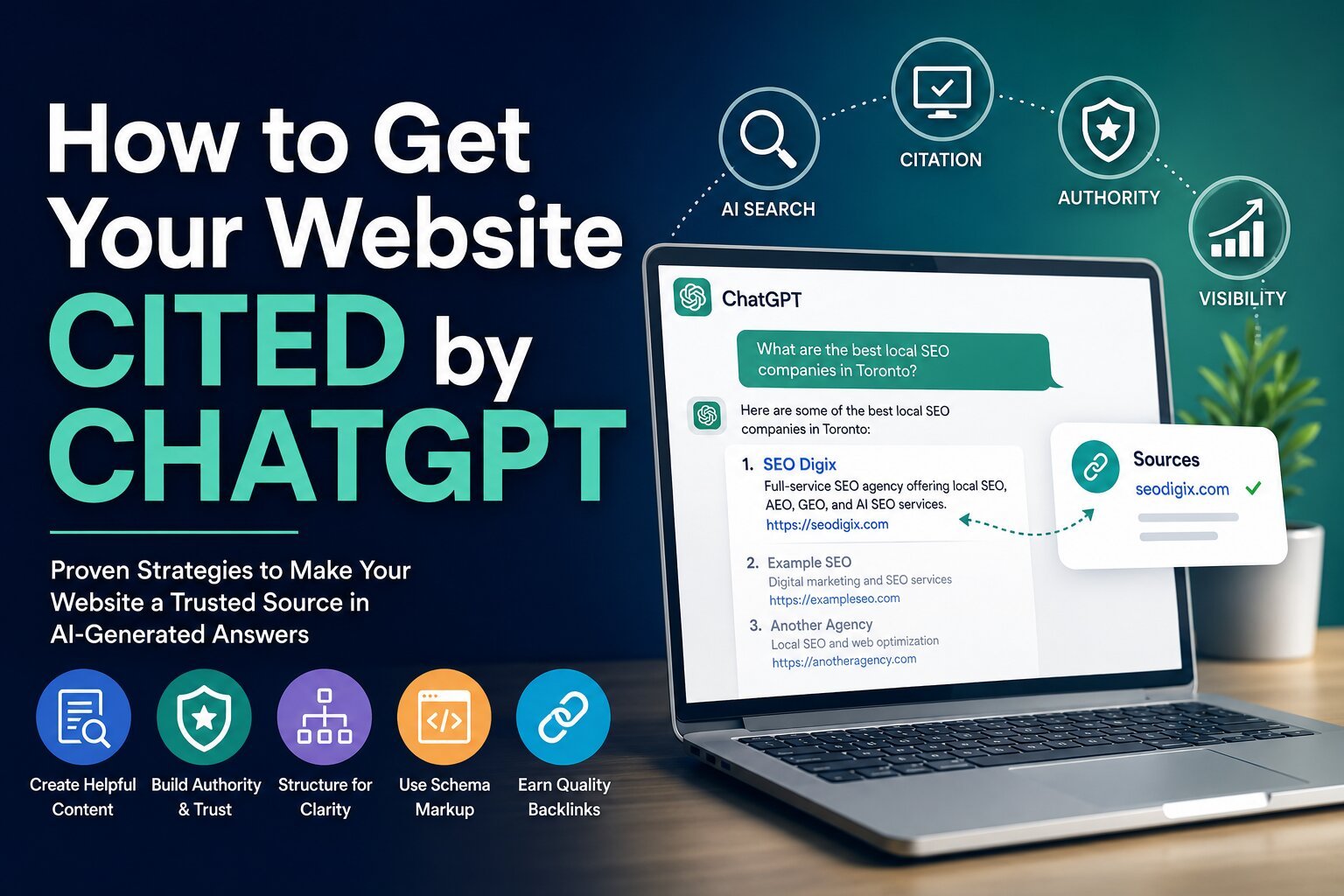
Imagine someone asks ChatGPT, “What are the best local SEO companies in Toronto?” Instead of clicking through ten Google results, they get a direct answer — and in many cases, that answer includes links pointing to specific websites that supported it.
That raises an obvious question: what makes one website get cited while another doesn’t?
Understanding how to get your website cited by ChatGPT starts with recognizing that this is a different goal than ranking #1 in Google. A citation isn’t a ranking position — it’s a website being used as a source when an AI system generates an answer. As more people turn to AI tools to research products, services, and decisions, AI citation visibility is becoming a meaningful part of how websites get discovered. This article explains, in plain terms, what a ChatGPT citation actually is, how the process works conceptually, and what you can realistically do to make your website a more useful source.
What Does It Mean to Be Cited by ChatGPT?
A citation happens when ChatGPT provides a link or source attribution pointing users toward information published on a specific website. For example, if someone asks, “What should I look for when choosing an SEO agency?” ChatGPT might explain several factors — pricing transparency, reporting, communication, past results — and link to one or more websites that supported those points.
It’s worth separating a few terms that often get used interchangeably:
- Being mentioned means your brand or website is referenced in the answer text, without necessarily being cited as a source.
- Being cited means a specific source link is attributed to information in the answer.
- Being recommended means your business is suggested as an option, which may or may not include a citation.
- Being linked means a clickable reference to your page appears, which usually accompanies a citation but isn’t identical to it.
These distinctions matter because a website can be mentioned without being cited, or cited without being explicitly recommended. They’re related but not the same outcome.
How Do ChatGPT Citations Work?
Rather than a fixed, publicly documented algorithm, the process can be described conceptually: a user asks a question, the AI system interprets the intent behind it, relevant information is retrieved (depending on the experience and whether web/search functionality is active), sources are evaluated for relevance and usefulness, an answer is generated, and relevant sources may be cited.
For example, someone might ask, “How much does local SEO cost for a small business?” A search-enabled AI system may look for current, useful sources discussing pricing ranges, service scope, business size, location, and typical deliverables. A well-structured article that actually explains these factors is more likely to be useful as a source than a thin page with a single vague sentence about pricing.
This is a conceptual explanation of the general process, not a claim about a fixed, publicly known ranking formula — no such formula has been published, and the exact mechanics can vary by product and over time.
Can You Submit Your Website Directly to ChatGPT?
No. There’s no simple submission process where a website owner can request or guarantee a citation. This is an important distinction: submitting a website is not the same as building a website that is discoverable, useful, authoritative, and relevant enough to be retrieved as a source.
Rather than looking for a shortcut, a better approach is to make your website easy to discover and understand while publishing genuinely useful information that answers the questions people are actually asking.
10 Ways to Increase Your Chances of Getting Cited by ChatGPT
1. Create Original, Useful Content
Avoid content that simply rewrites the first ten Google results in different words. Prioritize original research, expert insight, first-hand experience, case studies, and genuine statistics when available.
Compare: “SEO is important because it helps websites rank,” versus, “A local restaurant can improve organic visibility by optimizing its location page, maintaining accurate business information, earning relevant local links, and publishing location-specific content.” The second version gives a reader — and an AI system — something concrete and specific to work with.
2. Answer Specific Questions Clearly
Question-based content is easier for both readers and AI systems to parse. Structure sections around real questions like “What is AEO?” or “How does local SEO work?” and answer directly before expanding.
For example: Question: What is AEO? Direct answer: AEO is the practice of structuring and optimizing content so answer-focused search experiences can understand and surface useful responses. Then expand with detail. This structure improves usability — though it doesn’t guarantee a citation on its own.
3. Build Topical Authority
Instead of publishing a single article about SEO, build connected content around technical SEO, local SEO, on-page SEO, keyword research, link building, Google Business Profile, AEO, GEO, and AI SEO. A connected body of content signals a deeper knowledge base around a subject than isolated, disconnected posts.
4. Make Your Website Easy to Understand
Clear navigation, descriptive headings, logical URLs, internal linking, and readable paragraphs all help. Compare a vague heading like “Things You Need to Know” with a specific one like “How Technical SEO Improves Website Crawlability” — the second communicates meaning immediately, to a reader skimming the page and to a system trying to summarize it.
5. Strengthen Your Website’s Authority
Quality backlinks, mentions in industry publications, relevant directories, and digital PR contribute to a website’s broader credibility — though no specific number of backlinks guarantees a citation. A cybersecurity company mentioned by several respected technology publications has a stronger external reputation than a brand-new site with no independent references. Authority is about overall credibility, not link count alone.
6. Publish Expert-Led Content
Author bios, credentials, case studies, and transparent company information demonstrate the E-E-A-T qualities — Experience, Expertise, Authoritativeness, Trustworthiness — that support content credibility. Compare an anonymous “Complete Guide to Dental SEO” with “Dental SEO Guide by [Author Name], SEO Consultant with experience working on healthcare websites,” followed by genuine expertise and examples. An author bio alone doesn’t cause a citation, but it strengthens the overall trust signals around the content.
7. Keep Important Information Current
Freshness matters for topics involving prices, statistics, software features, regulations, or search platform behavior. An article describing “how Google’s AI search features work” should be reviewed periodically, since these products change. Update outdated statistics, remove obsolete information, and refresh screenshots — but only update a published date when the content itself has meaningfully changed.
8. Strengthen Your Brand and Entity Information
Your website should clearly communicate who the company is, what it does, where it operates, which services it offers, and how it can be contacted. For example, a company page might state plainly: “SEO Digix is a digital marketing and search optimization company offering SEO, AEO, GEO, AI SEO, and local SEO services.” Consistent business information across the web makes a brand easier for any system to understand and describe accurately.
9. Use Structured Data Where Appropriate
Schema markup helps search engines understand entities and relationships on a page — common types include Organization, LocalBusiness, Article, Person, Product, and Service. A LocalBusiness schema, for instance, can communicate a business name, address, phone number, and hours in a structured, machine-readable way. Schema markup does not guarantee a citation; its purpose is to make information clearer and easier to interpret.
10. Build Content That Deserves to Be Cited
Bring these principles together: citation-worthy content tends to be accurate, relevant, original, detailed, well structured, trustworthy, current, and supported by evidence where appropriate. Compare “SEO helps businesses get traffic” with “For a local plumbing company, SEO can improve visibility for service-specific searches such as ’emergency plumber in Toronto’ by combining relevant service pages, local signals, useful content, and a well-optimized Google Business Profile.” The second gives readers something specific and usable.
Does Traditional SEO Help You Get Cited by ChatGPT?
Yes, in an indirect but meaningful way. Websites generally need to be accessible, crawlable, indexable, relevant, useful, and authoritative before they can be retrieved as a source at all — which means technical SEO, content quality, internal linking, backlinks, topical authority, and search intent alignment all still matter.
That said, ranking highly on Google does not automatically mean ChatGPT will cite your website, and not ranking #1 on Google doesn’t mean your website can never be cited in an AI-generated answer. The two systems evaluate and use information differently, even though they draw on overlapping signals of quality and relevance.
AEO vs GEO vs AI SEO for Website Citations
These terms describe related but distinct areas of focus:
| Approach | Main Focus | Example |
|---|---|---|
| SEO | Search engine visibility | Ranking in Google |
| AEO | Answer visibility | Providing direct answers |
| GEO | Generative search visibility | Increasing chances of being referenced by AI |
| AI SEO | Broader AI-search optimization | Improving visibility across AI-powered search |
These strategies overlap considerably rather than functioning as separate replacements for one another. A well-optimized page that ranks well, answers a question directly, and is written clearly enough for an AI system to summarize is doing all of this work at once.
Examples of Content That Could Earn AI Citations
Local SEO agency: A “Local SEO Checklist for Small Businesses” that includes a genuinely useful checklist, clear explanations, and practical examples can function as a reference other content — and AI systems — might draw on.
Healthcare website: An article titled “What Is the Difference Between Preventive and Diagnostic Care?” benefits enormously from demonstrated expertise, accuracy, cited references, and appropriate medical review, given the sensitivity of health information.
SaaS company: “How to Choose CRM Software for a Small Business” becomes more useful with a genuine comparison framework and original research, rather than a generic overview of features.
Ecommerce website: “How to Choose the Right Running Shoes for Beginners” is stronger when it reflects real product expertise, clear selection criteria, and honest comparisons rather than generic buying advice.
Why Your Website May Not Be Getting Cited
Common reasons include: content that’s too generic, a website that lacks established authority, content that doesn’t directly answer the query being asked, outdated information, weak topical coverage of the subject, unclear business entity information, technical accessibility problems, stronger competing sources, or simply a query that doesn’t call for a citation from that type of source at all. AI search behavior and retrieval can also vary from one query to the next. Importantly, not receiving a citation does not mean your website has an SEO penalty — it usually just means the content hasn’t yet met the bar for that particular query.
Common Mistakes to Avoid
- Keyword stuffing “ChatGPT” into content doesn’t influence AI systems and hurts readability.
- Writing content specifically to manipulate AI rather than help readers tends to produce weak, unhelpful material.
- Publishing large volumes of low-quality AI-generated content dilutes authority instead of building it.
- Copying competitors limits your ability to offer anything genuinely useful or original.
- Buying backlinks or fake reviews damages trust signals and creates real risk.
- Making unsupported claims or using fake statistics undermines credibility once discovered.
- Creating shallow FAQ pages just to hit a content quota rarely produces useful answers.
- Adding unnecessary schema without real structured content behind it adds little value.
- Updating publication dates without meaningful content changes is a misleading practice.
- Expecting immediate citations overlooks that authority and trust build gradually over time.
How to Check Whether ChatGPT Is Citing Your Website
Build a list of relevant questions and test them periodically. For example: “What are the best local SEO companies in Karachi?” “How can a small business improve local SEO?” “What are the most important AEO strategies in 2026?” “How can a business improve its AI search visibility?”
For each test, record whether your brand appears, whether your website appears, whether a specific page is cited, which competitors are cited, what type of content earned the citation, and which exact query produced it. Treat these results as a snapshot rather than a permanent ranking — they can and will change as queries, retrieval systems, and available information evolve.
A Simple 30-Day AI Citation Optimization Plan
Week 1 — Technical Foundation: Review crawlability, indexing, site structure, internal links, page titles, and headings.
Week 2 — Content: Create or improve question-based articles, comprehensive guides, FAQs, original resources, and clear service explanations.
Week 3 — Authority: Work on expert contributions, relevant backlinks, brand mentions, and industry references.
Week 4 — Measurement: Test relevant AI queries, competitor queries, brand queries, and local queries, and track any changes over time.
This 30-day structure is an implementation framework to help you organize the work — not a promise of citation results within that timeframe.
Frequently Asked Questions
Can I submit my website directly to ChatGPT? No. There’s no submission process that guarantees a citation. Building a discoverable, authoritative, useful website is the more realistic path toward being retrieved as a source.
How do I get my website cited by ChatGPT? Focus on publishing original, accurate, well-structured content that directly answers real questions, strengthening your site’s authority and technical foundation, and keeping information current.
Does SEO help with ChatGPT citations? Indirectly, yes. SEO fundamentals like crawlability, content quality, and site structure help make a website accessible and understandable, which supports — but doesn’t guarantee — AI citation potential.
Do backlinks help websites get cited by AI? Quality backlinks from relevant, credible sources strengthen a website’s overall authority and reputation, which can support AI visibility. No specific number of backlinks guarantees a citation.
Does schema markup help with AI search? Structured data helps search engines and AI systems understand your content more clearly. It supports comprehension rather than guaranteeing that a citation will occur.
How important is topical authority for AI search? Fairly important. A website with connected, in-depth content on a subject is generally seen as a more credible, useful source than one with a single isolated article on the topic.
Can small websites get cited by ChatGPT? Yes. Citation potential depends more on the relevance, accuracy, and usefulness of specific content than on overall site size, though very small sites may need to focus tightly on a niche to build credible authority.
How long does it take to get cited by ChatGPT? There’s no fixed timeline. It depends on your starting authority, content quality, and how consistently you invest in the site over time — this is a long-term effort rather than a quick fix.
Does Google ranking guarantee ChatGPT citations? No. The two systems evaluate information differently, so strong Google rankings don’t guarantee a ChatGPT citation, and the reverse is also true.
Is GEO the same as SEO? No, though they overlap significantly. SEO focuses on traditional search rankings, while GEO focuses specifically on increasing the likelihood of being referenced within AI-generated responses.
Conclusion
You cannot force ChatGPT to cite your website — there’s no submission form, guaranteed formula, or shortcut that bypasses the underlying work. What you can do is steadily improve the quality, relevance, authority, accessibility, and clarity of your website so it becomes a genuinely useful potential source for AI-powered search experiences.
In practice, that means creating genuinely useful content, answering specific questions directly, building topical authority, demonstrating real expertise, strengthening your brand and entity signals, earning relevant authority, maintaining strong technical SEO, keeping information current, structuring content clearly, and monitoring your AI visibility over time. If you’d like to go deeper on any of these areas, SEO Digix publishes further resources on SEO, AEO, GEO, and AI search optimization.