Search behavior has changed faster in the last two years than in the previous two decades. Instead of typing a keyword into Google and scrolling through ten blue links, millions of people now open ChatGPT, Gemini, Perplexity, or Google’s AI Overviews and ask a direct question. They expect — and get — a direct answer, often with no click required at all.
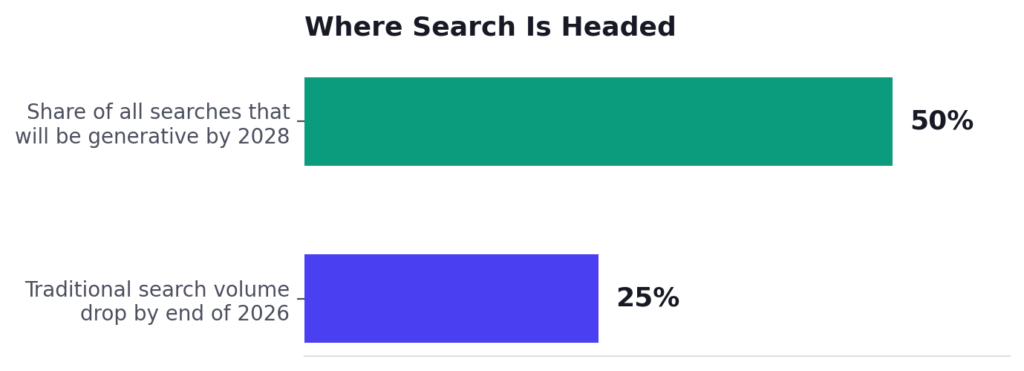
Industry projections suggest that roughly a quarter of traditional search volume will disappear by the end of 2026 as generative engines absorb more of the discovery journey, and some forecasts put generative search at half of all searches by 2028 (source). Consumer behavior is already shifting at the top of the funnel too, with more shoppers turning to AI tools than traditional search for product discovery (source).
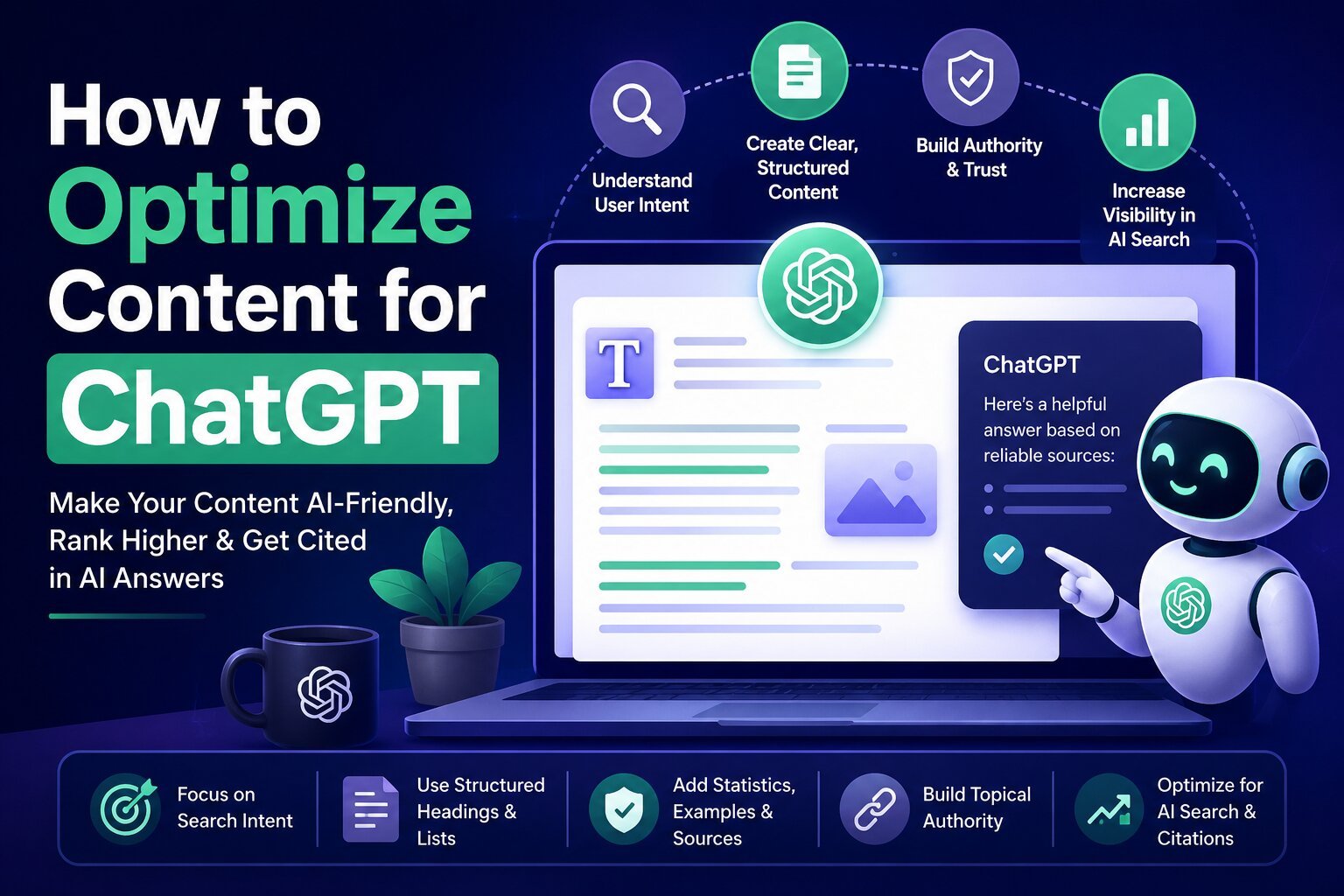
This is the reality behind Generative Engine Optimization (GEO) — the discipline of structuring content so that ChatGPT, Gemini, Perplexity, Claude, and Google’s AI Overviews can find it, understand it, trust it, and cite it. This guide walks through exactly how to optimize content for ChatGPT, why traditional SEO alone no longer cuts it, and what a practical, repeatable AI search optimization workflow looks like.
Expert tip: Think of ChatGPT and other generative engines less like a search index and more like a very well-read research assistant. It doesn’t want to send someone away with ten options — it wants to synthesize the single best answer. Your job is to become the source it trusts enough to quote.
What Is ChatGPT Search and How Does It Find Information?
ChatGPT can answer from three different sources depending on the query:
- Its trained knowledge — patterns and facts learned during training, with a fixed cutoff date.
- Live web search — when a question needs current information, ChatGPT issues real-time queries, retrieves pages, and summarizes them, often with inline citations.
- Connected tools and browsing plugins — for tasks like checking a specific site, reading a document, or pulling structured data.
For anything time-sensitive, comparative, or “best of” in nature, ChatGPT increasingly leans on live retrieval rather than memory alone. That retrieval step behaves a lot like a search engine crawler: it favors pages that are fast, well-structured, clearly written, and easy to extract a clean answer from.
This is the core mechanic behind ChatGPT SEO: you are no longer only optimizing to rank a page — you are optimizing a passage of content to be extractable, quotable, and attributable.
Why Traditional SEO Alone Is No Longer Enough
Traditional SEO was built around one goal: rank a URL high enough that a human clicks it. Generative engines break that model in a few important ways.
- No guaranteed click. The AI may answer the question fully in-line, meaning your content can influence the answer without ever generating a visit.
- Passage-level relevance beats page-level relevance. AI models often extract a specific sentence or paragraph, not “the page.” A 3,000-word article with one buried, well-phrased answer can win over a keyword-stuffed page.
- Synthesis over ranking. Instead of listing ten sources, the engine blends three or four into one answer — so being one of the sources chosen matters more than being ranked #1.
- Trust signals matter more than backlink volume. Research comparing ranking factors has found that brand mentions across the web correlate roughly three times more strongly with AI visibility than backlinks do (source).
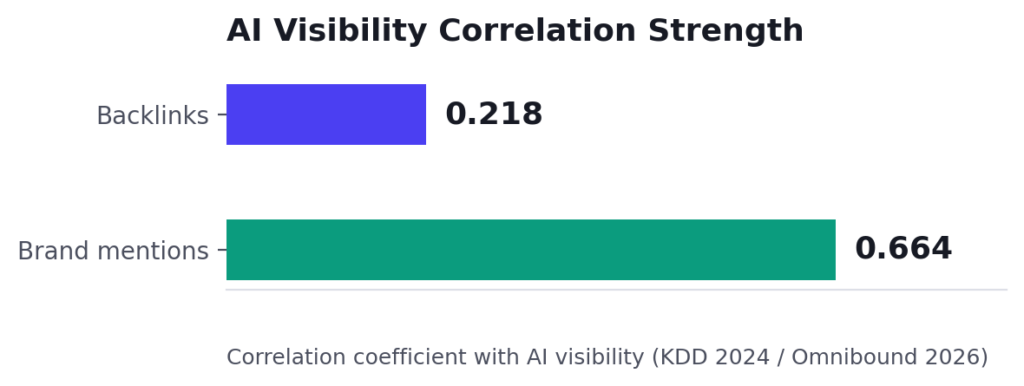
None of this means traditional SEO is dead — generative engines still frequently pull from content that already ranks well organically, so solid technical and on-page SEO remains the foundation GEO is built on (source). But it’s no longer sufficient by itself.
Key Ranking Signals ChatGPT Looks For
While OpenAI hasn’t published a literal “ranking algorithm,” patterns across GEO research and observed AI Overview behavior point to six recurring signals.
| Signal | What It Means | How to Strengthen It |
|---|---|---|
| Authority | Is the source recognized as credible in its niche? | Author bios, credentials, consistent publishing history, external mentions |
| Relevance | Does the passage directly answer the query? | Question-based headers, tight topical focus, no filler |
| Freshness | Is the information current? | Visible “last updated” dates, refreshed stats, current-year examples |
| Structured Information | Can the answer be extracted cleanly? | Headings, bullet points, tables, schema markup |
| Trustworthiness (E-E-A-T) | Are claims backed by evidence? | Citations, original data, transparent sourcing |
| Entity Relationships | Does the content clearly connect to known people, brands, and concepts? | Consistent naming, structured data, internal linking between related entities |
Expert tip: Research on generative engine visibility found that simply improving the fluency and readability of existing text produced a measurable visibility boost on its own (source) — sometimes as effective as adding new facts. Clarity is a ranking factor now, not just a nicety.
How to Structure Content for ChatGPT Visibility
Structure is arguably the single highest-leverage lever you control. AI models extract text more reliably when it’s organized the way a human skimmer would want it.
1. Use clear, descriptive headings Avoid clever or vague headers. “5 Ways to Reduce Cart Abandonment” beats “Let’s Talk Checkout.”
2. Write question-based subheadings Headers phrased as real user questions (“What is Generative Engine Optimization?”) are far more likely to be lifted directly into an AI answer or featured snippet.
3. Lead with the concise answer, then expand Put a 1–3 sentence direct answer immediately under the heading. Follow with supporting detail, examples, or nuance. This mirrors how featured snippets and AI Overviews are built.
4. Use bullet points and numbered lists Lists are easy for models to parse and reproduce faithfully.
5. Use tables for comparisons and data Tables compress information density and are frequently pulled wholesale into AI-generated comparisons.
6. Define key terms explicitly A short, standalone definition (“X is defined as…”) is one of the most commonly cited sentence structures in AI answers.
How to Create AI-Friendly Content
Structure gets you extracted. Semantic depth gets you trusted. Here’s what that looks like in practice.
Semantic SEO
Write around concepts and user intent, not isolated keywords. Cover the related questions a real person would ask next, in the same piece or a linked one.
Topic Clusters
Organize content into a pillar page (broad overview) supported by cluster pages (specific subtopics), all interlinked. This signals topical depth to both traditional crawlers and AI retrieval systems.
Topical Authority
Publishing consistently and comprehensively in one niche — rather than scattering shallow posts across many — builds the kind of concentrated authority generative engines associate with trustworthy sources.
Entity Optimization
Make sure your brand, products, and key people are described consistently across your site and in third-party mentions (directories, press, Wikipedia-style profiles, LinkedIn). AI models build an internal “entity graph,” and consistency helps them connect your content to the right entity.
Search Intent Matching
Classify each page against intent — informational, navigational, commercial, or transactional — and make sure the content format matches. A “best X” query wants a comparison; a “what is X” query wants a definition-first answer.
How to Increase Your Chances of Being Cited by ChatGPT
Getting cited is different from getting ranked. Citations go to content that adds something the model can’t already infer.
- Original research — surveys, proprietary data, internal benchmarks. Nothing beats a number no one else has.
- Statistics — a KDD 2024 study from Princeton, Georgia Tech, and IIT Delhi found that adding relevant statistics was the single most effective GEO tactic, improving AI visibility by roughly 41% (source).
- Case studies — concrete before/after outcomes with numbers are highly quotable.
- Expert insights — named quotes from credentialed people add attribution value an AI can lean on.
- Unique frameworks — a named methodology (like “the 5-signal ranking model” above) gives the AI a distinct, citable concept rather than generic advice.
- Broad distribution — the same research found that distributing content across a wide range of publications, rather than only your own site, increased AI citation rates by as much as 325% (source).
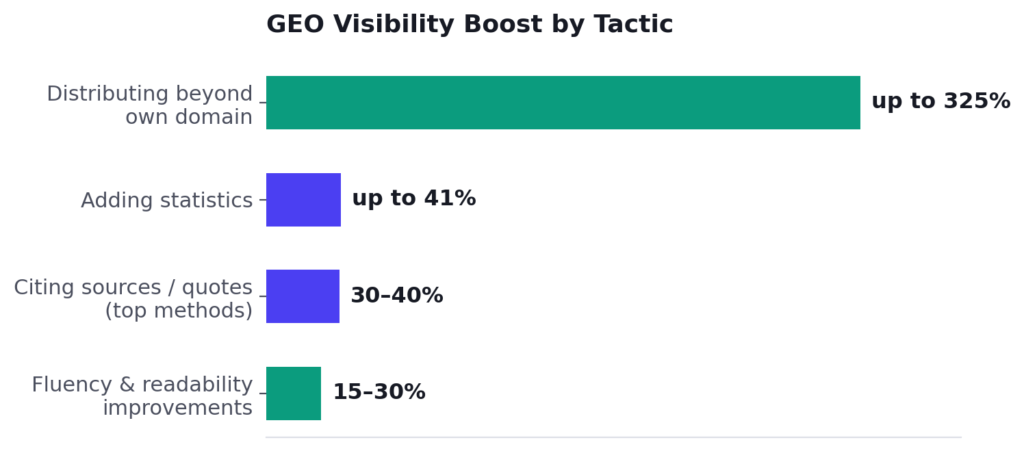
Expert tip: Across the top-performing GEO methods studied — citing sources, adding statistics, and including direct quotations — visibility improved by roughly 30–40% compared to unoptimized content (source). These are cheap edits with outsized returns.
Best Content Formats for ChatGPT Citations
Not all formats earn citations equally. Here’s how the most common formats compare for AI visibility.
| Format | Citation Potential | Best For | Notes |
|---|---|---|---|
| How-to Guides | High | Process/procedural queries | Strong when steps are numbered and outcome-focused |
| Tutorials | High | “How do I…” queries | Benefit from screenshots, code blocks, clear sequencing |
| Statistics Pages | Very High | Data-backed claims | Original or well-sourced numbers are heavily quoted |
| Glossaries | High | Definition queries | Short, standalone definitions are ideal snippet material |
| Case Studies | Medium–High | “Does this work?” queries | Needs concrete metrics, not just narrative |
| Comparison Articles | Very High | “X vs Y” and “best of” queries | Tables dramatically increase extractability |
Common Mistakes That Prevent Content From Appearing in AI Answers
- Burying the answer. If the direct answer is three paragraphs deep, models may skip the page entirely.
- Keyword stuffing. Unnatural repetition hurts readability and trust — both AI ranking signals now.
- No structured data. Missing schema markup (Article, FAQ, HowTo) makes content harder to interpret programmatically.
- Stale content with no update signals. No visible date, no refreshed stats — freshness is a real, measurable factor.
- Thin E-E-A-T. No author name, no credentials, no sourcing — this is a fast way to be filtered out as low-trust.
- Overly promotional tone. AI models tend to favor neutral, informative phrasing over sales copy.
- Ignoring crawlability. If a bot can’t access or render the page, none of the above matters.
How AI Search Optimization (GEO) Differs From Traditional SEO
| Dimension | Traditional SEO | Generative Engine Optimization (GEO) |
|---|---|---|
| Primary goal | Rank a URL on a results page | Be selected as a source in a synthesized answer |
| Unit optimized | The whole page | The specific passage or paragraph |
| Success metric | Click-through rate, position | Citation frequency, “share of model” |
| Key signals | Backlinks, keywords, page speed | Statistics, quotations, structure, entity clarity |
| Content depth | Comprehensive coverage helps ranking | Comprehensive and extractable coverage helps citation |
| Freshness role | Helps ranking, not always critical | Frequently critical — stale content gets skipped |
| Distribution | Primarily your own domain | Cross-publication presence boosts citation odds significantly |
Expert tip: GEO doesn’t replace SEO — it builds on it, since generative engines still tend to draw heavily from content that already ranks well organically (source). Treat GEO as an additional layer, not a rip-and-replace strategy.
How to Optimize Existing Content for ChatGPT
You don’t need to start from scratch. Run existing pages through this six-step process.
- Analyze the queries your content should answer. Pull real questions from search console data, “People Also Ask,” and ChatGPT itself — literally ask it what it knows about your topic and where the gaps are.
- Add entities. Name the people, brands, tools, and concepts explicitly rather than using vague pronouns or generic terms.
- Improve structure. Add question-based H2/H3s, move direct answers to the top of each section, and convert dense paragraphs into bullets or tables.
- Update statistics. Replace outdated numbers, add a visible “last updated” date, and cite the year explicitly where relevant.
- Add FAQs. A dedicated FAQ section with schema markup captures long-tail, conversational queries almost verbatim.
- Strengthen EEAT. Add or update author bios, link to credentials, and cite external sources to back up claims.
| Statistic | Data Point |
|---|---|
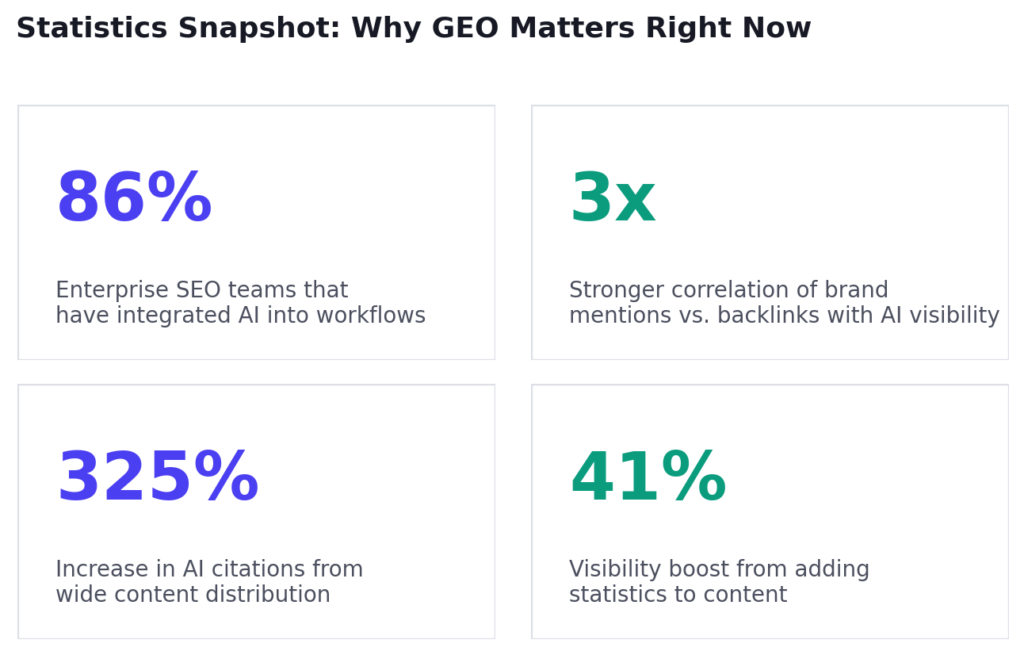
| Drop in traditional search volume expected by end of 2026 | Up to 25% (source) |
| Share of searches projected to be generative by 2028 | 50% (source) |
| Visibility boost from top GEO tactics (citations, stats, quotes) | 30–40% (source) |
| Visibility boost from adding statistics specifically | ~41% (source) |
| Increase in AI citations from wide content distribution | Up to 325% (source) |
| Strength of brand mentions vs. backlinks as an AI visibility signal | ~3x stronger correlation (source) |
| Enterprise SEO teams that have integrated AI into workflows | 86% (source) |
Future of SEO in the Age of ChatGPT and AI Search
The direction of travel is clear: search is becoming a conversation, not a list of links. A few shifts worth planning around:
- “Share of Model” becomes a real KPI. Instead of tracking rank position, teams will track how often their brand is mentioned across ChatGPT, Gemini, Perplexity, and Google AI Overviews responses for target queries.
- Multi-platform optimization. Content increasingly needs to work across ChatGPT, Gemini, Claude, Perplexity, and traditional Google results simultaneously — each with slightly different retrieval behavior.
- Zero-click strategy matters more than ever. Brands will need value beyond the click: newsletters, communities, and direct relationships that don’t depend solely on search referral traffic.
- Structured data becomes non-negotiable. Schema markup, clean HTML, and crawlable pages move from “best practice” to baseline requirement.
- Human expertise becomes a differentiator, not a formality. As AI-generated content floods the web, verifiably human, credentialed, original insight becomes the scarce resource generative engines are trained to seek out.
ChatGPT Content Optimization Checklist
Use this as a quick pre-publish and content-refresh audit.
- Direct, concise answer appears within the first 1–2 sentences of each section
- Headings are phrased as real user questions where relevant
- At least one table or bulleted list per major section
- Original statistics, data, or a named framework included
- Author byline with visible credentials/expertise
- External citations to credible, authoritative sources
- “Last updated” date visible on the page
- FAQ section with schema markup
- Consistent naming of brand, product, and key entities throughout
- Content distributed beyond your own domain (guest posts, PR, partnerships)
- Clean, crawlable HTML with no content locked behind JavaScript-only rendering
- Internal links connecting the page to related topic-cluster content
Frequently Asked Questions About ChatGPT SEO
1. What does it mean to optimize content for ChatGPT?
It means structuring, sourcing, and writing content so ChatGPT’s web retrieval can easily find, understand, and confidently cite a specific passage as the answer to a user’s question.
2. Is GEO the same as SEO?
No. SEO optimizes a page to rank on a results list; GEO optimizes a passage to be selected and quoted inside an AI-generated answer. They overlap heavily but measure success differently.
3. Can I rank in ChatGPT without ranking in Google?
It’s possible but harder. Generative engines often lean on content that already performs well organically, so strong traditional SEO remains a practical foundation for AI visibility.
4. How do I get cited by ChatGPT specifically?
Publish original data, clear definitions, and well-sourced claims; structure content with question-based headers and direct answers; and distribute that content across multiple credible publications, not just your own site.
5. Does ChatGPT use backlinks like Google does?
Backlinks still help indirectly through traditional ranking, but brand mentions and consistent entity recognition across the web appear to correlate more strongly with AI citation likelihood than raw backlink counts.
6. How important are statistics in AI-friendly content?
Very. Adding relevant, sourced statistics is consistently one of the highest-impact single changes you can make to improve AI visibility.
7. Do I need schema markup for AI search optimization?
Yes. Structured data (Article, FAQ, HowTo schema) helps machines parse your content accurately and is increasingly treated as a baseline technical requirement, not an optional extra.
8. How often should I update content for AI Overview SEO?
Review high-value pages at least quarterly. Update statistics, refresh examples, and keep a visible “last updated” date, since freshness is a meaningful trust and relevance signal.
9. Does content length matter for ChatGPT citations?
Not directly. What matters is whether a specific passage answers the question clearly and concisely — a well-structured 800-word page can outperform an unstructured 3,000-word one.
10. Are Google AI Overviews and ChatGPT optimized the same way?
Largely yes. Both favor structured, concise, well-sourced, and fresh content, though each platform has its own retrieval quirks — so testing visibility across ChatGPT, Gemini, Perplexity, and AI Overviews separately is worthwhile.
11. What’s the biggest mistake brands make with AI search optimization?
Treating GEO as a copy-paste of old SEO tactics. Keyword density and link volume alone won’t earn a citation — clarity, evidence, and structure will.
Conclusion and Key Takeaways
Optimizing content for ChatGPT isn’t a separate universe from good content strategy — it’s an evolution of it. The brands winning visibility in ChatGPT, Gemini, Perplexity, and Google AI Overviews are the ones combining solid technical SEO with clear structure, original evidence, and genuine expertise.
Key takeaways:
- Generative search is growing fast enough that AI visibility now belongs on every content team’s roadmap, not just SEO’s.
- Structure — question-based headers, direct answers, bullets, and tables — is one of the fastest wins available.
- Statistics, quotations, and citations are the highest-leverage content additions for AI visibility.
- Distribution beyond your own domain meaningfully increases citation odds.
- GEO builds on SEO — it doesn’t replace it.
Start with your highest-traffic, highest-intent pages, run them through the checklist above, and treat AI citation tracking as a recurring part of your content workflow — not a one-time project.