
That’s the opportunity long-tail keywords represent, and it’s only getting bigger. Search behavior has shifted dramatically toward natural, conversational phrasing, driven by voice assistants, AI chat tools, and a public that’s simply gotten more comfortable typing full questions instead of two-word fragments. According to Ahrefs’ keyword database, roughly 95% of all keywords get fewer than 10 searches a month individually — and it’s exactly that long tail of specific, low-volume phrases that now drives the bulk of qualified organic traffic (source).
At the same time, AI search platforms — Google AI Overviews, ChatGPT, Gemini, and Perplexity — are fundamentally built around answering specific, conversational questions rather than matching broad keywords. That makes long-tail keyword strategy not just a traffic tactic anymore, but a prerequisite for showing up in AI-generated answers at all.
This guide covers exactly what long-tail keywords are, why they matter more in 2027 than ever before, and how to build a strategy around them that drives real, qualified traffic.
Table of Contents
ToggleWhat Are Long-Tail Keywords?
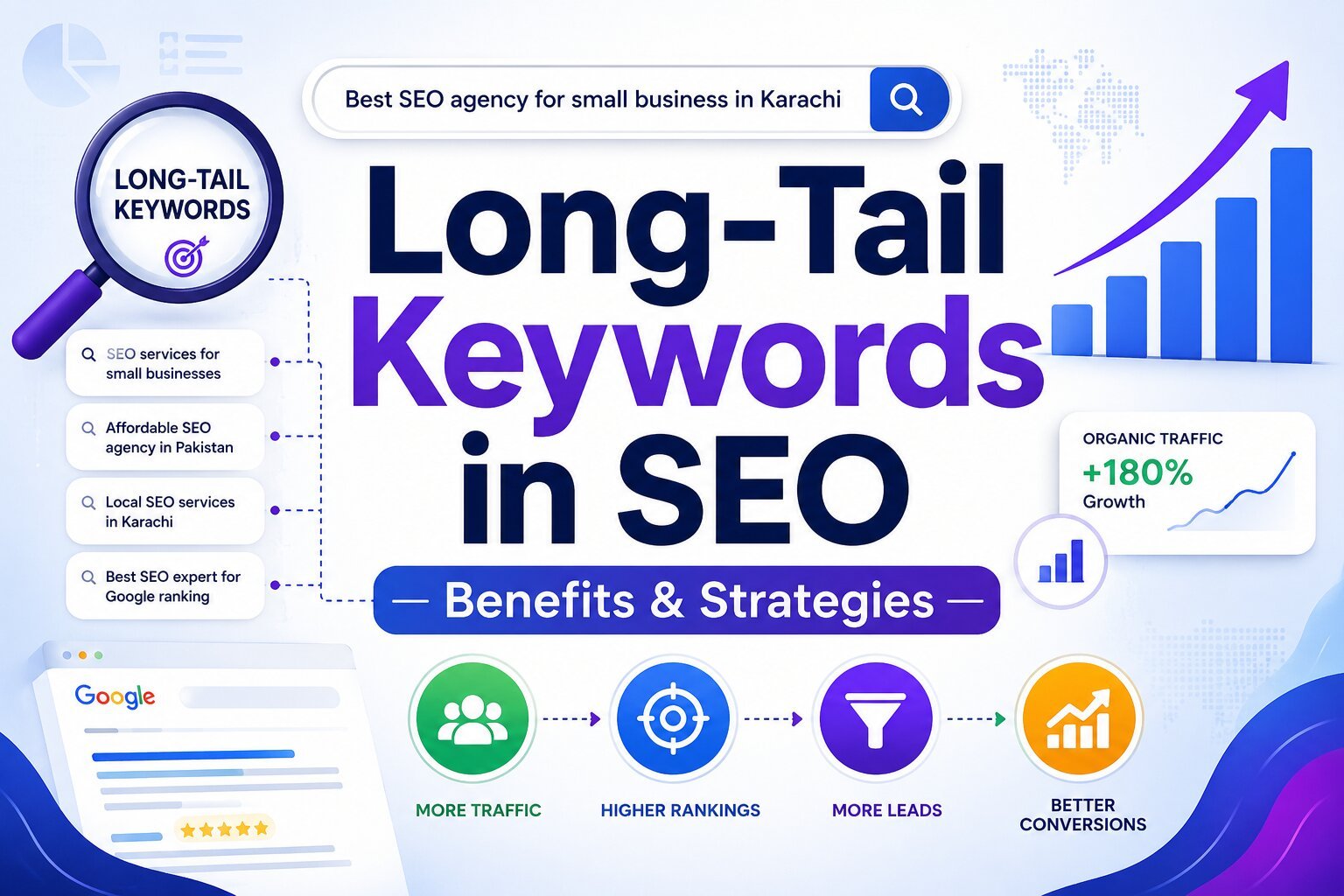
Long-tail keywords are specific, multi-word search phrases — typically three or more words — that reflect precise user intent. Instead of searching “shoes,” someone using a long-tail query might search “best running shoes for flat feet under $100.”
Key Characteristics
- Longer phrasing — usually 3 to 10+ words
- Lower individual search volume — often just 10 to 100 searches per month
- Highly specific intent — the searcher usually knows exactly what they want
- Lower competition — fewer sites actively target the exact phrase
- Higher relevance to niche audiences — they match a distinct need, not a general category
Search Intent Relevance
Long-tail keywords tend to map cleanly onto one of the four core search intent types:
- Informational — “how does semantic SEO work”
- Navigational — “Ahrefs keyword explorer login”
- Commercial investigation — “best SEO tools for small agencies 2027”
- Transactional — “hire affordable SEO consultant for ecommerce store”
The more specific the phrase, the easier it is to tell exactly what the searcher wants — which is precisely why long-tail content tends to convert so much better than broad, generic pages.
Short-Tail vs. Long-Tail: A Quick Example
| Short-Tail Keyword | Long-Tail Keyword |
|---|---|
| SEO Services | Affordable SEO Services for Small Businesses |
| Shoes | Best Running Shoes for Flat Feet |
| Coffee Maker | Best Single-Serve Coffee Maker Under $50 |
| Marketing Agency | B2B Content Marketing Agency for SaaS Startups |
Why Long-Tail Keywords Are Important for SEO
Long-tail keywords matter for a handful of very practical reasons that compound over time.
- Lower competition. Broad terms like “shoes” or “SEO services” are dominated by massive brands and marketplaces with huge domain authority. A long-tail phrase narrows the competitive field to a handful of genuinely relevant pages.
- Higher conversion rates. Specific searches signal that someone has already done their research and is closer to a decision.
- Better user intent matching. A page built around a precise phrase can directly answer what the searcher is actually looking for, rather than covering a topic broadly and hoping it’s relevant enough.
- Easier rankings. Newer sites and smaller businesses can realistically reach page one for long-tail terms — something that’s nearly impossible for competitive head terms without significant domain authority.
- More qualified traffic. Visitors arriving via long-tail search tend to stay longer and engage more, because the content matches exactly what they searched for.
- Better content targeting. Long-tail research naturally surfaces the sub-questions and related needs your audience has, giving you a roadmap for deeper, more useful content.
Expert tip: Don’t think of long-tail keywords as “settling” for less traffic. A single long-tail page might only bring in 20–50 visits a month, but a cluster of 50–100 well-targeted long-tail pages can realistically add well over 1,000 monthly organic visits — and that traffic converts at a meaningfully higher rate than broad-term traffic (source).
Top Benefits of Using Long-Tail Keywords
1. Higher Search Intent
Long-tail queries almost always reveal a specific need, making it far easier to create content that satisfies the searcher immediately.
2. Increased Conversion Rates
Data from Neil Patel’s analysis of paid search performance found that one-word keywords convert at just 0.17%, while six-word keyword phrases peak at 1.94% — more than 11 times higher (source). Separate research puts the average long-tail keyword conversion rate around 36% (source).
3. Faster SEO Wins
Because competition is lower, long-tail pages often rank within weeks rather than the months (or years) it can take to rank for a competitive head term.
4. Better Voice Search Visibility
Voice queries are inherently conversational and long-form — people speak in full sentences to Alexa, Siri, or Google Assistant in a way they rarely type into a search box. Long-tail content is naturally structured to match that phrasing.
5. Improved AI Search Visibility
AI Overviews, ChatGPT, and Gemini are built to answer specific conversational questions. Long-tail phrasing is essentially the native language of these systems — matching how people actually prompt them.
6. Enhanced User Experience
Because long-tail content answers a precise question, readers spend less time hunting for relevant information and more time getting what they came for.
7. Stronger Content Relevance
Building content around long-tail phrases naturally pushes you toward deeper, more specific coverage — which search engines increasingly reward through topical authority signals.
Long-Tail Keywords vs. Short-Tail Keywords
| Factor | Short-Tail Keywords | Long-Tail Keywords |
|---|---|---|
| Search Volume | High (thousands+ monthly) | Low (often 10–100 monthly) |
| Competition | Very high | Low to moderate |
| Conversion Rate | Low (~0.17–0.35%) | High (often 1.5–2%+ per query, ~36% average across studies) |
| User Intent | Broad, ambiguous | Specific, clear |
| Ranking Difficulty | Hard — requires strong domain authority | Easier — achievable for newer sites |
| Cost Per Click (PPC) | Expensive | Generally cheaper |
| Best For | Brand awareness, broad visibility | Conversions, qualified leads, niche targeting |
Neither type should be ignored entirely — short-tail terms still matter for brand visibility and top-of-funnel awareness. But for most businesses, especially smaller or newer ones, long-tail keywords offer a far better return on content investment.
How Long-Tail Keywords Drive More Traffic
It’s easy to underestimate long-tail keywords because each individual phrase brings modest traffic. The real power shows up in aggregate.
- Capturing niche audiences. Long-tail content reaches searchers that broad content simply misses entirely.
- Ranking for multiple keyword variations. A single well-written long-tail page often ranks for dozens of closely related phrases and question variations, not just the one it was built around.
- Building topical authority. A cluster of long-tail pages around one subject signals depth of expertise to search engines — which in turn helps your broader, higher-competition pages rank better too.
- Supporting content clusters. Long-tail pages act as supporting “spokes” around a pillar page, strengthening internal linking and topical relevance across the whole cluster.
- Increasing organic visibility. More indexed, relevant pages simply means more opportunities to appear in search results across a wider range of queries.
A useful real-world example: Semrush has documented how the SaaS company Wave built landing pages around highly specific service-and-audience intersections — like “free accounting software for nonprofits” — and used that long-tail targeting to capture a distinct, high-value search intent that broader pages never could (source).
How to Find Long-Tail Keywords in 2027
You don’t need an expensive toolset to start finding strong long-tail opportunities. A combination of free and paid sources works best.
- Google Autocomplete — start typing your seed keyword and note what Google suggests.
- People Also Ask (PAA) — these boxes reveal the exact follow-up questions real searchers have.
- Google Search Console — check your existing “Queries” report for long phrases you’re already ranking for on page two or three; these are often quick wins.
- Ahrefs — use Keywords Explorer’s “Questions” and “Also rank for” filters to surface long-tail variations.
- SEMrush — the Keyword Magic Tool is particularly strong at grouping long-tail variations by topic.
- Ubersuggest — a lower-cost option for surfacing keyword ideas and search volume estimates.
- AnswerThePublic — visualizes question-based and preposition-based long-tail queries around a seed term.
- Reddit — search relevant subreddits for the exact phrasing real people use when asking for recommendations or advice.
- Quora — question titles here often mirror long-tail search queries almost word-for-word.
- AI tools like ChatGPT — ask directly for common questions, pain points, or search phrases your target audience might use around a topic; useful for early brainstorming before validating volume in a keyword tool.
Expert tip: Cross-reference any promising long-tail phrase against the live Google search results in an incognito window. If the exact same pages ranking for your broader “head” term also dominate the long-tail variation, that phrase is a supporting long-tail — fold it into an existing page rather than building a new one. If the SERP looks genuinely different, that’s a sign of a distinct search intent worth a dedicated page.
Proven Long-Tail Keyword Strategies
Focus on Search Intent
Before writing anything, identify whether the keyword is informational, commercial, or transactional — and match the content format accordingly.
Build Topic Clusters
Organize long-tail content around a central pillar page, with each cluster page targeting a specific long-tail variation and linking back to the pillar.
Target Local SEO Queries
Location-based long-tail keywords (“SEO consultant near me,” “best dentist in [city]”) consistently drive high-intent, ready-to-convert local traffic.
Create Question-Based Content
Structure headers as direct questions (“What is semantic SEO?”) to align with both featured snippets and AI-generated answers.
Optimize for Voice Search
Write in a natural, conversational tone that mirrors how people actually speak, not how they type abbreviated search queries.
Use Semantic Keywords
Incorporate closely related terms and concepts throughout the content, not just the exact target phrase — this helps search engines understand full topical context.
Update Existing Content
Revisit older pages that already rank on page two or three for long-tail variations. Often, small structural or content updates are enough to push them onto page one.
Long-Tail Keywords for Local SEO
Local businesses are uniquely well-positioned to benefit from long-tail targeting, because location itself is a natural long-tail modifier.
Examples:
- Best SEO Agency in Karachi
- Restaurant SEO Services in Pakistan
- SEO Consultant Near Me
- Automotive SEO Services in Lahore
Why Local Businesses Benefit
Local long-tail searches almost always carry strong commercial intent — someone searching “best SEO agency in Karachi” isn’t casually browsing; they’re actively looking to hire. Because these phrases combine a service term with a location, competition is naturally narrower than competing for the service term alone, making it realistic for a local business to rank on page one without competing against national or global brands.
Long-Tail Keywords and AI Search Optimization
The rise of AI-powered search is arguably the single biggest reason long-tail keyword strategy matters more in 2027 than at any point before.
- Google AI Overviews synthesize answers from multiple sources, favoring content that directly and concisely answers a specific question — the exact structure long-tail content naturally takes.
- ChatGPT increasingly pulls from live web search for time-sensitive or specific queries, and tends to extract passages that closely match the phrasing of the user’s actual question.
- Gemini integrates deeply with Google’s search index and rewards the same structured, intent-matched content that performs well in traditional search.
- Perplexity is built entirely around answering specific questions with cited sources, making long-tail, well-sourced content a natural fit for citation.
Conversational queries — the kind people type or speak into AI tools — are, by definition, long-tail. A prompt like “what’s the best budget laptop for video editing under $800” is a long-tail keyword in every meaningful sense, just typed into a chat box instead of a search bar. Content built around this same specificity is what gets surfaced and cited across all of these platforms.
Common Long-Tail Keyword Mistakes to Avoid
- Keyword stuffing. Repeating the exact long-tail phrase unnaturally hurts readability without meaningfully helping rankings.
- Ignoring intent. Targeting a long-tail phrase without confirming what searchers actually want leads to content that technically matches the keyword but fails the reader.
- Targeting only volume. Chasing the highest-volume long-tail terms while ignoring lower-volume, higher-intent phrases often means missing your best conversion opportunities.
- Using outdated keywords. Search phrasing shifts over time — a term that worked two years ago may no longer reflect how people currently search.
- Creating thin content. A long-tail keyword still deserves a genuinely useful, complete answer — not a 200-word page built purely to “capture” the phrase.
Real Examples of Long-Tail Keywords That Generate Leads
| Industry | Long-Tail Keyword Example |
|---|---|
| Legal | Personal injury lawyer for car accidents in Houston |
| SaaS | Free accounting software for nonprofits |
| E-commerce | Vegan leather chelsea boots for women |
| Healthcare | Pediatric dentist that accepts Medicaid near me |
| Real Estate | Pet-friendly two-bedroom apartments for rent downtown |
| Education | Online MBA programs for working professionals |
| Home Services | Emergency plumber available 24/7 in Karachi |
| Travel | Budget-friendly all-inclusive resorts for families |
Long-Tail Keyword Optimization Checklist
Use this step-by-step checklist when building or optimizing long-tail content:
- [ ] Identify the searcher’s exact intent behind the phrase (informational, commercial, transactional)
- [ ] Confirm the SERP shows a genuinely distinct set of ranking pages (not just the head-term winners)
- [ ] Use the exact long-tail phrase naturally in the H1 and within the first 100 words
- [ ] Write the title and headers using the same conversational phrasing your audience actually searches
- [ ] Structure content with clear H2/H3 headers, ideally phrased as questions
- [ ] Answer the core question directly within the first 1–2 sentences of the relevant section
- [ ] Include semantically related terms and subtopics throughout
- [ ] Add supporting statistics, examples, or case studies where relevant
- [ ] Interlink to a broader pillar page and related cluster content
- [ ] Include a location modifier if the keyword has local intent
- [ ] Review and refresh underperforming long-tail pages that rank on page two or three
- [ ] Track performance in Google Search Console and adjust based on real query data
Frequently Asked Questions About Long-Tail Keywords
1. What are long-tail keywords?
Long-tail keywords are specific, multi-word search phrases — usually three or more words — that reflect precise user intent, such as “best running shoes for flat feet” rather than just “shoes.”
2. Why are long-tail keywords important for SEO?
They face lower competition, convert at significantly higher rates, and match user intent more precisely than broad, generic keywords — making them easier to rank for and more valuable per visitor.
3. Are long-tail keywords easier to rank for?
Generally yes. Because fewer sites actively target the exact phrase, even sites without strong domain authority have a realistic shot at ranking on page one.
4. How many long-tail keywords should I target per page?
Focus each page around one primary long-tail keyword, while naturally incorporating a handful of closely related semantic variations and sub-questions the same page can also satisfy.
5. Do long-tail keywords increase conversions?
Yes. Studies show long-tail keyword phrases can convert more than 11 times higher than single-word keywords, with average conversion rates cited around 36% (source).
6. How is long-tail keyword research different from regular keyword research?
It focuses more heavily on question-based tools (like People Also Ask, Reddit, and Quora) and existing Search Console data, rather than relying solely on high-volume keyword lists.
7. Do long-tail keywords matter for voice search?
Very much so. Voice queries are naturally conversational and long-form, closely mirroring the structure of long-tail keyword phrases.
8. Can long-tail keywords help with AI search visibility?
Yes. AI platforms like ChatGPT, Gemini, and Google AI Overviews are built around answering specific conversational questions — the exact format long-tail content is designed to satisfy.
9. Should small businesses prioritize long-tail keywords over short-tail keywords?
In most cases, yes — especially early on. Long-tail keywords offer a faster, more realistic path to ranking and converting traffic without needing to compete directly against large, established competitors.
10. What’s the difference between a “supporting” and a “topical” long-tail keyword?
A supporting long-tail keyword shares the same SERP and search intent as a broader head term and should be folded into an existing page. A topical long-tail keyword shows a distinct SERP and represents its own unique search intent, meaning it deserves a dedicated page.
11. How often should long-tail content be updated?
Review high-value long-tail pages at least every few months, especially those ranking on page two or three, since small structural or content refreshes often unlock meaningful ranking gains.
Conclusion: Why Long-Tail Keywords Remain One of the Most Effective SEO Tactics in 2027
Long-tail keywords aren’t a consolation prize for sites that can’t compete for big head terms — they’re where the real opportunity has been all along. Lower competition, dramatically higher conversion rates, and a natural fit with how people now search through voice assistants and AI tools all make long-tail targeting one of the highest-leverage SEO strategies available today.
Key takeaways:
- Long-tail keywords make up the vast majority of all search queries and convert far better than short, broad terms.
- Long-tail content is naturally suited to how AI search platforms like ChatGPT, Gemini, and Google AI Overviews answer conversational questions.
- The winning strategy isn’t dozens of thin pages — it’s a structured pillar-and-cluster approach built around genuine, distinct search intent.
- Local businesses in particular benefit from long-tail targeting, since location naturally narrows competition while signaling strong intent.
- Consistently reviewing and refreshing existing long-tail content often unlocks fast, low-effort ranking gains.
For businesses looking to grow organic traffic and conversions in 2027, the tail isn’t the consolation prize — it’s the strategy.