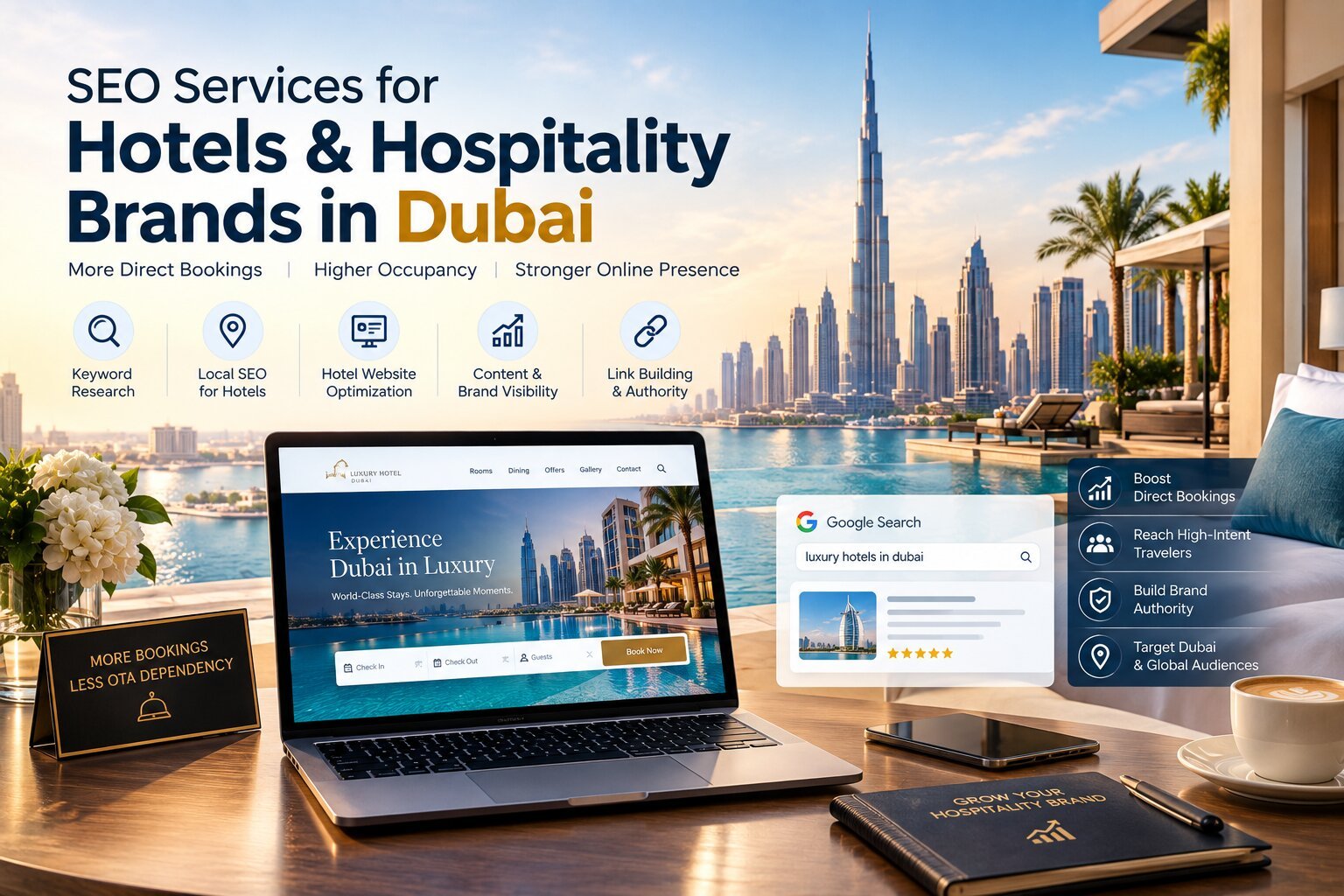
Hotel SEO services help Dubai hospitality brands rank higher for high-intent booking searches, driving qualified traffic directly to their own website instead of an OTA listing. This increases direct bookings, improves occupancy through more consistent lead flow, and reduces the commission costs tied to heavy OTA dependency. Unlike paid campaigns, SEO builds visibility that continues generating bookings without an ongoing per-click cost attached to every guest.
Table of Contents
ToggleIntroduction
Dubai’s hospitality sector keeps expanding. New hotels, resorts, and serviced apartment brands open constantly, all competing for the same pool of travelers.
That competition drives up customer acquisition costs everywhere — paid ads, OTA placement fees, and commission rates all climb as more properties compete for the same visibility.
OTA commissions in particular quietly erode margin on every booking that comes through them, often 15 to 25 percent per reservation. A booking that comes directly through your own website costs a fraction of that over time.
Direct bookings matter for more than just margin. They also give you full ownership of the guest relationship — email, preferences, repeat booking potential — none of which an OTA hands back to you.
SEO is one of the few channels that reliably drives direct bookings without an ongoing per-click or per-commission cost once rankings are established.
What Are Hotel SEO Services?
Hotel SEO is the practice of optimizing a property’s website and online presence to rank for the searches travelers use when researching and booking accommodation — capturing that demand directly, rather than losing it to an OTA listing ranking above you.
It differs from general SEO because hospitality search behavior is unusually competitive and unusually booking-focused. A single search like “5-star hotel Dubai Marina” might return dozens of individual property websites competing directly against OTA aggregator pages that often dominate the top results by default.
Traveler search intent in hospitality is also highly specific — location, star rating, amenities, and room type all factor into search behavior, which means hotel SEO needs granular, detail-rich content rather than a single generic homepage trying to capture every possible search.
Why Hotels in Dubai Need SEO
High competition in Dubai tourism. With one of the world’s most competitive hospitality markets, visibility is a genuine competitive advantage, not a nice-to-have.
OTA commission challenges. Every booking routed through an OTA carries a built-in cost that a direct booking simply doesn’t.
Direct booking opportunities. SEO captures travelers at the exact research moment, before they default to booking through a familiar OTA out of habit.
Local and international traveler searches. Dubai draws both international tourists planning ahead and regional or local travelers booking short-notice stays — two distinct search behaviors your SEO strategy needs to address separately.
Mobile-first booking behavior. A large share of hotel research and even final booking now happens on mobile, often during multiple short sessions across several days of comparison.
Key Components of Hotel SEO Services
Hotel Keyword Research
Hotel keyword research identifies the specific terms travelers use — by location, property type, amenity, and booking stage — rather than relying on broad, generic hospitality terms alone.
This drives bookings because travelers searching “boutique hotel Downtown Dubai with rooftop pool” are far closer to booking than someone searching “Dubai hotels” generally, and content built around that specificity captures higher-intent traffic.
Example: A serviced apartment provider targeting “monthly serviced apartments Business Bay” alongside broader “serviced apartments Dubai” captures both specific, ready-to-book searchers and broader early-stage researchers.
Local SEO for Hotels
Local SEO ensures your property appears prominently in Google Maps and local search results for both branded and unbranded location-based searches.
This drives bookings because a strong local presence captures last-minute and near-term searches — travelers already in Dubai or its immediate booking window, searching with clear intent.
Example: A fully optimized Google Business Profile for a Palm Jumeirah resort, listing exact amenities and current photos, captures searches like “beachfront resort Palm Jumeirah” that a generic booking page alone might miss.
Hotel Landing Pages
Dedicated landing pages for room types, packages, and specific traveler segments (business, family, romantic getaway) outperform a single generic booking page.
This drives bookings because a landing page addressing a specific need — “family suites with kids club access” — answers a traveler’s exact question far more directly than a general amenities page ever could.
Example: A resort building a dedicated “Family-Friendly Stays in Dubai” landing page, detailing kids’ facilities and family room configurations, captures a specific, high-value traveler segment competitors’ generic pages miss.
Technical SEO
Fast-loading, mobile-optimized, well-structured websites perform better in search and convert better with travelers comparing multiple properties across short mobile sessions.
This drives bookings because a slow booking engine or laggy mobile experience loses impatient travelers directly to a competitor or an OTA with a faster interface.
Example: Compressing high-resolution room and property photography without sacrificing visual appeal directly improves both search rankings and mobile booking completion rates.
Hotel Content Marketing
Guides, area content, and experience-focused articles build authority and capture travelers earlier in their planning, before they’ve chosen a specific property.
This drives bookings because early-stage content — “best areas to stay in Dubai,” “things to do near Dubai Marina” — builds familiarity and trust with your brand well before the final booking decision.
Example: A hotel in JBR publishing “A Local’s Guide to Dubai Marina & JBR” naturally links to its own booking page throughout, capturing readers at multiple stages of their trip planning.
Google Business Profile Optimization
A fully optimized Google Business Profile — accurate amenities, current photos, direct booking links — significantly influences both local visibility and a traveler’s immediate impression of your property.
This drives bookings because many travelers check a property’s Google listing directly before or instead of visiting the website, particularly for quick comparison shopping.
Example: Adding a direct “Book Now” link on your Google Business Profile removes an entire step between a traveler discovering your property and completing a reservation.
Reputation Management
Reviews significantly influence both search rankings and a traveler’s final booking decision, arguably more than almost any other hospitality marketing lever.
This drives bookings because travelers comparing similar properties frequently make their final decision based on recent review sentiment, not price or amenities alone.
Example: A structured process for requesting reviews at checkout, combined with prompt, professional responses to any negative feedback, measurably improves both conversion and search visibility over time.
Link Building for Hospitality Brands
Backlinks from travel publications, local tourism boards, and hospitality directories strengthen a property’s overall domain authority and referral visibility.
This drives bookings because hospitality is a heavily reviewed and discussed industry — coverage from a recognized travel publication carries outsized trust value with both search engines and travelers.
Example: Securing a feature in a “Best New Hotels in Dubai” roundup from a recognized travel publication often drives both direct referral traffic and meaningful long-term SEO authority.
Conversion Rate Optimization
Ranking well matters little if visitors don’t complete a booking. CRO ensures the traffic your SEO efforts earn actually converts into confirmed reservations.
This drives bookings because even strong organic traffic underperforms without a fast, trustworthy, low-friction booking process once a traveler lands on your site.
Example: Displaying a live “best rate guarantee” message alongside your booking engine directly addresses the price-comparison hesitation that often sends travelers back to an OTA at the final step.
High-Converting Hotel SEO Keywords
| Keyword | Search Intent |
|---|---|
| “5-star hotels Dubai Marina” | Commercial — comparing high-end options |
| “boutique hotel Downtown Dubai” | Commercial — specific property type search |
| “serviced apartments Business Bay” | Transactional — ready to book, extended stay |
| “family resort Dubai beach” | Commercial — segment-specific comparison |
| “best hotel deals Dubai” | Commercial — price-conscious comparison |
| “luxury resort Palm Jumeirah” | Commercial/Transactional — high-value, near-decision |
| “hotel near Dubai Mall” | Local/Transactional — location-driven, high intent |
| “book hotel Dubai tonight” | Transactional — immediate, last-minute booking |
Transactional and local-intent keywords convert fastest, but commercial-intent keywords — where a traveler is still actively comparing — represent the larger opportunity to influence the final decision before it’s made.
Hotel SEO vs OTA Dependency and Paid Ads
| Factor | Hotel SEO | OTA Listings | Paid Ads |
|---|---|---|---|
| Cost per booking | Decreases over time as rankings stabilize | Fixed commission, typically 15–25% per booking | Stays consistent or rises with competition |
| Guest relationship ownership | Full — direct booking, direct data | None — OTA retains the relationship | Full, if booked directly |
| Traffic sustainability | Continues without ongoing spend | Depends entirely on OTA platform visibility | Stops immediately when budget pauses |
| Brand control | Full control over presentation and offers | Limited — OTA controls listing format | Full control over ad messaging |
| Long-term value | Builds a durable, owned asset | No residual value, ongoing dependency | No residual value once spend stops |
Most successful Dubai hospitality brands don’t abandon OTAs entirely — they use SEO to shift the balance, capturing a larger share of bookings directly over time while maintaining OTA presence for broader reach and last-minute inventory.
Common SEO Mistakes Hotels Make
Relying entirely on OTA visibility — with no meaningful investment in an owned, ranking website. Fix: treat direct-booking SEO as a genuine revenue strategy, not an afterthought to OTA listings.
Generic, templated property descriptions — content that reads like every other hotel’s copy. Fix: write specific, detailed content highlighting what genuinely differentiates your property.
Weak or outdated Google Business Profile — missing photos, incorrect amenities, no direct booking link. Fix: fully optimize and actively maintain the listing.
Slow, image-heavy websites — beautiful photography that tanks load times and loses mobile visitors. Fix: optimize images without sacrificing visual quality.
Ignoring guest reviews — no active review request process, slow or absent responses to feedback. Fix: build review collection into the checkout process and respond promptly to all feedback.
No dedicated segment landing pages — one generic booking page trying to serve business travelers, families, and couples simultaneously. Fix: build specific landing pages for your key traveler segments.
How Long Does Hotel SEO Take?
At 3 months: Technical improvements are typically implemented, Google Business Profile is fully optimized, and early ranking movement may appear for lower-competition, local search terms.
At 6 months: Stronger rankings typically emerge across a broader set of commercial keywords, with organic direct-booking traffic becoming more clearly measurable.
At 12 months: Established campaigns often show compounding results — higher rankings across highly competitive terms, a growing base of backlinks and reviews, and a measurably reduced reliance on OTA-driven bookings.
Hospitality businesses should plan major SEO investment ahead of peak booking seasons, since rankings build gradually and won’t materialize instantly right before high season begins.
FAQ: SEO Services for Hotels & Hospitality Brands in Dubai
What are hotel SEO services? Hotel SEO services optimize a property’s website and online presence to rank for booking-related searches, driving qualified traffic directly to the hotel’s own site rather than through an OTA listing.
How does SEO help reduce OTA dependency? By capturing travelers directly through organic search before they default to booking through a familiar OTA platform, reducing the share of bookings that carry OTA commission costs.
How long does hotel SEO take to show results? Most properties see early movement within 3 months, with stronger, more stable rankings typically building over 6 to 12 months.
Is SEO worth it if we already invest heavily in OTAs? Yes. SEO doesn’t require abandoning OTA presence — it shifts a growing share of bookings toward the direct channel, meaningfully reducing overall commission costs over time.
What keywords should Dubai hotels target? A mix of location and property-type commercial keywords, transactional booking-intent keywords, and local search terms tied to specific neighborhoods or landmarks.
Does Google Business Profile really affect hotel bookings? Significantly. Many travelers check a property’s Google listing directly for quick comparison, often before or instead of visiting the full website.
How important are reviews for hotel SEO? Very important. Reviews influence both search rankings and a traveler’s final decision, often more heavily than price or amenities alone in close comparisons.
How much does hotel SEO cost in Dubai? Hotel and hospitality SEO in Dubai typically ranges from AED 6,000 to AED 25,000+ per month, depending on property size, competition, and content requirements.
Should boutique hotels invest in SEO differently than large resort chains? Yes, to some extent. Boutique properties often benefit from highly specific, niche-focused content that larger, more generic competitor pages can’t match as precisely.
Does mobile optimization really matter for hotel bookings? Yes, significantly. A large share of hotel research and booking now happens on mobile, often across multiple short comparison sessions.
How does AI search affect hotel discovery? AI tools increasingly generate direct hotel recommendations, citing sources based on clarity, structure, and demonstrated relevance — well-organized, detailed property content is more likely to be surfaced accurately.
What’s the biggest SEO mistake hospitality brands make? Treating the website as secondary to OTA listings, rather than investing in it as a genuine, revenue-generating direct booking channel in its own right.
Planning Hotel SEO Around Dubai’s Booking Seasons
Dubai hospitality demand follows a clear seasonal rhythm — winter months bring peak international visitor volume, while summer sees a shift toward regional short-stay travelers and value-driven domestic bookings.
SEO content and technical improvements need lead time. A landing page optimized in August for winter high-season searches may not reach its full ranking potential until well into the season it’s actually targeting, since rankings build gradually rather than appearing the moment content publishes.
This makes a consistent, year-round SEO investment more effective than a last-minute push right before peak season. Properties that treat content and technical optimization as an ongoing process tend to enter each high season already ranking, rather than scrambling to catch up against competitors who started earlier.
Shoulder-season content — value packages, staycation offers, and off-peak promotions — also deserves genuine attention, since it captures a meaningfully different, often more price-sensitive traveler segment that peak-season content alone won’t reach.
Conclusion
Dubai’s hospitality market isn’t getting less competitive, and OTA commissions aren’t getting smaller on their own. SEO offers a genuine path toward reclaiming a larger share of direct bookings, at a fraction of the ongoing cost of paid ads or OTA dependency.
Properties that invest in detailed, segment-specific content, strong technical performance, and an actively managed local and review presence consistently see stronger direct booking growth over time than those relying on OTA visibility alone.
If your property hasn’t reviewed its search visibility and direct booking strategy recently, it’s worth a genuine look — the gap between a well-optimized hotel website and one relying purely on OTA traffic often shows up directly in your margin on every single booking.