
Search used to mean one thing: typing a phrase into Google and scanning ten blue links. That model still exists, but it’s no longer the whole picture. Today, the same question might be answered by a Google AI Overview before a single link ever loads, summarized by ChatGPT without a search engine in sight, or synthesized by Perplexity from a dozen sources stitched into one paragraph.
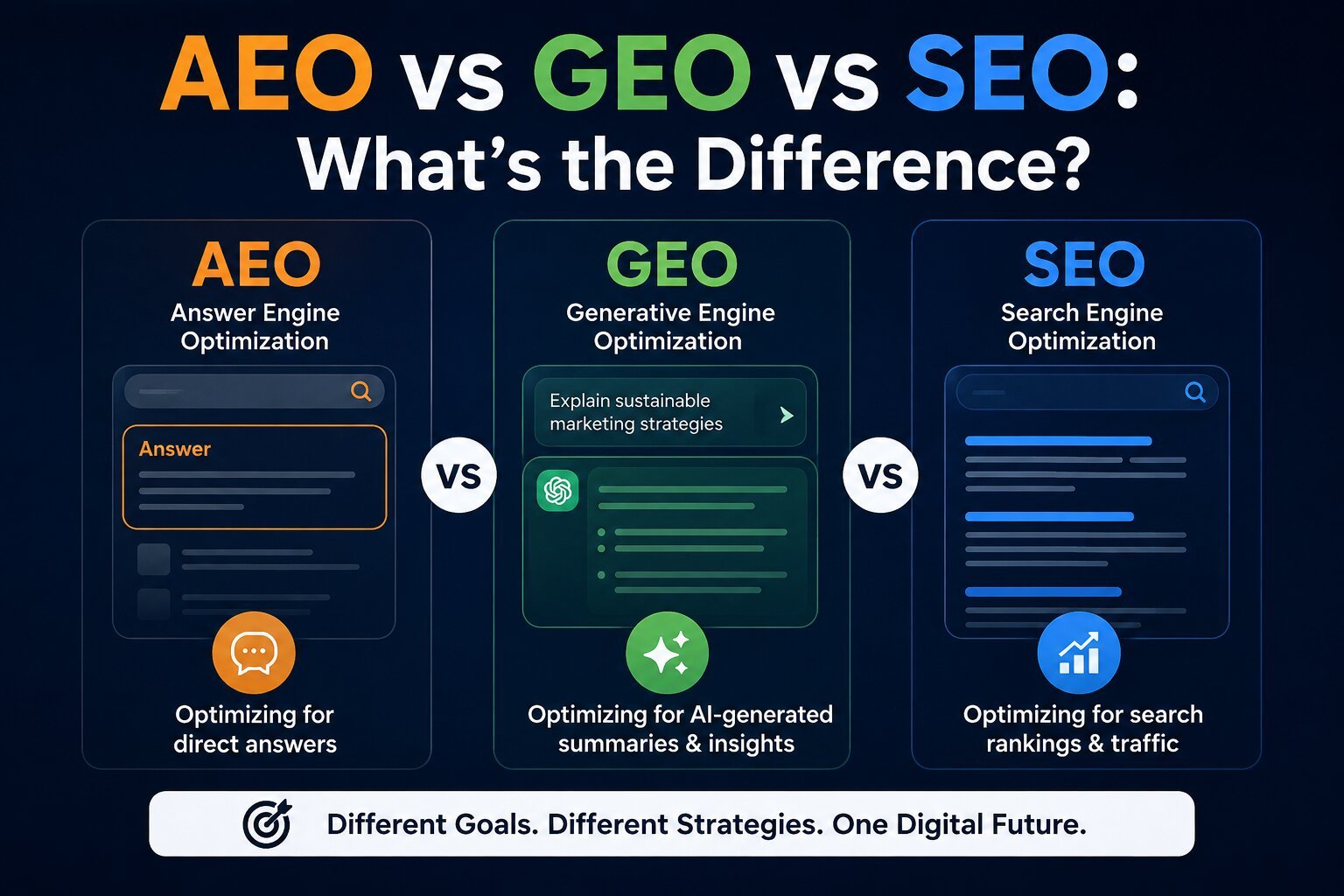
That shift has produced three overlapping — and frequently confused — disciplines: search engine optimization (SEO), answer engine optimization (AEO), and generative engine optimization (GEO). Marketers now throw all three terms around interchangeably, but they solve different problems, target different systems, and require different tactics. Understanding where they diverge — and where they reinforce each other — is what determines whether a brand stays visible as search keeps fragmenting across engines, chatbots, and AI assistants.
This guide breaks down what each discipline actually optimizes for, how they work together as layers of one strategy rather than competing approaches, and what a practical implementation plan looks like for a business trying to stay visible in 2026’s search landscape.
Table of Contents
ToggleQuick Definitions: SEO, AEO, and GEO in One Line Each
- SEO (Search Engine Optimization): The practice of improving a website’s visibility in traditional search engine results pages (SERPs) — think organic rankings, keyword targeting, and click-through traffic.
- AEO (Answer Engine Optimization): The practice of structuring content so it can be directly extracted and surfaced as an answer — in featured snippets, People Also Ask boxes, voice search results, and AI-generated answer panels.
- GEO (Generative Engine Optimization): The practice of optimizing content — and increasingly, brand entity data — so large language models (LLMs) like ChatGPT, Claude, Gemini, and Perplexity cite, reference, or accurately represent it when generating a synthesized response.
The simplest way to remember the distinction: SEO earns a ranking. AEO earns an answer. GEO earns a citation (and, at a deeper level, a correct representation of who you are).
Why This Distinction Matters Right Now
Search behavior is fragmenting in a way that didn’t exist even a couple of years ago. Google’s AI Overviews now appear across a large share of informational queries, ChatGPT and other assistants have become a genuine first stop for research and purchase decisions, and a growing share of searches end without a single click to any website — commonly referred to as zero-click search. Brands that only optimize for the traditional ten blue links are optimizing for a shrinking slice of how people actually find information.
None of this makes SEO obsolete. It makes it foundational. Every credible analysis of how AI Overviews and LLM answers get generated shows the same pattern: these systems still lean heavily on well-established, well-ranked, well-structured web content as their source material. GEO and AEO don’t replace SEO — they sit on top of it.
SEO, AEO, and GEO Side by Side
| Dimension | SEO | AEO | GEO |
|---|---|---|---|
| Primary goal | Rank in organic search results | Get extracted as a direct answer | Get cited or accurately represented in AI-generated responses |
| Target systems | Google, Bing organic results | Featured snippets, People Also Ask, voice assistants, AI Overviews | ChatGPT, Claude, Gemini, Perplexity, Copilot, AI Overviews |
| Output format | A ranked link | A short, direct answer | A synthesized, multi-source answer with or without citation |
| Core content style | Keyword-optimized pages, topical depth | Question-and-answer structure, concise definitions | Evidence-backed, well-sourced, entity-clear content |
| Key technical layer | Metadata, site speed, crawlability, internal linking | Schema markup (FAQPage, HowTo), structured headings | Schema markup, authorship data, consistent entity signals, llms.txt |
| Success metric | Organic rankings, impressions, click-through rate | Snippet ownership, answer-box appearances | Citation frequency, brand mention accuracy, AI referral traffic |
| Measurement tools | Google Search Console, rank trackers | Search Console (snippet data), SERP tracking tools | AI-visibility monitoring tools, brand mention trackers, referral segmentation |
| User behavior | Clicks through to compare options | Reads the answer, may not click | Reads a generated summary, rarely clicks |
This table is a starting point, not a rulebook — the lines blur constantly in practice, and a single well-built page can perform across all three at once.
SEO: The Foundation Everything Else Depends On
SEO is the oldest of the three disciplines, and it remains the base layer that AEO and GEO are built on. AI systems — whether that’s Google’s AI Overview or an LLM like ChatGPT — still draw disproportionately from content that already ranks well organically. Skipping SEO to chase AI visibility is like trying to build the second floor of a house before the foundation is poured.
SEO breaks down into three core categories:
On-page SEO covers everything within the content itself: keyword placement in titles, headers, and body copy; descriptive, click-worthy meta titles and descriptions; alt text on images; internal linking between related pages; and content that thoroughly answers the topic’s core search intent.
Technical SEO covers the backend factors that determine whether a page can even be crawled and indexed properly: site speed and Core Web Vitals, mobile responsiveness, clean URL structures, XML sitemaps, structured data implementation, and secure (HTTPS) hosting. A page can have flawless copy and still be invisible to search engines if the technical foundation is broken.
Off-page SEO covers signals earned outside your own website: backlinks from authoritative domains, Google Business Profile optimization for local visibility, mentions and reviews on third-party platforms, and a consistent presence across forums and social channels that search engines use as trust signals.
AEO: Optimizing to Be the Answer, Not Just a Link
Answer engine optimization is about structuring content so a machine can lift it out and present it directly to a user — without that user needing to click through and read the full page. This has existed in a simpler form for years (think featured snippets), but it’s expanded dramatically with the rise of AI Overviews, voice assistants, and conversational search.
AEO succeeds or fails on a few core principles:
- Directness. Lead each section with a clear, self-contained answer to the implied question before adding supporting detail. Answer engines tend to lift the first well-formed sentence or two that directly resolves the query.
- Question-based structure. Headings phrased as natural-language questions (“What is GEO?” rather than “Understanding GEO”) mirror how people phrase both typed and spoken queries, making content easier for answer engines to match to a query.
- Extractable formatting. Numbered steps, bullet points, comparison tables, and short definitional paragraphs are far more likely to be pulled into a snippet or AI Overview than dense narrative paragraphs.
- Structured data. FAQPage, HowTo, and QAPage schema markup give search engines explicit, machine-readable signals about which content blocks answer which questions.
- Conversational, unambiguous language. Long-tail, natural-language queries — the kind people type or speak into AI assistants — reward content that reads the way a knowledgeable person would actually explain the topic out loud, not content stuffed with keyword variations.
GEO: Optimizing for How AI Models Understand and Cite You
Generative engine optimization is the newest and least standardized of the three — there’s still no single agreed-upon methodology, and it continues to evolve as LLM providers change how their models retrieve and cite information. But two consistent layers have emerged.
Content-level GEO is about making individual pieces of content more citable. LLMs generating a response synthesize information from multiple sources rather than ranking and linking to one. To get pulled into that synthesis, content generally needs:
- Evidence and specificity. Original data, cited statistics, and verifiable facts get referenced far more often than unsupported opinion or generic marketing copy.
- Clear authorship and transparency. Bylines, credentials, and visible publication or update dates help models weight content as trustworthy — this overlaps directly with Google’s E-E-A-T (Experience, Expertise, Authoritativeness, Trustworthiness) framework.
- Freshness. Independent research has found that AI assistants — ChatGPT in particular — skew toward citing recently published or recently updated content, which makes a regular content-refresh cadence part of GEO, not just SEO housekeeping.
- Clean structure. The same scannable formatting that helps AEO (headers, lists, tables) also helps LLMs parse and accurately extract content during generation.
Entity-level GEO is the layer most competitor content on this topic skips entirely, and it matters more as AI adoption scales. This is about how consistently an LLM understands who you are as an entity — not just whether one blog post gets cited. It includes:
- Consistent business information (name, services, locations, credentials) across your website, Google Business Profile, directories, and third-party mentions.
- Structured Organization and LocalBusiness schema markup that gives machines an explicit, unambiguous definition of your brand.
- A presence on the platforms LLMs actually pull from when forming opinions about a brand or topic — research on AI citation patterns consistently shows Reddit, Wikipedia, YouTube, LinkedIn, and G2-style review platforms are cited far more often than most brand websites, which is why community and third-party presence now functions as an SEO/GEO ranking factor in its own right.
Get entity-level GEO wrong, and different AI platforms — or the same platform on different days — may describe your company inconsistently, misattribute your services, or simply fail to surface you at all, regardless of how well any single page is written.
An Important Technical Layer Most Guides Skip: llms.txt
Alongside the familiar robots.txt file that tells search crawlers what they can and can’t index, a growing number of sites are adding an llms.txt file — a plain-text summary placed at the root of a domain that gives AI crawlers a distilled, structured overview of a site’s key pages and purpose. It’s not yet a universal standard and adoption varies by AI platform, but it reflects the same underlying principle behind all of GEO: the easier you make it for a machine to understand your content without having to infer it, the more likely that content is to be used accurately.
How the Three Work Together
The most useful way to think about SEO, AEO, and GEO isn’t as three separate strategies competing for budget — it’s as three layers of one visibility strategy, each depending on the one below it:
- SEO gets you discovered and indexed. Without it, there’s no content for AEO or GEO to build on.
- AEO gets your content extracted and surfaced. It takes discoverable content and makes it directly answer-ready.
- GEO gets your brand cited and correctly represented. It takes answer-ready content and positions it — and your entity data — as trustworthy enough for a generative model to reference by name.
A single well-built page, done right, can rank organically, get pulled into a featured snippet, and get cited in an AI Overview or ChatGPT response — all at once, because the underlying disciplines (clarity, structure, evidence, trust signals) overlap by design.
Optimizing Across Individual AI Platforms
Not every AI engine sources or formats answers the same way, so a one-size-fits-all approach leaves visibility on the table:
- Google AI Overviews lean on already-ranking organic content, FAQPage/HowTo schema, and concise definitional passages — a strong signal that traditional SEO and AEO fundamentals still carry the most weight here.
- ChatGPT favors clearly structured, scannable formats — bullet points and FAQs are often lifted with minimal rewriting — and shows a documented preference for fresher content.
- Perplexity consistently attaches citations to its answers and tends to favor sources with strong topical authority and original data over generic overviews.
- Microsoft Copilot synthesizes from higher-quality organic results and tends to favor step-by-step, comparison-style content.
- Claude tends to draw on longer, coherently written passages with clear explanations and well-supported reasoning rather than fragmented bullet lists.
How to Measure Performance Across All Three
One of the most common frustrations marketers run into — and something most competitor guides gloss over — is that AI platforms don’t yet offer the equivalent of Google Search Console. There’s no native, comprehensive dashboard showing exactly which of your pages ChatGPT cited last week. Until that tooling matures, measurement has to be pieced together:
- SEO: Google Search Console and Bing Webmaster Tools for rankings, impressions, and click-through rate; standard rank-tracking tools for keyword position over time.
- AEO: Search Console’s performance data can surface featured-snippet and “position zero” appearances; manual SERP checks for People Also Ask and AI Overview inclusion on target queries.
- GEO: Periodically prompting ChatGPT, Perplexity, Claude, and Gemini directly with relevant queries to check whether and how your brand is cited; segmenting referral traffic in analytics for sessions arriving from ai.chatgpt.com, perplexity.ai, and similar sources; and a growing category of dedicated AI-visibility and brand-monitoring platforms built specifically to track citation frequency across LLMs.
No agency or platform can guarantee inclusion in an AI Overview or an LLM-generated answer. These are algorithmically generated, frequently updated, and outside any website owner’s direct control — treat AEO and GEO as strategies that materially improve your odds, not guarantees of appearing in a given result.
Common Mistakes to Avoid
- Treating GEO as a replacement for SEO. It isn’t. It’s an additional layer that depends on strong organic fundamentals already being in place.
- Over-optimizing for machines at the expense of readers. Cramming FAQ sections onto pages where they don’t naturally belong, or writing in flat, robotic sentences purely to be “AI-friendly,” tends to produce exactly the kind of generic, low-value content that both users and increasingly sophisticated AI quality filters are trained to deprioritize.
- Ignoring off-site presence. Because LLMs frequently cite community platforms and review sites over brand-owned pages, a GEO strategy that only touches your own website is incomplete.
- Letting content go stale. Freshness signals matter more for AI citation than they historically did for organic rankings — a page that hasn’t been reviewed in two years is a weaker GEO candidate even if it still ranks organically.
- Fabricating authority. Inventing statistics, credentials, or reviews to appear more citable is not just an ethical problem — it’s also a fast way to get flagged by the same trust-and-safety layers that AI platforms are increasingly building around hallucination and misinformation.
A Practical Roadmap for Implementing All Three
- Audit your SEO foundation first. Confirm core technical health — crawlability, site speed, mobile usability, indexing status — before layering on AEO or GEO tactics.
- Map your content to real questions. Identify the natural-language questions your audience actually asks, and structure headings and answer blocks around them.
- Add structured data systematically. Implement Organization, FAQPage, HowTo, and Article schema across relevant pages, not just a handful of flagship posts.
- Build evidence into your content. Original data, case studies, and clearly cited sources outperform generic advice in both AEO and GEO contexts.
- Standardize your entity information. Make sure your business name, services, and locations are described identically across your website, Google Business Profile, directories, and social profiles.
- Extend beyond your own website. Invest in a presence on the third-party platforms — review sites, LinkedIn, relevant community forums — that AI models cite most often in your industry.
- Refresh on a schedule. Revisit and update cornerstone content regularly rather than publishing once and leaving it static for years.
- Monitor manually until better tools exist. Build a simple routine of checking your target queries across Google, ChatGPT, and Perplexity monthly to track how your visibility is shifting.
Frequently Asked Questions
Is GEO the same as AEO? No. AEO is about getting content extracted as a direct answer within a search engine’s own interface (featured snippets, AI Overviews). GEO is broader — it’s about getting cited and accurately represented by generative AI models like ChatGPT and Claude, which may draw from many sources across the web, not just search-indexed pages.
Do I need to choose between SEO, AEO, and GEO? No. They’re layered, not competing. SEO builds the foundation, AEO makes content answer-ready, and GEO builds citation-worthiness and consistent brand representation on top of both.
Will AI search eventually replace traditional SEO? Not based on current evidence. AI Overviews and LLM answers still rely heavily on well-ranked, well-structured organic content as source material. SEO is shifting in importance, not disappearing.
How long does it take to see results from AEO or GEO? There’s no fixed timeline, and no one can promise a specific date of inclusion in an AI Overview or LLM answer. In general, technical and structural changes (schema markup, content restructuring) can influence extraction relatively quickly, while entity-level trust and citation frequency tend to build gradually, similar to traditional domain authority.
What’s the single most important first step? Get the SEO fundamentals right. Every credible pattern in how AI Overviews and LLMs source information points back to content that was already well-structured, well-ranked, and trustworthy before AEO or GEO tactics were layered on top.