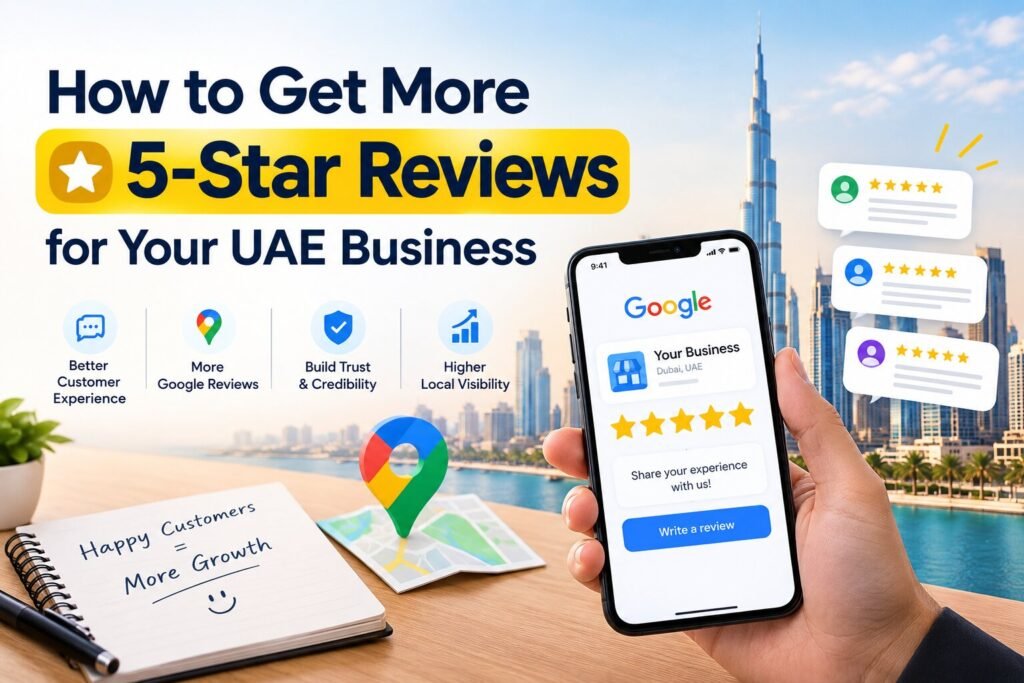
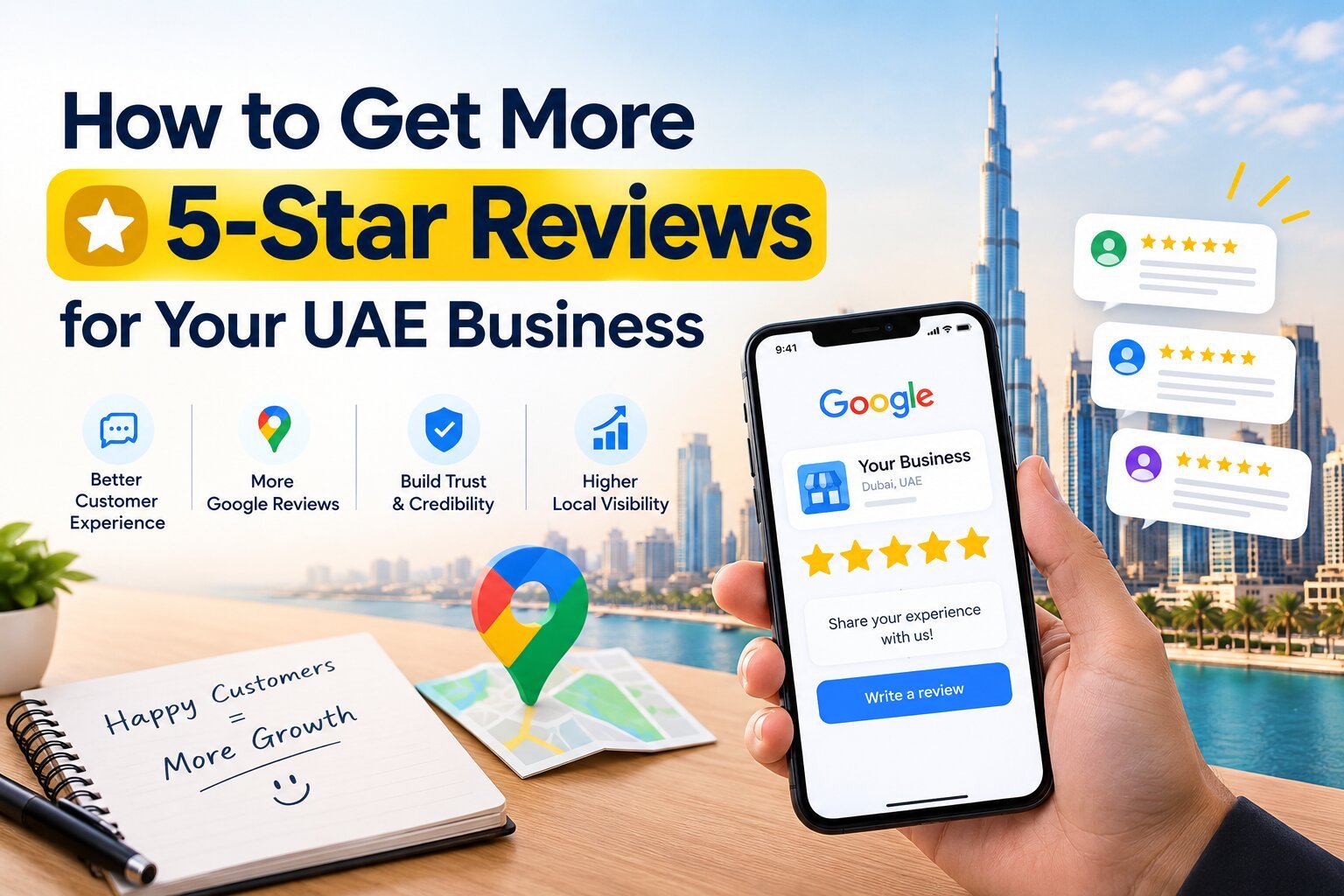
Walk into almost any conversation with a UAE business owner about growth, and Google reviews come up within minutes. Whether you run a salon in Sharjah, a cleaning company covering Dubai and Abu Dhabi, or a boutique hotel on the coast, your review profile is often the deciding factor between a customer choosing you or the business next door.
What is the best way to get more 5-star reviews? The most sustainable approach is to consistently deliver a genuinely good customer experience, then make it easy for satisfied customers to share honest feedback at the right moment in their journey — right after a positive interaction, through a simple, direct channel. There’s no shortcut that replaces this. Everything else in this guide — timing, wording, tools, follow-up systems — exists to remove friction from that basic process, not to manufacture ratings that don’t reflect reality.
This guide walks through exactly how to build that process for a UAE business, industry by industry, without resorting to fake reviews, review buying, or manipulation tactics that put your entire online presence at risk.
Table of Contents
Toggle1. Why Genuine Reviews Matter for UAE Businesses
Reviews influence customer behavior in several concrete ways:
- Consumer trust: most people read reviews before choosing a local business, especially for services like clinics, salons, contractors, and restaurants
- Purchase decisions: a strong, recent set of reviews often tips the decision between two similar options
- Brand reputation: your review profile is frequently a customer’s first real impression of your business
- Click-through behavior: listings with more reviews and stronger ratings tend to get more clicks in search results and Google Maps
- Conversion rates: detailed, specific reviews build the confidence needed to actually book, call, or purchase
- Customer confidence: recent, varied reviews reassure new customers that your quality is consistent, not a one-off
It’s worth being precise here: reviews are a trust and engagement signal, not a direct, guaranteed ranking lever. Google’s local ranking factors — which we’ll cover later — are broader than review count alone. More reviews won’t automatically place you #1 on Google Maps, but they consistently improve how customers perceive and choose you once they find you.
2. Understand What Makes Customers Leave Reviews
Most customers don’t leave reviews by default — something has to prompt them. Understanding what drives that helps you design a better process.
Customers are more likely to leave a review when they’ve had:
- An exceptional experience — something noticeably better than expected, positive or negative
- An easy process — a direct link or QR code removes the biggest barrier
- A timely request — asked while the experience is still fresh
- Personal follow-up — a request that feels specific to their interaction, not generic
- A strong relationship — repeat customers and those who felt genuinely cared for are more likely to respond
- A memorable moment — something specific worth mentioning (fast turnaround, a thoughtful gesture, solving a tricky problem)
Important: simply sending a review request without addressing the underlying experience usually produces weak results. If service was average, a well-worded request won’t turn it into a 5-star review — it might not get a response at all, or worse, it might prompt an honest but mediocre one. The request is the easy part; the experience is what actually earns the review.
3. Create a Simple Google Review Strategy
A repeatable framework works better than asking sporadically. Use this six-stage cycle:
Deliver → Ask → Make It Easy → Follow Up → Respond → Improve
- Deliver a service or experience worth talking about
- Ask at the natural, appropriate moment
- Make it easy with a direct link, QR code, or one-tap option
- Follow up once, briefly, if there’s no response — never repeatedly
- Respond to every review that comes in, positive or negative
- Improve based on the patterns that show up in your feedback
This cycle should become part of your normal customer journey — not a separate campaign you run occasionally. A restaurant might build it into the bill presentation; a cleaning company might build it into the job-completion confirmation message.
4. Ask Customers at the Right Time
Timing matters more than almost anything else in this process. Ask too early, and the experience isn’t complete. Ask too late, and the moment — and the customer’s motivation — has passed.
Restaurants: Ask shortly after a positive dining experience, ideally as the bill is settled or via a short follow-up message the same day.
Salons: Ask right after the service is completed, while the customer can still see and feel the result.
Cleaning companies: Ask after the customer has confirmed the job was completed to their satisfaction — not before they’ve had a chance to inspect the work.
Real estate agencies: Ask after a successful transaction closes, or after a meaningful milestone like a signed lease or completed viewing process.
Digital marketing agencies: Ask after a measurable milestone — a completed project phase, a reporting period showing clear results, or project delivery.
The underlying principle: ask when the positive outcome is freshest and most concrete in the customer’s mind, not on a fixed schedule disconnected from the actual experience.
5. Make Leaving a Google Review Easy
Even a happy customer often won’t leave a review if it takes more than a few taps. Reduce friction wherever possible:
- Direct Google review links — a link that opens straight to your review box, not just your profile
- QR codes — scannable and instant, ideal for physical locations
- WhatsApp — widely used across the UAE for both personal and business communication
- SMS — quick and effective for customers who prefer text
- Email — useful for post-purchase or post-service follow-up
- Website buttons — a visible “Leave us a review” link on your site or booking confirmation
- Post-purchase messages — built into your existing confirmation or thank-you communication
- Printed cards — a QR code on a receipt, packaging insert, or thank-you card for offline businesses
The goal is simple: the customer should never have to search for your business manually to leave a review. Every extra step is a chance for them to lose motivation and move on.
6. How to Ask for Google Reviews Without Sounding Pushy
Wording matters. The best requests sound like a genuine, low-pressure ask — not a demand.
WhatsApp:
“Hi [Name], thank you for choosing us today! If you have a minute, we’d really appreciate your honest feedback here: [link]”
SMS:
“Thanks for visiting us, [Name]! We’d love to hear how it went — quick review here: [link]”
Email:
“We hope you’re happy with [service]. If you have a moment, sharing your experience on Google really helps other customers — and helps us improve: [link]”
In person:
“We’re glad you had a good experience today. If you don’t mind, a quick Google review would mean a lot to us.”
Post-purchase follow-up:
“Just checking in — how did everything go with [product/service]? We’d appreciate your feedback here: [link]”
Service completion message:
“Your service is complete! If you were happy with the work, we’d love a quick review: [link]. And if anything wasn’t right, please let us know directly first.”
Keep the tone warm and low-pressure. Never imply that a specific rating is expected or required.
7. Ask for Honest Feedback, Not Just 5-Star Reviews
There’s a meaningful difference between these two requests:
“Please leave us a 5-star review.”
versus:
“We’d appreciate your honest feedback about your experience.”
The first explicitly asks for a specific rating, which risks appearing manipulative, can violate platform guidelines, and — even when it “works” — produces reviews that don’t reflect genuine sentiment. The second invites authentic feedback, which builds far more credible, durable trust over time, even if the occasional review isn’t perfect.
Businesses that consistently deliver good service don’t need to specify a star rating — the genuine experience speaks for itself in the review that follows.
8. Improve the Customer Experience First
No review strategy compensates for a weak underlying experience. Before focusing on requests, strengthen the fundamentals:
- Fast communication — quick responses to inquiries, before and after the sale
- Clear pricing — no surprise costs, especially important for UAE service businesses where pricing transparency builds trust quickly
- Professional staff — trained, courteous, and consistent
- On-time service — arriving and delivering when promised
- Clean facilities — for any physical location, cleanliness is one of the most commonly mentioned factors in reviews
- Accurate expectations — don’t overpromise what a service or product will deliver
- Helpful support — easy to reach when something needs attention
- Quick problem resolution — issues handled promptly, before they escalate
- Follow-up after service — checking in shows the relationship doesn’t end at payment
Example: A Dubai-based AC maintenance company that texts customers an accurate arrival window, sends a technician photo before arrival, and follows up two days later to confirm everything’s working properly will naturally generate stronger, more detailed reviews than one that simply completes the job and leaves.
9. Use WhatsApp to Request Reviews
WhatsApp is one of the most widely used communication channels for both personal and business interactions across the UAE, which makes it a natural fit for review requests — as long as it’s used responsibly.
A simple, respectful process:
Customer completes service → Thank customer → Ask for honest feedback → Provide review link → Thank them again
Keep messages short, personal, and infrequent. Sending a single well-timed message performs far better than following up multiple times, which can feel like pressure or spam and may prompt customers to block or ignore future communication entirely.
10. Use QR Codes for Offline Businesses
For physical, walk-in businesses, QR codes remove almost all friction from the review process. Good placement options include:
- Reception desk — visible as customers check out or leave
- Receipt — printed directly on the transaction record
- Table card — for restaurants and cafés
- Packaging — for retail and product-based businesses
- Thank-you card — handed to the customer at the end of a service
- Service completion document — for contractors, cleaning companies, and similar businesses
Make sure the QR code links directly and transparently to your legitimate Google review page — never route it through any tool designed to filter or redirect based on expected sentiment (more on why in the review-gating section below).
11. Use Email and SMS Follow-Ups
Email and SMS work well for businesses with a natural post-purchase or post-service touchpoint — e-commerce, real estate, clinics, and professional services in particular.
When it makes sense: shortly after a purchase, delivery, or service completion, while the experience is still recent.
Keep it effective:
- Personalize with the customer’s name and, where relevant, the specific service or product
- Keep the message short — a sentence or two, plus the link
- Include a single, direct review link — don’t make the customer search
- Send at most one polite follow-up if there’s no response; avoid repeated reminders
Example SMS: “Hi [Name], thanks for shopping with us! We’d love your feedback here: [link]. Reply STOP to opt out.”
12. Respond to Every Genuine Review
Responding to reviews signals to future customers that your business is active, attentive, and accountable.
Positive reviews: thank the customer and reference something specific from their experience rather than a generic reply.
“Thank you, Fatima! So glad our team could get the leak fixed the same day you called — we’re here anytime you need us.”
Neutral reviews: acknowledge the feedback and show genuine openness to improving.
“Thanks for sharing this, Ahmed. We appreciate the honest feedback and will look into the wait times you mentioned.”
Negative reviews: stay professional, acknowledge the concern directly, and move detailed resolution to a private channel.
“We’re sorry to hear this didn’t meet expectations. This isn’t the standard we aim for — please reach out to us directly at [contact] so we can make it right.”
Avoid copy-pasting the same response across every review — customers browsing your profile notice this quickly, and it undercuts the authenticity you’re trying to build.
13. How to Handle Negative Reviews
A clear, calm process prevents negative reviews from turning into bigger reputation problems:
- Read carefully — understand exactly what the customer is describing before responding
- Avoid reacting emotionally — take time before replying if needed
- Verify the issue — check with your team or records to understand what actually happened
- Respond professionally — acknowledge the concern without being defensive
- Offer a path to resolution — invite them to continue the conversation privately
- Resolve the underlying problem — follow through on what you offer
- Learn from recurring complaints — if the same issue appears repeatedly, it points to something worth fixing operationally
On reporting reviews: platforms allow reporting reviews that violate policies — for example, reviews that are fake, posted by someone with no genuine interaction with your business, or that contain harassment or clearly false claims. Reporting a review simply because it’s negative but genuine is not appropriate, and most platforms will not remove legitimate critical feedback just because a business disagrees with it.
14. Never Buy Fake 5-Star Reviews
It’s worth stating plainly: buying reviews, however tempting as a shortcut, creates serious risk. Businesses should avoid:
- Buying Google reviews from third-party sellers
- Creating fake customer accounts
- Using review farms or review exchange groups
- Having employees pose as customers
- Leaving reviews on competitors’ profiles
- Using mass automated review-generation tools
The risks are real and cumulative:
- Trust: fake reviews are increasingly detectable through pattern analysis, and discovery destroys the credibility you’ve built
- Reputation: customers who suspect manipulation — through generic wording, review clusters, or mismatched account activity — become skeptical of everything else on your profile
- Platform compliance: violating Google’s review policies can result in review removal, profile suspension, or permanent loss of your review history
- Business credibility: a damaged reputation is far harder to rebuild than a slow, honest start
There is no version of fake reviews that’s worth the risk to a business that plans to operate long-term in the UAE market.
15. Avoid Review Gating
Review gating means selectively filtering customers before they leave a review — for example, asking customers privately whether their experience was good or bad, then directing only the happy ones to Google while diverting unhappy customers elsewhere.
This practice violates the guidelines of most review platforms, including Google’s, because it manufactures a misleadingly positive public rating rather than reflecting genuine customer sentiment across your full customer base.
The goal should always be collecting authentic feedback from everyone, not selectively curating who gets to speak publicly. A business confident in its service quality doesn’t need to filter who gets asked.
16. Build a Review Request Automation Workflow
A simple, repeatable system makes review requests consistent without requiring manual effort every time:
Customer → Service Completed → Follow-Up → Review Request → Reminder (if needed) → Response → Feedback Analysis
Many UAE businesses use CRM systems, email marketing tools, or SMS/WhatsApp business platforms to trigger these follow-ups automatically after a purchase or service is marked complete. This kind of automation is perfectly appropriate — it’s simply removing manual work from a legitimate process.
What automation should never do: generate reviews on a customer’s behalf, send excessive repeated requests that feel like spam, or filter which customers receive the request based on predicted sentiment (see review gating above).
17. Create Industry-Specific Review Strategies
Restaurants: Ask shortly after a successful meal, ideally through a short follow-up message or a table QR code.
Hotels: Ask after checkout, when the full stay experience is complete and fresh.
Salons: Ask immediately after the service, while the customer can see the result.
Clinics: Use privacy-conscious, general language — ask about the overall experience and service quality without referencing specific treatments or conditions in the request itself.
Cleaning companies: Ask after the customer has confirmed the completed job meets expectations.
Real estate agencies: Ask after a completed transaction or a meaningful milestone in the process.
SEO and marketing agencies: Ask after a successful project milestone or a reporting period that shows clear, measurable progress.
Retail businesses: Ask after purchase, once the customer has had a chance to actually use or receive the product.
18. How to Increase Review Response Rates
A few practical adjustments consistently improve how many customers follow through:
- Personalize the request — using the customer’s name and referencing their specific experience
- Keep messages short — a sentence or two plus a direct link outperforms long explanations
- Choose the right timing — as close to the positive experience as reasonably possible
- Use direct links — never make the customer search for your business
- Use the customer’s preferred channel — WhatsApp for some, email for others
- Avoid excessive reminders — one polite follow-up is usually the limit
- Explain why feedback matters — a brief, genuine note about how it helps you or other customers
19. How Many Google Reviews Should a UAE Business Have?
There’s no universal ideal number, and any figure quoted as a fixed target should be treated with skepticism. Instead, evaluate your position against:
- Competitor review volume in your specific area and industry
- Review quality — detailed, specific reviews carry more weight than a large volume of short, generic ones
- Review recency — a steady, ongoing flow of new reviews matters more than a large historical total that’s gone stale
- Business age — a newer business naturally has fewer reviews than an established one
- Industry norms — some industries (restaurants, hotels) naturally accumulate more reviews than others (B2B services, consultancies)
- Location — review volume expectations vary between high-footfall areas and specialized service areas
- Customer volume — a business serving hundreds of customers monthly should expect a different review pace than one serving a handful of clients
Focus on consistent, genuine feedback over time, not chasing an arbitrary number that may not even be relevant to your specific market position.
20. Does Getting More 5-Star Reviews Improve Google Maps Rankings?
Reviews are relevant to local reputation and to one of Google’s core local ranking factors — prominence — but they are not the only factor, and more reviews alone won’t guarantee a higher Google Maps position.
Google Maps rankings are generally understood to depend on three factors:
- Relevance — how well your business profile matches the search
- Distance — how close you are to the searcher or search location
- Prominence — how well-established and trusted your business appears, based on signals including reviews, but also citations, backlinks, and overall online presence
A business with excellent reviews but a poorly optimized profile, inconsistent business information, or weak website relevance may still be outranked by a competitor with fewer reviews but stronger overall signals. Reviews are an important piece of a larger picture — not a standalone ranking lever.
21. How Reviews Support Local SEO
Even without directly controlling rankings, reviews play a meaningful supporting role in your overall local SEO presence:
Google Business Profile → Reviews → Trust → Customer Engagement → Local Visibility
- Consumer confidence: strong reviews reduce hesitation for new customers discovering you for the first time
- Local brand credibility: a consistent pattern of positive, detailed reviews builds recognition within your specific area
- Conversion rates: customers who read genuine, relevant reviews are more likely to complete a call, booking, or purchase
- Business differentiation: specific, detailed reviews help you stand out from competitors with generic or sparse profiles
- Local search presence: an actively reviewed, well-maintained profile signals an operating, trustworthy business to both users and search systems
This is a supporting relationship, not a guaranteed ranking mechanism — treat reviews as one part of a broader local SEO effort that includes profile completeness, citations, and website optimization.
22. Monitor Your Online Reputation
Ongoing monitoring helps you catch problems early and understand what’s working. Track:
- New reviews as they come in
- Overall rating trends over time
- Review volume and how it compares to previous periods
- Review recency — are you still receiving reviews regularly, or has it slowed down?
- Common complaints that appear more than once
- Positive themes customers consistently mention
- Your response rate and response time
- How your reputation compares to nearby competitors
Recurring themes in feedback — whether praise or complaints — often point directly to what’s working well or what needs attention operationally.
23. Turn Reviews Into Business Insights
Reviews are also a free, ongoing source of customer research. Look for patterns in mentions of:
- Staff friendliness or professionalism
- Speed of delivery or service
- Pricing and value perception
- Overall service or product quality
- Location convenience
- Cleanliness
- Product quality or durability
- Communication clarity
Example: if multiple reviews for a Dubai cleaning company mention “always on time” as a highlight, that’s a genuine competitive strength worth featuring in marketing. If several reviews mention unclear pricing, that’s a concrete, actionable fix.Common Review-Marketing Mistakes
| Mistake | Better Approach |
|---|---|
| Asking every customer repeatedly | Ask once at the right moment, follow up at most one more time |
| Demanding 5-star reviews explicitly | Ask for honest, genuine feedback instead |
| Buying reviews | Build genuine reviews through real customer requests |
| Creating fake reviews | Focus entirely on authentic feedback |
| Review gating | Send every customer to the same public review channel |
| Ignoring negative feedback | Respond professionally and offer resolution |
| Copy-paste review responses | Personalize each response with specific details |
| Sending requests too late | Ask while the experience is still fresh |
| Making the review process difficult | Provide a single, direct link or QR code |
| Using generic, impersonal messages | Reference the specific service or interaction |
| Offering inappropriate incentives | Never tie rewards to a specific star rating |
| Focusing only on the rating number | Prioritize the underlying customer experience first |
30-Day Google Review Strategy for UAE Businesses
A realistic, no-pressure rollout plan:
Week 1 — Foundation
- Audit your current reviews and overall rating
- Create a direct Google review link
- Review your existing customer follow-up process
- Identify the key touchpoints where a review request would fit naturally
Week 2 — Implementation
- Introduce review requests at your identified touchpoints
- Create WhatsApp and SMS message templates
- Add QR codes at physical locations where appropriate
Week 3 — Monitoring
- Track response rates and adjust timing or wording as needed
- Respond to all existing reviews, old and new
- Note any recurring themes in the feedback you’re receiving
Week 4 — Refinement
- Address any weak points in the customer experience the feedback has revealed
- Review overall performance for the month
- Refine your messaging and timing based on what actually worked
- Document the process so it becomes a standard, repeatable part of your operations
This is a foundation to build on, not a guarantee of a specific number of reviews by day 30 — consistency over months is what produces lasting results.
Google Review Checklist for UAE Businesses
- ☐ Deliver a quality customer experience first
- ☐ Create a direct Google review link
- ☐ Ask at the right moment in the customer journey
- ☐ Use natural, low-pressure language
- ☐ Make the process as easy as possible
- ☐ Use WhatsApp, SMS, or email appropriately for your customer base
- ☐ Use QR codes for physical, walk-in businesses
- ☐ Ask for honest feedback, not a specific star rating
- ☐ Respond to every genuine review, positive or negative
- ☐ Handle negative reviews professionally and privately
- ☐ Monitor new reviews and rating trends regularly
- ☐ Analyze recurring feedback themes for business insights
- ☐ Never buy fake reviews
- ☐ Never create fake customer accounts
- ☐ Avoid review gating entirely
- ☐ Continuously improve the underlying customer experience
Frequently Asked Questions
How can I get more genuine reviews for my UAE business? Focus first on delivering a strong customer experience, then ask for honest feedback at the right moment through an easy, direct channel like a Google review link, QR code, or WhatsApp message. Consistency over time matters more than any single tactic.
How do I get more Google reviews in Dubai? Use the same core principles as anywhere: ask promptly after a positive experience, make the process frictionless with a direct link, and follow up once if needed — without pressuring customers toward a specific rating.
What is the best way to ask customers for a Google review? A short, personal, low-pressure message sent shortly after a positive experience works best — ideally through the customer’s preferred channel, with a direct link so they don’t have to search for your business.
Can I ask customers for 5-star reviews specifically? It’s better to ask for honest feedback rather than explicitly requesting a specific star rating, which can come across as manipulative and may violate platform guidelines. Genuine positive experiences tend to produce strong ratings naturally.
Can I offer discounts for Google reviews? Offering an incentive tied to leaving any review (regardless of rating) sits in a gray area and requires caution; offering a reward specifically for a positive or 5-star review is not appropriate and can violate platform policies. When in doubt, don’t tie any incentive to the review’s content.
How do I create a Google review link? You can generate a direct review link through your Google Business Profile dashboard, which takes customers straight to the review box rather than your general profile page.
Can WhatsApp be used to request Google reviews? Yes — WhatsApp is a widely accepted and effective channel for this in the UAE, as long as requests are sent once, kept brief, and not repeated excessively.
Do Google reviews help Google Maps rankings? Reviews contribute to prominence, one of Google’s three core local ranking factors, but they don’t guarantee a higher position on their own. Relevance and distance also play significant roles.
How many reviews should a business have? There’s no fixed target. Compare your review volume, quality, and recency against similar local competitors rather than chasing an arbitrary number.
How should I respond to a negative Google review? Stay calm and professional, acknowledge the customer’s concern specifically, and invite them to continue the conversation privately to resolve the issue rather than debating publicly.
Should I respond to every Google review? Yes, ideally — responding to both positive and negative reviews shows an active, engaged business and builds trust with anyone reading your profile later.
How can a new UAE business get its first reviews? Start with your earliest satisfied customers, ask personally and directly, and make the process as easy as possible with a direct link — early reviews often come from your most engaged, loyal early customers.
Can I buy Google reviews? No — buying reviews violates platform policies and puts your entire profile at risk of suspension, while also undermining the genuine trust you’re trying to build with real customers.
What is review gating? Review gating is the practice of screening customers privately and only directing happy customers to leave a public review while diverting unhappy ones elsewhere. It’s against most platforms’ guidelines because it manufactures a misleadingly positive rating.
How often should I ask customers for reviews? Ask once per relevant transaction or service, at the appropriate moment, with at most one polite follow-up if there’s no response — repeated requests tend to annoy customers rather than convert them.
Conclusion
There’s no shortcut to a genuinely strong review profile — and the businesses that try to manufacture one through fake reviews, review gating, or incentivized ratings almost always end up worse off once it’s discovered. The businesses that consistently earn strong, authentic reviews are the ones that treat the process as an extension of good service, not a separate marketing task.
The path that actually works, month after month, comes down to a few core habits: deliver an excellent customer experience, make honest feedback easy to provide, respond professionally to every review you receive, and continuously improve based on what your customers are telling you. Build that into how your UAE business already operates, and the reviews — genuine, detailed, and worth having — tend to follow.