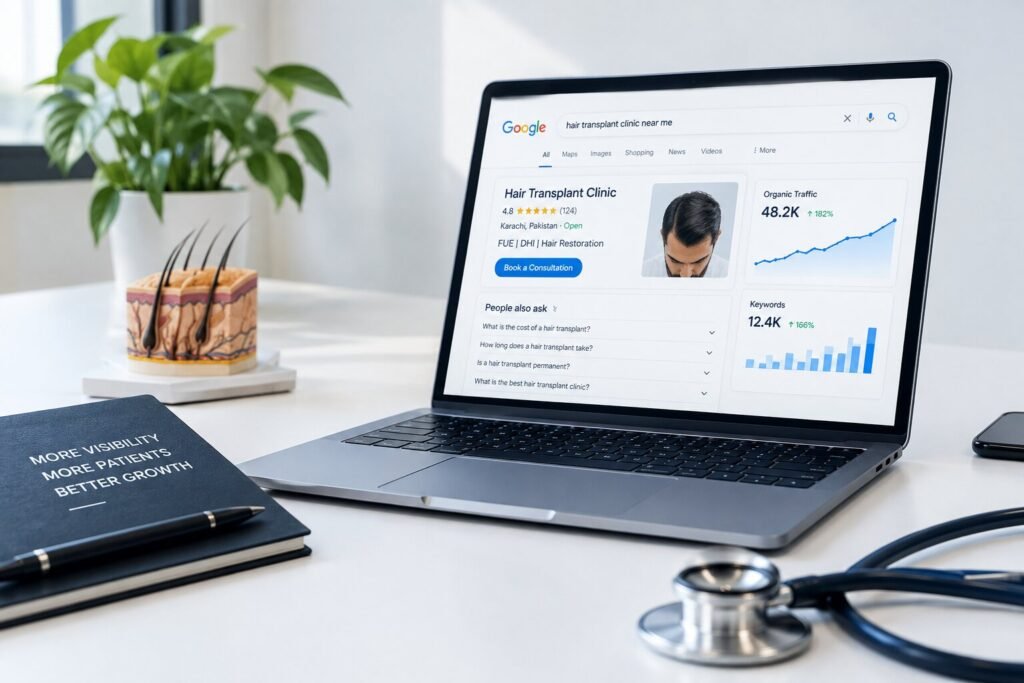
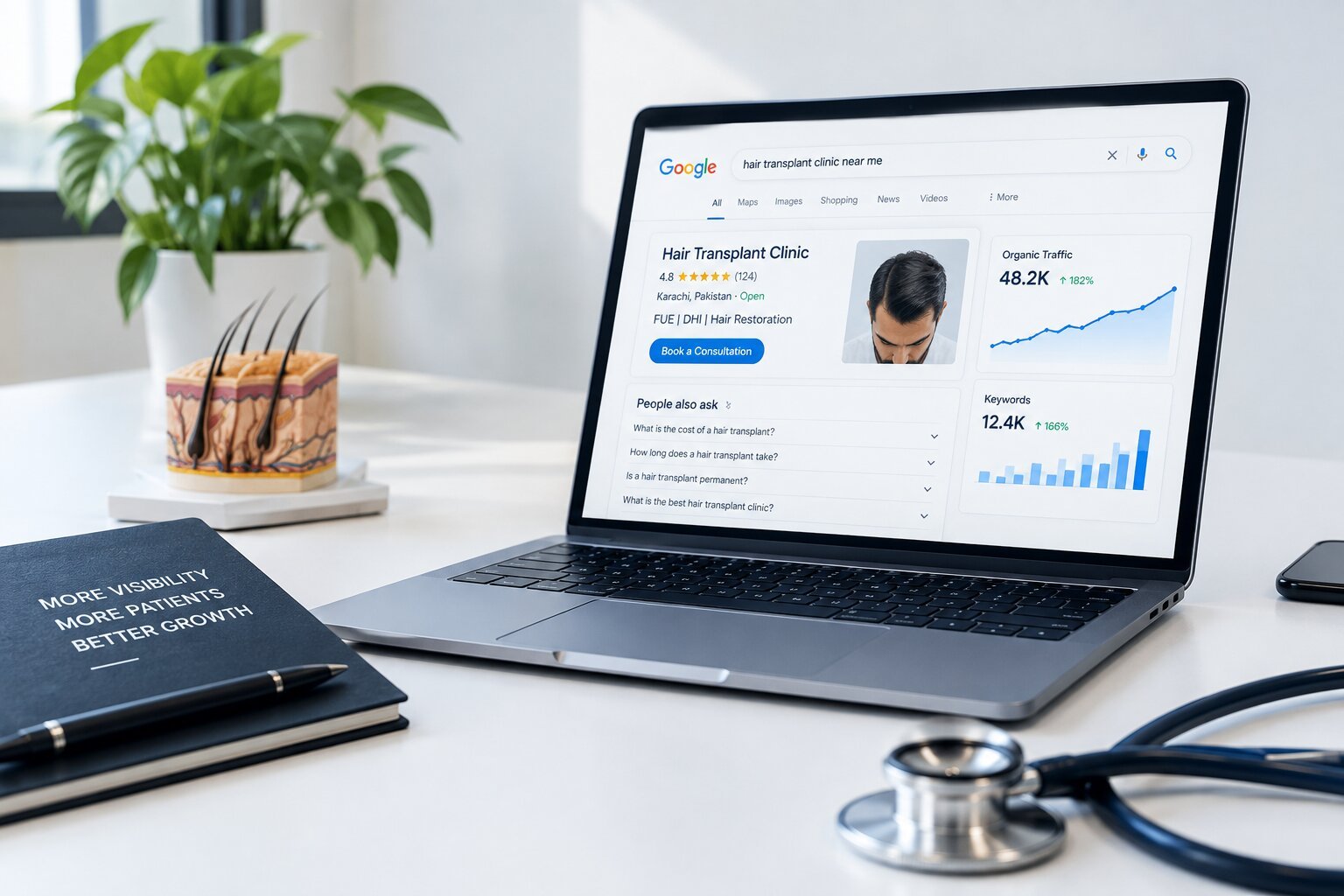
Hair transplant clinics grow patient inquiries through a mix of local SEO, technical site health, authoritative content, and AI search visibility. Clinics that rank well typically have an optimized Google Business Profile, fast and mobile-friendly websites, procedure-specific content that answers real patient questions, genuine before-and-after case studies, and consistent local citations. This guide breaks down each piece so you can build a search strategy that brings in patients actively looking for treatment.
Table of Contents
ToggleWhy SEO Matters for Hair Transplant Clinics
Most people researching hair loss treatment start on Google, not with a referral. They search things like “best hair transplant clinic near me” or “FUE vs DHI hair transplant cost,” often months before booking a consultation.
If your clinic doesn’t show up during that research phase, a competitor will. SEO puts your clinic in front of these patients at the exact moment they’re comparing options and deciding who to trust with a visible, permanent procedure.
Unlike paid ads, organic visibility compounds over time. A well-optimized clinic website keeps generating consultation requests long after the initial work is done.
How Do Patients Search for Hair Transplant Clinics?
Understanding search intent shapes everything else in your strategy. Patients typically fall into a few groups:
- Early researchers: “why am I losing hair,” “hair transplant success rate”
- Comparison shoppers: “FUE vs FUT hair transplant,” “hair transplant cost in [city]”
- Local, high-intent searchers: “hair transplant clinic near me,” “best hair transplant surgeon in [city]”
- Brand-specific searchers: people searching your clinic name after seeing an ad or referral
Each group needs different content. Ranking for local, high-intent terms drives bookings fastest, but early-researcher content builds the trust that turns a long-term reader into a future patient.
Local SEO: Winning the “Near Me” Searches
Most hair transplant patients prefer a clinic they can visit in person for consultations and follow-ups. That makes local SEO one of the highest-leverage areas for this industry.
Core local SEO tactics:
- Create city- and area-specific landing pages if you serve multiple locations
- Keep your business name, address, and phone number (NAP) consistent across your website and directories
- Build citations on medical and general directories relevant to your country
- Encourage genuine patient reviews and respond to every one, positive or negative
- Use local schema markup so search engines understand your clinic’s location and services
A clinic ranking in the local map pack often gets more calls than one ranking on page one of standard results, since map pack listings show phone numbers and directions directly.
Optimizing Your Google Business Profile
Your Google Business Profile (GBP) is frequently the first thing a prospective patient sees, before they ever visit your website.
What to optimize:
- Choose accurate primary and secondary categories (e.g., “Hair Transplant Clinic,” “Cosmetic Surgery Clinic”)
- Write a clear, keyword-relevant business description without exaggerated claims
- Upload real clinic photos, not stock images: waiting areas, procedure rooms, staff
- Post updates regularly, such as new services or clinic milestones
- List services and pricing ranges where appropriate, so expectations are set early
- Answer the Q&A section proactively before patients ask
Profiles that are complete and active tend to outperform sparse ones, especially in competitive metro areas with many clinics.
Keyword Research for Hair Restoration Clinics
Generic keywords like “hair transplant” are valuable but extremely competitive. A stronger strategy layers in mid- and long-tail terms that match real patient questions.
Keyword categories to target:
| Category | Example Keywords |
|---|---|
| Procedure-specific | FUE hair transplant, DHI hair transplant, robotic hair transplant |
| Cost-related | hair transplant cost per graft, financing hair transplant |
| Local intent | hair transplant clinic in [city], best hair transplant surgeon near me |
| Concern-based | receding hairline treatment, crown hair loss solutions |
| Comparison | hair transplant vs PRP, natural hair transplant results |
Tools like Google Keyword Planner, Ahrefs, or SEMrush help validate search volume, but reading actual patient forums and reviews often surfaces phrasing that keyword tools miss.
Technical SEO: The Foundation Patients Never See
No amount of great content overcomes a slow, broken, or unindexed website. Technical SEO ensures search engines can crawl, understand, and rank your site properly.
Priority technical checks:
- Page speed: Compress images and minimize scripts, especially on mobile, where most patients browse
- Mobile usability: A clinic site that’s hard to tap or read on a phone loses inquiries fast
- Secure site (HTTPS): Non-negotiable for any medical-related website
- Clean URL structure: Use descriptive URLs like
/services/fue-hair-transplantinstead of generic strings - Structured data: Add MedicalClinic, Physician, and FAQ schema where applicable
- Crawlability: Fix broken links, orphaned pages, and duplicate content
Running a technical audit every few months catches issues before they quietly drain your rankings.
Content Marketing That Builds Trust and Rankings
Hair loss is a personal, sometimes emotional topic. Content that’s informative and honest, rather than promotional, tends to earn more trust and more organic traffic.
Content types worth investing in:
- Procedure explainer pages (FUE, FUT, DHI, PRP) written in plain language
- Cost breakdown guides, since price transparency reduces patient hesitation
- Recovery timelines and aftercare guides
- Real patient case studies with proper consent and disclosed timeframes
- Surgeon and clinic team bios that establish credentials and experience
Avoid vague or exaggerated claims about outcomes. Instead, describe typical processes, general timelines, and what factors influence results, and always recommend a consultation for anything specific to an individual’s case.
Link Building for Medical and Cosmetic Clinics
Backlinks from relevant, reputable sites signal authority to search engines. For clinics, quality matters far more than quantity.
Realistic link-building tactics:
- Get listed on local business and healthcare directories
- Partner with dermatology or wellness bloggers for genuine guest content
- Earn coverage from local news or lifestyle publications
- Sponsor or participate in local health events, which often generate natural links
- Ask satisfied patients (with consent) to mention their experience on relevant platforms
Avoid link schemes or bulk-purchased backlinks. Search engines have gotten better at detecting these, and the risk to a medical brand’s reputation isn’t worth it.
Conversion Rate Optimization: Turning Visitors into Consultations
Traffic alone doesn’t grow a clinic. The website needs to convert visitors into booked consultations.
CRO essentials for clinic websites:
- Place a clear call-to-action (“Book a Free Consultation”) above the fold on every page
- Add click-to-call buttons on mobile
- Use a simple, short consultation request form (name, phone, concern)
- Show trust signals near CTAs: certifications, years in practice, patient review counts
- Add live chat or WhatsApp contact for patients who prefer messaging over calling
Small changes, like reducing a form from seven fields to three, often produce a noticeable increase in inquiries without any extra traffic.
AI Search Visibility: Showing Up in AI Overviews and Chat-Based Search
Patients increasingly ask AI tools and Google’s AI Overviews questions like “what’s the average cost of a hair transplant” or “how do I choose a good hair transplant clinic.” Being cited as a source in these answers, sometimes called AEO (Answer Engine Optimization) or GEO (Generative Engine Optimization), is becoming a real visibility channel alongside traditional rankings.
How to improve AI search visibility:
- Structure content with clear, direct answers near the top of each page
- Use question-based H2/H3 headings that mirror how patients actually ask things
- Add FAQ schema so answers are machine-readable
- Keep factual claims accurate and attributable, since AI systems tend to favor clear, well-sourced content
- Maintain consistent entity information (clinic name, location, services) across your site and third-party profiles, which helps AI systems understand who you are
This is a newer, evolving area, so treat it as complementary to strong fundamentals, not a replacement for them.
Bringing It All Together: A Simple SEO Roadmap
- Audit your current site for technical issues and mobile performance
- Optimize and fully complete your Google Business Profile
- Build out procedure, cost, and location-specific content
- Strengthen local citations and pursue relevant backlinks
- Tighten your conversion paths and calls-to-action
- Structure content for AI-driven search alongside traditional SEO
Most clinics see the biggest early gains from local SEO and Google Business Profile work, since these directly influence high-intent, near-me searches.
Ready to Grow Your Clinic’s Patient Inquiries?
Ranking a hair transplant clinic website takes a coordinated strategy across local SEO, technical health, content, and AI search visibility, not a single quick fix. At SEO Digix, we work with healthcare and cosmetic clinics to build organic visibility that brings in patients who are ready to book, not just browse.
If you’re ready to see where your clinic currently stands and what’s holding back your rankings, get a free SEO audit from SEO Digix and let’s map out a plan built around your clinic’s goals and market.
Frequently Asked Questions
How long does SEO take to show results for a hair transplant clinic?
Most clinics start seeing measurable movement in rankings and traffic within 3 to 6 months, with stronger results building over 6 to 12 months. Timelines vary based on your market’s competitiveness and your site’s starting point.
Is local SEO more important than general SEO for clinics?
For most clinics, yes. Since patients typically want an in-person consultation, ranking well for local, near-me searches tends to drive more qualified inquiries than competing for broad national terms.
Can SEO guarantee more patients?
No ethical SEO provider can guarantee rankings or patient volume, since search algorithms and market conditions change. What a solid strategy can do is steadily improve visibility, traffic, and inquiry quality over time.
What’s the difference between SEO and paid ads for a clinic?
Paid ads deliver immediate visibility but stop generating traffic once the budget stops. SEO takes longer to build but continues driving inquiries organically without ongoing per-click cost.
Do before-and-after photos help with SEO?
They help more with conversion than direct rankings, since they build trust with visitors. Using proper image alt text and file names on these photos does support SEO by helping search engines understand page content.
How often should a clinic update its website content?
Reviewing and updating key pages every 3 to 6 months helps keep information accurate and signals freshness to search engines, especially for cost pages and procedure details that may change.